
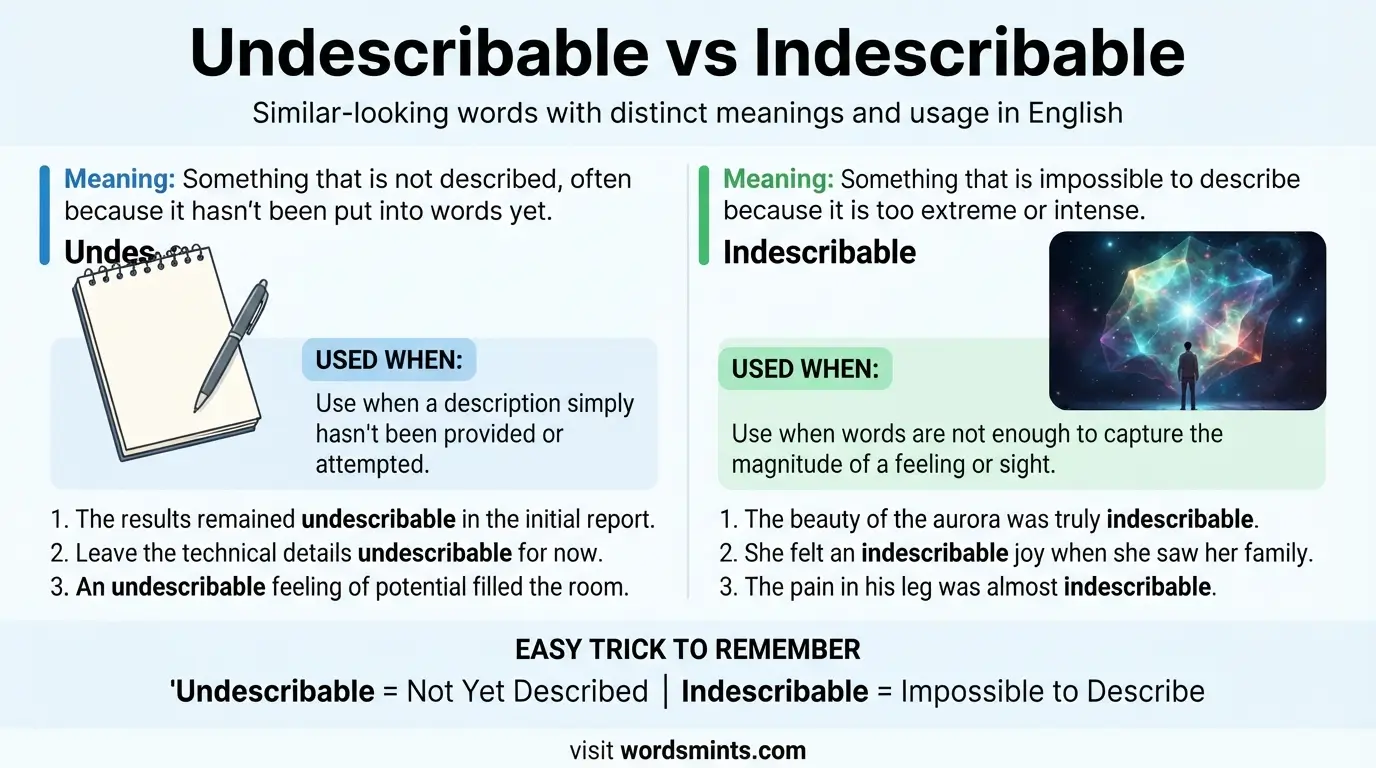
Have you ever typed “undescribable” and wondered if it should be “indescribable”? You are not alone.
These two words look very similar, and both can be found in English dictionaries. That makes the choice confusing, especially for English learners, students, bloggers, and professional writers.
The good news is that the answer is simple. Indescribable is the standard and much more common spelling in modern English.
It means something is impossible or very difficult to describe with words. For example, you can say, “The beauty of the mountains was indescribable.”
But what about undescribable? It is not simply a meaningless spelling mistake. Dictionaries such as Cambridge recognize it, while Collins describes it as a variant of indescribable.
This guide explains the difference between undescribable and indescribable, their history, British and American usage, common mistakes, everyday examples, and search trends.
By the end, you will know exactly which spelling to use in professional and everyday writing.
Undescribable or Indescribable Quick Answer
Indescribable is the standard and preferred spelling.
It means impossible or very difficult to describe, often because something is extremely beautiful, painful, strange, powerful, or emotional.
Cambridge defines indescribable as something that is impossible to describe, especially because it is extremely good or bad.
Correct and preferred
- The view was indescribable
- She felt indescribable joy
- The pain was indescribable
- The beauty of the sunset was indescribable
What about “undescribable”?
Undescribable is a real word, but it is rare. Cambridge lists it as a synonym of indescribable, and Collins calls it a variant.
So, if you want the safest choice:
Use “indescribable.”
The Origin of Undescribable or Indescribable
The word indescribable comes from three parts:
in- + describe + -able
The prefix in- can mean “not,” while -able means capable of being or suitable for something.
The verb describe has a long history. It comes through French from Latin describere, meaning to write down, copy, sketch, or represent. The English adjective describable appeared in the 17th century.
Historical sources record indescribable in English from the 18th century. Etymonline dates the adjective to 1726, while some dictionaries give later first-use dates.
The formation is therefore logical:
- describe = explain or represent something in words
- describable = able to be described
- indescribable = not able to be described adequately
So why does undescribable exist?
English has more than one negative prefix. Words such as unhappy, unable, uncertain, and unusual use un-. Other words use in-, such as invisible, inaccurate, and indescribable.
Historically, English speakers have also used undescribable. Wiktionary records it as an alternative form of indescribable, including examples from older English.
Over time, however, indescribable became the normal and much more familiar form.
British English vs American English Spelling
There is no major British-versus-American spelling difference for indescribable.
British English uses:
indescribable
American English also uses:
indescribable
The same applies to the rare alternative undescribable. It is not a case like colour/color or organise/organize, where British and American English have different standard spellings.
| Feature | British English | American English |
| Standard spelling | indescribable | indescribable |
| Rare variant | undescribable | undescribable |
| Meaning | Impossible to describe | Impossible to describe |
| Recommended form | indescribable | indescribable |
| Adverb | indescribably | indescribably |
For both varieties of English, indescribable is the best choice for normal writing.
Which Spelling Should You Use?
For a US audience
Use indescribable.
It is suitable for:
- Emails
- School assignments
- Websites
- Business writing
- News articles
- Social media
- Academic writing
Example:
The experience was indescribable.
For UK and Commonwealth audiences
Use indescribable here too.
British English does not require undescribable. In fact, indescribable is the familiar standard form.
For a global audience
Indescribable is the safest choice.
If your website has readers from the United States, United Kingdom, Canada, Australia, India, Pakistan, or other English-speaking markets, indescribable is clear and widely recognized.
Should you ever use “undescribable”?
You may see undescribable in dictionaries, older texts, or occasional modern writing. However, it is much less common.
For professional writing, there is usually no benefit in choosing it.
Best advice: use “indescribable.”
Common Mistakes with Undescribable or Indescribable
1. Using “undescribable” in formal writing
❌ The beauty of the place was undescribable.
✅ The beauty of the place was indescribable.
The first sentence is understandable, but the second sounds more natural and standard.
2. Thinking “un-” must always be correct
English does not allow writers to freely choose between un- and in-.
For example:
- unhappy
- unable
- uncertain
- unusual
But:
- invisible
- inaccurate
- impossible
- indescribable
The established form of a word matters.
3. Writing “indescribeable”
A common spelling mistake is:
❌ indescribeable
The correct spelling is:
✅ indescribable
Do not add an extra e before -able.
4. Confusing the adjective and adverb
Indescribable is an adjective.
The view was indescribable.
Indescribably is an adverb.
The view was indescribably beautiful.
5. Using “indescribable” when a more exact word is better
Indescribable is useful, but sometimes a more precise word makes your writing stronger.
Instead of:
The problem was indescribable.
You could write:
The problem was extremely complex and difficult to explain.
Use indescribable when you really want to show that words seem inadequate.
Undescribable or Indescribable in Everyday Examples
In Emails
Thank you for your kindness. Your support has been indescribable.
For a professional email, you could also choose more precise wording:
Thank you for your support. It has meant more to me than I can express.
In News Writing
Witnesses described the scene as indescribable.
News writers may use the word for events that are extremely shocking, emotional, or difficult to explain.
On Social Media
This sunset is indescribable.
This is a natural and common casual use.
In Formal Writing
The event caused an indescribable sense of uncertainty among the participants.
However, formal writing often benefits from specific descriptions rather than broad emotional words.
In Creative Writing
She felt an indescribable mixture of joy and fear.
This is a strong use because emotions can be difficult to put into exact words.
In Everyday Conversation
The food was indescribable.
Depending on context, this could mean the food was extremely good or extremely bad.
Undescribable or Indescribable Google Trends & Usage Data
Google Trends measures relative search interest, not exact monthly search volume. Results can change based on the country, time period, language, and search type selected.
For the spelling question “undescribable or indescribable,” dictionary evidence gives the clearest usage signal: indescribable is the mainstream form, while undescribable is a rare variant.
Cambridge lists undescribable with indescribable as its synonym, and Collins explicitly describes undescribable as a variant.
Searches for both forms can come from people who are:
- Checking spelling
- Learning English
- Writing school assignments
- Creating blog content
- Editing emails
- Checking grammar
- Comparing British and American English
Usage by region
| Region | Preferred form | Typical context |
| United States | indescribable | General and professional English |
| United Kingdom | indescribable | General and formal English |
| Canada | indescribable | Mainstream English |
| Australia | indescribable | Mainstream Commonwealth English |
| New Zealand | indescribable | Mainstream Commonwealth English |
| International English | indescribable | Websites, education, business |
| Spelling searches | Both | Users checking which form is correct |
The important SEO lesson is simple: people may search for an uncommon spelling because they are unsure about it. That does not mean the uncommon spelling is the preferred word.
For content targeting a broad English-speaking audience, indescribable is the stronger choice.
Indescribable vs Undescribable: Comparison Table
| Variation | Status | Meaning | Frequency | Recommended? |
| indescribable | Standard | Impossible or very difficult to describe | Common | ✅ Yes |
| undescribable | Variant | Impossible to describe | Rare | ⚠️ Usually avoid |
| indescribably | Standard adverb | In an indescribable way | Common | ✅ Yes |
| indescribability | Standard noun | The quality of being indescribable | Less common | ✅ Yes, when needed |
| describable | Standard adjective | Able to be described | Common | ✅ Yes |
FAQs About Undescribable or Indescribable
Is it “indescribable” or “undescribable”?
Indescribable is the standard and preferred spelling. Undescribable is recognized as a rare variant.
Is “undescribable” a real word?
Yes. Cambridge recognizes undescribable, and Collins calls it a variant of indescribable. However, it is much less common.
What does “indescribable” mean?
It means something is impossible or very difficult to describe with words.
Example:
The beauty of the mountains was indescribable.
Is “indescribable” British or American English?
It is used in both British and American English. There is no separate regional spelling.
What is the opposite of “indescribable”?
The closest opposite is describable, meaning something that can be described.
What is another word for “indescribable”?
Depending on the context, alternatives include:
- Inexpressible
- Ineffable
- Unspeakable
- Beyond words
- Impossible to describe
How do you use “indescribable” in a sentence?
Here are two examples:
The joy she felt was indescribable.
The view from the mountain was indescribable.
Conclusion
If you are deciding between undescribable or indescribable, choose indescribable in almost all modern writing.
Indescribable is the standard, familiar, and professional form. It describes something that is so beautiful, painful, powerful, strange, emotional, or extreme that words cannot fully explain it.
Major dictionaries recognize this form and provide examples of its everyday use.
Undescribable is not completely wrong. Some dictionaries recognize it as a variant or alternative form. However, it is rare and is not the form most readers expect.
There is also no important British-versus-American spelling difference. Writers in both varieties normally use indescribable.
So whether you are writing an email, school essay, blog post, news article, social media caption, or formal document, indescribable is the safest choice.
When in doubt, remember this simple rule:
Use “indescribable” for clear, natural, and professional English.

welcome to Words Mints! I’m Halay Sultan, a web developer and AI-Powered SEO content writer.