
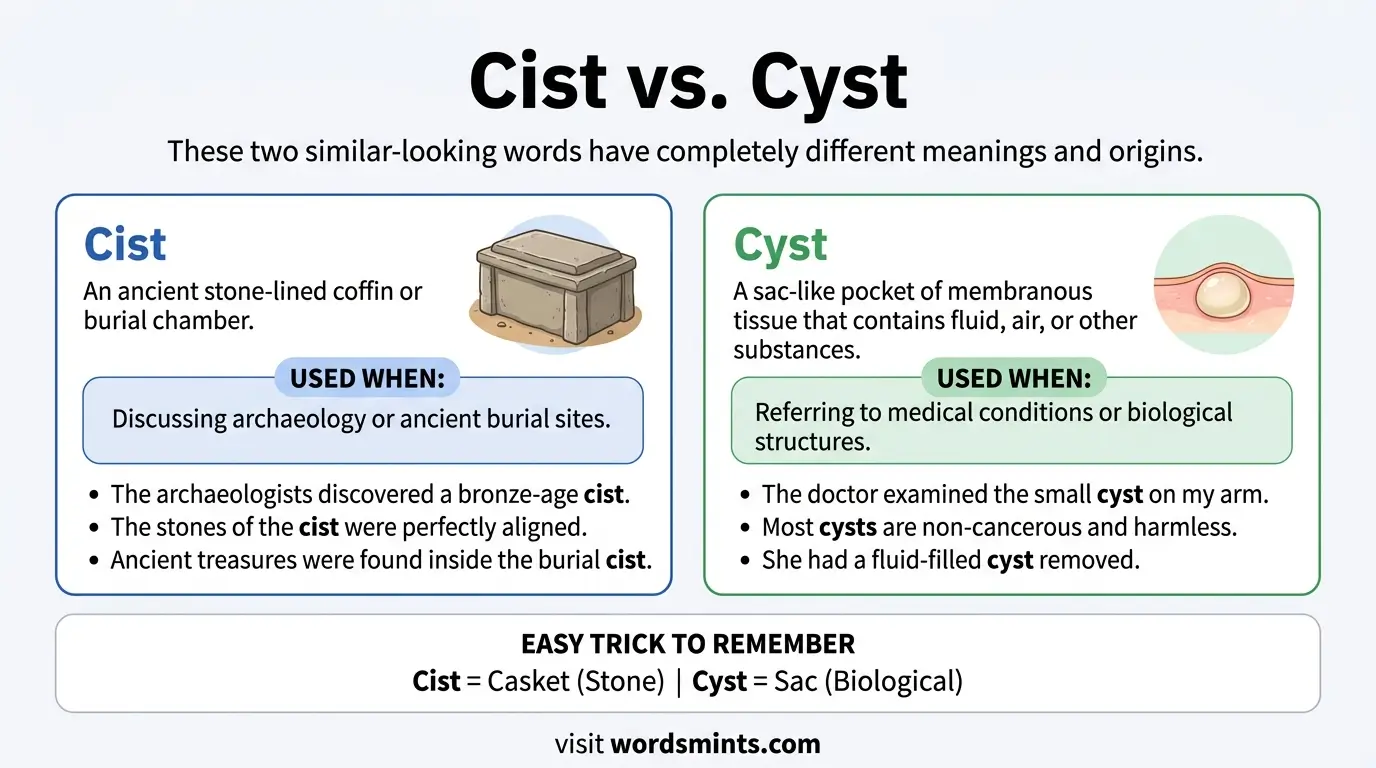
If you have ever seen “cist” and “cyst” and wondered which one is correct, you are not alone. These words look almost identical, but they do not have the same meaning or usage.
The confusion often comes from their similar pronunciation and spelling. People may search for “cist or cyst” when writing about a lump, a medical condition, or a historical container.
The correct spelling depends on what you mean. Cyst is the common word for a closed sac or lump in the body that may contain fluid, air, or other material.
Cist is a much less common word. It usually refers to an ancient stone-lined burial container or chest.
Understanding the difference helps you avoid spelling errors in medical, academic, historical, and everyday writing.
This guide explains cist vs cyst, their origins, spelling, common mistakes, examples, and usage. By the end, you will know exactly when to use each word.
Cist or Cyst Quick Answer
Cyst is the correct spelling when you mean a sac or lump in the body.
- Correct: The doctor found a small cyst
- Correct: The ovarian cyst was treated
- Correct: A skin cyst can contain fluid or other material
Cist is also a real English word, but it has a different meaning. It commonly refers to an ancient stone-built burial container or chest.
- Correct: Archaeologists discovered a Bronze Age cist
- Correct: The remains were found inside a stone cist
Simple rule
Cyst = a sac or lump, often in the body.
Cist = an ancient stone burial container or chest.
So, if you are talking about a medical lump, cyst is the word you need.
The Origin of Cist or Cyst
The two words have different histories, even though they look and sound similar.
Cyst comes from the Greek word kystis, meaning “bladder” or “pouch.” It entered medical English through Latin and later developed its modern meaning of a closed sac or cavity in the body.
Cist comes from Latin cista, meaning “box” or “chest.” It is related to the idea of a container. In archaeology, a cist is usually a small stone-built structure used for burial.
The spelling difference reflects their different origins:
- Cyst → Greek kystis → medical sac or cavity
- Cist → Latin cista → box, chest, or burial container
Because the words have similar sounds, they can easily be confused. However, they should not be treated as spelling variants of the same word.
British English vs American English Spelling
Unlike some British and American spelling differences, cist and cyst are not alternative British and American spellings.
Both British English and American English use cyst for a medical sac or lump.
Both varieties also recognize cist as a separate word, mainly in historical or archaeological contexts.
| Meaning | British English | American English |
| Medical sac or lump | cyst | cyst |
| Ancient burial container | cist | cist |
| Alternative spelling of cyst | ❌ No | ❌ No |
| Common medical usage | cyst | cyst |
| Archaeological usage | cist | cist |
Examples
British English:
The scan showed a small ovarian cyst.
American English:
The doctor diagnosed a benign cyst.
Archaeology:
The excavation uncovered a stone cist.
There is no standard US-versus-UK spelling rule that changes cyst to cist.
Which Spelling Should You Use?
Your choice depends on the meaning, not the country where you write.
For medical writing
Use cyst.
This applies to medical articles, health information, school assignments, and conversations about lumps or sacs in the body.
Example:
“The ultrasound showed a small cyst.”
For archaeology or history
Use cist when referring to an ancient stone burial container or similar structure.
Example:
“The archaeologists found a Bronze Age cist.”
For US readers
Use cyst for medical contexts. Cist remains correct when discussing its historical or archaeological meaning.
For UK and Commonwealth readers
The same rule applies. Cyst is used for the medical meaning, while cist is used for the historical meaning.
For global English
If you mean a medical lump, choose cyst. It is the clear and widely recognized spelling.
Common Mistakes with Cist or Cyst
1. Writing “cist” for a medical lump
❌ The doctor found a cist.
✅ The doctor found a cyst.
2. Assuming cist is a British spelling
❌ “Cist” is the British spelling of “cyst.”
✅ Cist and cyst are different words with different meanings.
3. Using “cyst” for an ancient burial container
❌ Archaeologists found an ancient cyst.
✅ Archaeologists found an ancient cist.
4. Treating the words as interchangeable
❌ A cist can mean a medical cyst.
✅ A cyst is a sac or cavity; a cist is generally a box-like or stone-built structure, especially an ancient burial container.
5. Confusing pronunciation with spelling
The words can sound similar, but similar pronunciation does not make them interchangeable.
Cist or Cyst in Everyday Examples
In Emails
Medical context:
My doctor recommended another scan to check the cyst.
Historical context:
The museum guide explained how the ancient cist was used for burial.
In News
Medical news:
Doctors removed a large cyst during the procedure.
Archaeology news:
Archaeologists discovered a stone cist during the excavation.
On Social Media
I learned that a cyst and a cist are not the same thing!
In Formal Writing
Medical:
The patient was diagnosed with a benign cyst.
Academic or archaeological:
The excavation revealed a stone cist containing human remains.
These examples show why choosing the correct word matters. The meaning changes when you change the spelling.
Cist or Cyst Google Trends & Usage Data
Search interest for cyst is much higher than cist because cyst is a common medical term.
People frequently search for cyst-related information when they notice a lump, receive a diagnosis, or want to understand a medical report.
Cist has a much narrower audience. Searches for this word are more likely to come from archaeology, history, museums, or academic research.
Usage also differs by context:
| Word | Main Context | General Popularity |
| cyst | Medicine and health | Very high |
| cist | Archaeology and history | Low |
| cyst | Everyday searches | Common |
| cist | Academic research | Specialized |
Because search interest can change over time and across regions, Google Trends should be treated as a measure of search behavior rather than a dictionary of correct spelling.
The key point remains the same: cyst is the standard word for the medical meaning.
Cist vs Cyst Comparison Table
| Feature | Cist | Cyst |
| Meaning | A box, chest, or ancient burial container | A closed sac or cavity |
| Main field | Archaeology and history | Medicine and biology |
| Medical meaning | ❌ No | ✅ Yes |
| Ancient burial meaning | ✅ Yes | ❌ No |
| Common word | No | Yes |
| British spelling | Cist | Cyst |
| American spelling | Cist | Cyst |
| Example | Stone cist | Ovarian cyst |
FAQs About Cist or Cyst
Is it cist or cyst?
Both are correct words, but they have different meanings. Cyst usually refers to a sac or lump in the body, while cist commonly refers to an ancient stone burial container.
Is “cist” a correct word?
Yes. Cist is a real English word. It is mainly used in archaeology and history.
Is “cist” the British spelling of “cyst”?
No. Cist is not a British spelling of cyst. Both British and American English use cyst for the medical term.
What is the correct spelling for a lump in the body?
The correct spelling is cyst.
Example: “The doctor examined the cyst.”
What does cist mean?
A cist is generally a box-like structure or container, especially an ancient stone-lined burial container.
How do you spell ovarian cyst?
It is spelled ovarian cyst, with a y.
Are cist and cyst pronounced the same?
They can be pronounced similarly in English, which is one reason they are often confused. Their meanings and spellings, however, are different.
Conclusion
The difference between cist or cyst is simple once you know their meanings.
Cyst is the correct and common spelling when you are talking about a closed sac, cavity, or lump, especially one found in the body.
You will see it in medical terms such as skin cyst, ovarian cyst, and sebaceous cyst.
Cist is a separate word. It is mainly used in archaeology and history for a box-like structure or ancient stone burial container.
It is not an alternative British spelling of cyst, and American English does not use cist for the medical meaning either.
If you are writing about health or medicine, choose cyst. If you are discussing an ancient burial structure, cist is usually the appropriate word.
Remembering this simple distinction will help you avoid a common spelling mistake and make your writing clearer and more professional.

welcome to Words Mints! I’m Halay Sultan, a web developer and AI-Powered SEO content writer.