
Have you ever wondered whether dawn or dusk means the same time of day?
These two words are easy to mix up because both describe the short period when the sky changes between darkness and daylight.
However, they refer to opposite parts of the day. Dawn happens before sunrise, while dusk happens after sunset.
People often search for “dawn or dusk” when writing about travel, photography, weather, nature, daily routines, or the best time to see the sky change color.
The confusion can also come from the fact that dawn and dusk have similar light conditions, but they occur at different times.
Knowing the difference helps you choose the right word in emails, essays, news reports, captions, and everyday conversations.
In this guide, you will learn the meaning, origin, correct usage, common mistakes, and practical examples of dawn and dusk. You will also see how the words are used in different contexts and which one fits your sentence.
Dawn or Dusk Quick Answer
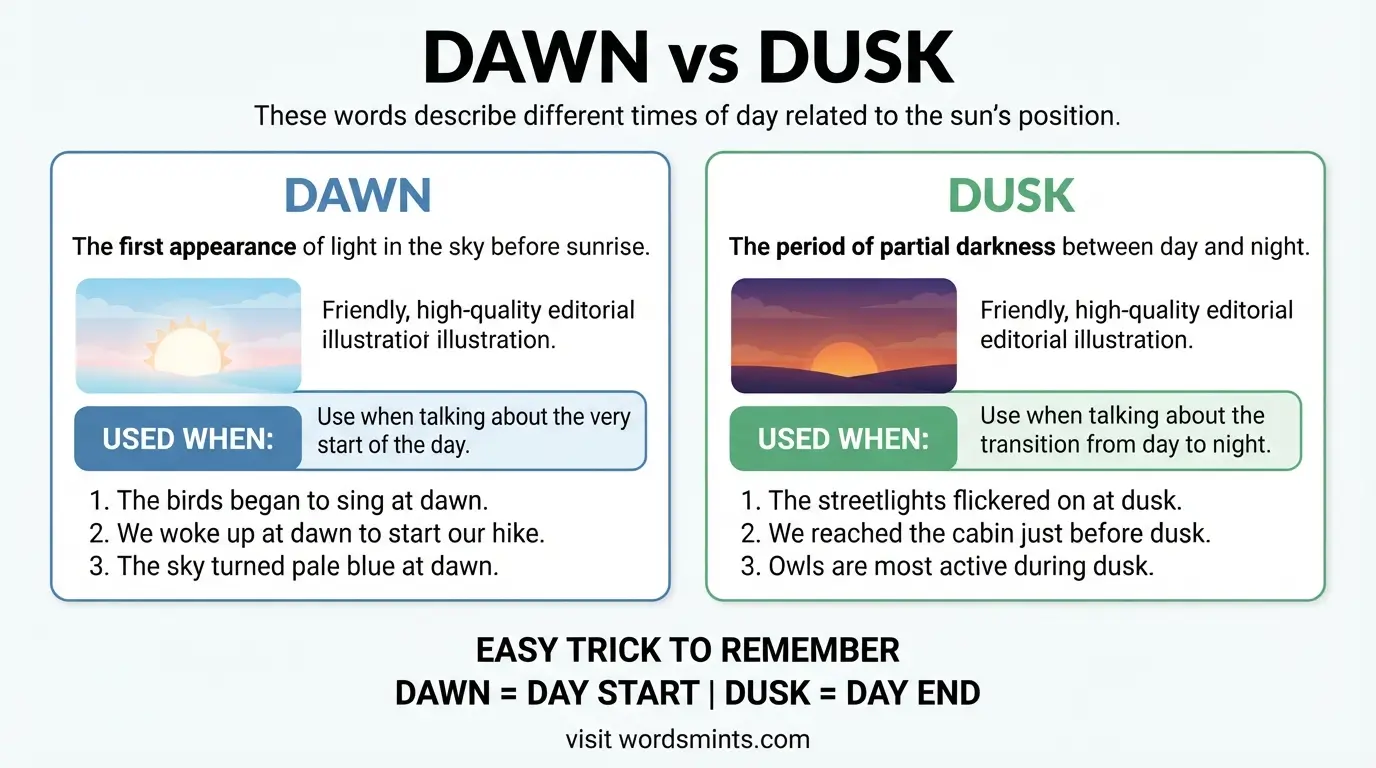
Dawn and dusk are both times when natural light appears in the sky, but they occur at opposite ends of the day.
- Dawn = the time before sunrise when daylight begins to appear.
- Dusk = the time after sunset when daylight fades into darkness.
Simple way to remember
Dawn = day begins
Dusk = day ends
Examples
- We left home at dawn
- The birds became active at dawn
- The sky looked beautiful at dusk
- We reached the village at dusk
So, if you mean the beginning of daylight, use dawn. If you mean the fading light after sunset, use dusk.
The Origin of Dawn or Dusk
The words dawn and dusk have old roots in the English language.
Dawn comes from Old English dagian, which meant “to become day.” Over time, the word developed into dawn. Its meaning has remained closely linked to the beginning of daylight.
Dusk has a different history. It comes from an older English word related to darkness and dimness. It developed from the idea of the sky becoming dark or less bright.
Both words describe changes in natural light, but their meanings developed in opposite directions:
| Word | Basic idea |
| Dawn | Darkness changing into daylight |
| Dusk | Daylight changing into darkness |
Because both periods can have soft, colorful light, people sometimes confuse them. The easiest solution is to remember their position in the daily cycle.
British English vs American English Spelling
There is no major British-American spelling difference between dawn and dusk.
Both British English and American English use:
- dawn
- dusk
The words have the same spelling and almost the same meaning in both varieties of English.
| Meaning | British English | American English |
| Beginning of daylight | dawn | dawn |
| Fading daylight after sunset | dusk | dusk |
| Before sunrise | dawn | dawn |
| After sunset | dusk | dusk |
Examples
British English:
We arrived at dawn.
American English:
We arrived at dawn.
British English:
The streets were quiet at dusk.
American English:
The streets were quiet at dusk.
The difference is therefore not about spelling. It is about meaning and timing.
Which Spelling Should You Use?
You can use dawn and dusk in both British and American English.
For US readers
Use dawn for the early light before sunrise and dusk for the fading light after sunset.
For UK and Commonwealth readers
The same rule applies. Both words are standard and natural.
For a global audience
Use the standard forms dawn and dusk. There is no need to change the spelling based on the country.
For professional writing, focus more on the correct meaning than on regional spelling.
Common Mistakes with Dawn or Dusk
Because dawn and dusk describe similar light conditions, several mistakes are common.
Mistake 1: Using dawn for evening
❌ We watched the sunset at dawn.
✅ We watched the sunset at dusk.
Sunset happens in the evening, so dusk is the correct word.
Mistake 2: Using dusk for early morning
❌ We woke up at dusk to watch the sunrise.
✅ We woke up at dawn to watch the sunrise.
Sunrise occurs around dawn.
Mistake 3: Thinking dawn means sunrise itself
Dawn is the period when daylight begins to appear before sunrise. Sunrise is the moment when the sun rises above the horizon.
Mistake 4: Thinking dusk means sunset itself
Dusk occurs after sunset, as the remaining daylight fades.
Mistake 5: Treating the words as exact opposites in every technical context
In everyday English, dawn and dusk are often used as simple opposites. In astronomy, however, the exact periods of twilight have more specific definitions.
Dawn or Dusk in Everyday Examples
Knowing how these words work in real sentences makes the difference easier to remember.
In emails
I will arrive at dawn to avoid the morning traffic.
The event will continue until dusk.
In news writing
Rescue teams began their search at dawn.
The fire was still burning at dusk.
In social media
“A peaceful walk at dawn.”
“Beautiful colors in the sky at dusk.”
In formal writing
The researchers began their fieldwork at dawn.
The animals returned to the shelter at dusk.
In travel writing
Visitors often arrive before dawn to see the sunrise.
The old city looks especially beautiful at dusk.
In photography
Photographers often enjoy both times because they can provide soft natural light.
- Dawn photography → early morning light
- Dusk photography → evening light
Dawn or Dusk Google Trends & Usage Data
Search interest in dawn and dusk can vary by country, season, and context. Google Trends does not provide one permanent worldwide ranking.
Interest changes over time as people search for topics related to weather, sunrise, sunset, photography, travel, literature, and daily schedules.
The two words are also used in different search contexts.
Dawn often appears in searches related to:
- sunrise times
- early morning
- dawn photography
- dawn prayer
- wildlife activity
- travel
Dusk often appears in searches related to:
- sunset times
- evening photography
- twilight
- evening travel
- animals becoming active
- outdoor activities
Search interest may also rise when people look for the sunrise or sunset time in a particular city.
For SEO writing, it is useful to understand that dawn and dusk have different search intent.
A page targeting “dawn meaning” should explain the early part of the day, while a page targeting “dusk meaning” should focus on evening twilight.
Dawn vs Dusk: Comparison Table
| Feature | Dawn | Dusk |
| Time of day | Early morning | Evening |
| Relation to sunrise | Before sunrise | After sunset |
| Light | Increasing | Decreasing |
| Direction of change | Darkness → daylight | Daylight → darkness |
| Common activity | Waking, sunrise viewing | Evening walks, sunset viewing |
| Easy memory | Day begins | Day ends |
| British spelling | Dawn | Dusk |
| American spelling | Dawn | Dusk |
Dawn or Dusk: Which One Is Correct?
Both dawn and dusk are correct words. The correct choice depends on the time you mean.
Use dawn when talking about the beginning of daylight.
The farmer starts work at dawn.
Use dusk when talking about the fading light after sunset.
The children came home at dusk.
If you are unsure, ask yourself:
“Is the day beginning or ending?”
Beginning → dawn
Ending → dusk
FAQs About Dawn or Dusk
Is dawn morning or evening?
Dawn is morning. It is the period when daylight begins before sunrise.
Is dusk before or after sunset?
Dusk is after sunset. It is when the remaining daylight fades toward darkness.
Are dawn and dusk opposites?
Yes, in everyday usage they describe opposite ends of the daylight cycle. Dawn is associated with the beginning of the day, while dusk is associated with its end.
Is dawn the same as sunrise?
No. Dawn is the gradual appearance of daylight before sunrise. Sunrise is the point when the sun appears above the horizon.
Is dusk the same as sunset?
No. Sunset is when the sun goes below the horizon. Dusk refers to the period of fading light that follows.
Which is darker, dawn or dusk?
Both can be quite dark, but their light is moving in opposite directions. At dawn, light is increasing. At dusk, light is decreasing.
Do British and American English spell dawn and dusk differently?
No. Dawn and dusk have the same spelling in British and American English.
Conclusion
Understanding dawn or dusk is simple once you connect each word with its place in the day.
Dawn refers to the early period when darkness gives way to daylight, while dusk refers to the evening period when daylight fades after sunset.
They may look similar because both involve changing light, but they describe opposite times. There is also no British-American spelling problem with these words.
Dawn and dusk are spelled the same in British English, American English, and other major forms of English. The main challenge is choosing the word that matches the time you mean.
For quick recall, use this rule: dawn means day begins, and dusk means day ends. Use dawn for sunrise-related situations and dusk for sunset-related situations.
This simple distinction will help you write more clearly in emails, articles, news reports, social media posts, essays, and everyday conversations.

welcome to Words Mints! I’m Halay Sultan, a web developer and AI-Powered SEO content writer.