
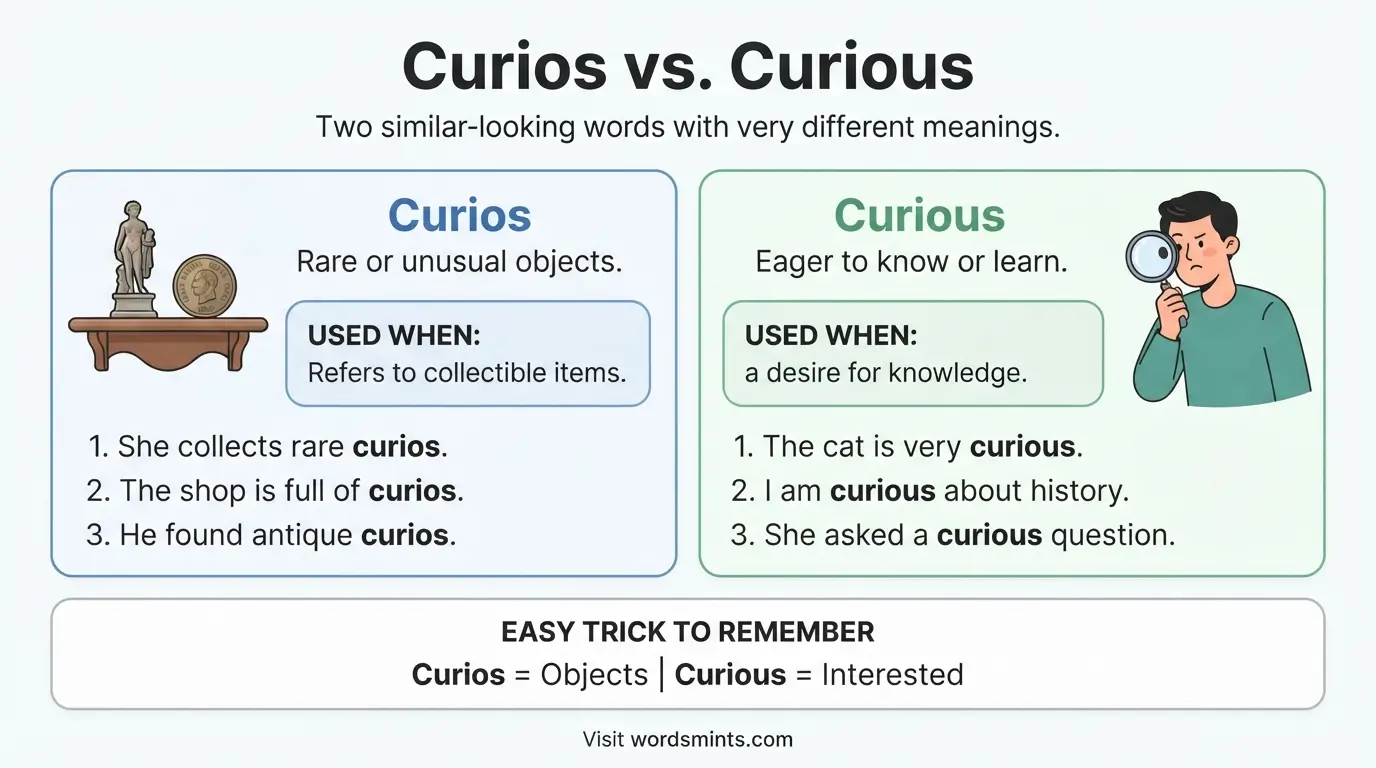
Have you ever typed “curios” when you meant “curious”? You are not alone. These two words look very similar, but they have different meanings and uses.
This makes “curios or curious” a common spelling and word-choice question for English learners, writers, students, and professionals.
The confusion usually happens because curious is the adjective most people want when they mean “wanting to know or learn something.”
Curios, however, is a real word, but it is much less common. It is the plural of curio, which means a rare, unusual, or interesting object.
Understanding the difference is important because using curios instead of curious can change the meaning of a sentence completely.
In this guide, you will learn the correct spelling, meanings, origins, common mistakes, and practical examples.
We will also look at British and American English, usage patterns, and advice for choosing the right word.
Curios or Curious Quick Answer
Curious is the correct spelling when you mean interested in learning or knowing something.
- ✅ I am curious about the answer.
- ✅ She was curious to know what happened.
- ❌ I am curios about the answer.
Curios is also a correct word, but it has a different meaning. It is the plural form of curio, referring to unusual, rare, or interesting objects.
- The shop sells antique curios.
- The museum contains many fascinating curios.
Quick Comparison
| Word | Meaning | Example |
| Curious | Wanting to know or learn something | I am curious about the results. |
| Curios | Unusual or interesting objects | The shop sells historical curios. |
So, if you are asking whether the adjective is spelled curios or curious, the answer is curious.
The Origin of Curios or Curious
The word curious comes from the Latin word curiosus, meaning “careful,” “inquisitive,” or “eager to know.” It entered English through Old French and developed into its modern meaning over time.
The word curio has a related history. It comes from the Latin curiosum, meaning something curious or unusual. English later used curio as a noun for an unusual or interesting object.
The spelling difference is therefore not simply a British-versus-American spelling issue.
Curious and curios are different words.
- Curious = an adjective
- Curio = a noun
- Curios = the plural of curio
This distinction explains why you should not use curios as a shortened spelling of curious.
British English vs American English Spelling
There is no British-American spelling difference between curious and curios.
Both British and American English use:
- curious when describing someone who wants to know something
- curio for an unusual object
- curios as the plural of curio
Comparison Table
| Meaning | British English | American English |
| Interested in knowing | curious | curious |
| Unusual object | curio | curio |
| More than one unusual object | curios | curios |
Examples
British English:
She was curious about the new teacher.
American English:
She was curious about the new teacher.
The spelling remains the same in both varieties.
Which Spelling Should You Use?
Choose curious when you are describing someone who wants to know, understand, or discover something.
Use curios only when you are talking about more than one unusual or interesting object.
For US English
Use curious in everyday and professional writing:
I am curious to learn more about the project.
For UK and Commonwealth English
Use curious in the same way:
I am curious to learn more about the project.
For Global English
Curious is the safest choice when you mean “interested in knowing something.” It is widely understood and commonly used around the world.
Use curios only when the context clearly refers to unusual objects.
Common Mistakes with Curios or Curious
1. Writing “curios” instead of “curious”
❌ I am curios about your opinion.
✅ I am curious about your opinion.
2. Adding “-s” incorrectly
Some writers may think curios is formed by simply removing the final letter from curious. It is not.
Curios is a separate noun form related to curio.
3. Confusing “curious” with “curio”
❌ The child is very curio about space.
✅ The child is very curious about space.
4. Using “curios” for a person
❌ He is curios about science.
✅ He is curious about science.
A person can be curious, not curios.
5. Assuming it is a US/UK spelling difference
❌ Curios is British and curious is American.
✅ Both English varieties use “curious.”
Curios or Curious in Everyday Examples
In Emails
Correct:
I am curious to know whether the meeting has been rescheduled.
Incorrect:
I am curios to know whether the meeting has been rescheduled.
In News Writing
Researchers are curious about why the species behaves differently.
Here, curious describes the researchers’ interest.
In Social Media
Just curious has anyone tried this new app?
This is a natural and common informal use of curious.
In Formal Writing
Scientists remain curious about the long-term effects of the discovery.
Curious works well in academic and professional writing.
Using “Curios”
The antique store displayed several unusual curios.
Here, curios is correct because it means unusual objects.
Curios or Curious Google Trends & Usage Data
Search interest for curious is much broader than for curios because curious is a common everyday adjective.
People regularly use it in conversations, education, journalism, entertainment, and professional writing.
The word curios has a narrower use because it is mainly associated with the plural noun curio. Searches containing curios may relate to antiques, collectibles, museums, unusual objects, or shops.
Usage can also vary by context. Someone searching “curios or curious” is usually trying to confirm the spelling of the adjective curious.
For practical English writing, curious is overwhelmingly the more useful word to remember.
Curios vs Curious: Side-by-Side Comparison
| Feature | Curious | Curios |
| Part of speech | Adjective | Plural noun |
| Meaning | Interested in knowing something | Unusual or interesting objects |
| Singular form | Curious | Curio |
| Commonness | Very common | Less common |
| Used for people | Yes | No |
| Used for objects | Can describe objects | Refers to objects |
| Example | She is curious about art. | The shop sells curios. |
| British spelling | Curious | Curios |
| American spelling | Curious | Curios |
FAQs About Curios or Curious
Is “curios” a correct word?
Yes. Curios is a correct word, but it is the plural of curio, meaning unusual or interesting objects.
Is “curious” the correct spelling?
Yes. Curious is the correct spelling when you mean interested in knowing or learning something.
Is “curios” a spelling mistake?
Not always. It is a real English word. However, it is a spelling mistake if you use it when you mean curious.
What is the difference between curious and curios?
Curious is an adjective describing interest in knowing something. Curios is a plural noun referring to unusual or interesting objects.
Is curious British or American English?
Curious is used in both British and American English. There is no spelling difference.
Can I say “I am curios”?
No. The correct sentence is:
I am curious.
What is the plural of curio?
The plural of curio is curios.
For example:
The museum has several rare curios.
Conclusion
The difference between curios and curious is simple once you understand their meanings. Curious is the word you need when you mean interested in learning, discovering, or knowing something.
For example, you can say, “I am curious about the answer” or “She was curious to see what happened.”
Curios is also a correct English word, but it has a completely different role. It is the plural of curio, a noun used for unusual, rare, or interesting objects.
For example, “The antique shop displayed several curios.”
There is no British-versus-American spelling difference here. Both varieties use curious and curios in the same ways.
For everyday writing, academic work, emails, social media, and professional communication, curious is the spelling you will most often need.
Remember the simple rule: curious describes interest; curios are unusual objects. Keeping this distinction in mind will help you avoid a common spelling mistake and choose the right word confidently.

welcome to Words Mints! I’m Halay Sultan, a web developer and AI-Powered SEO content writer.