
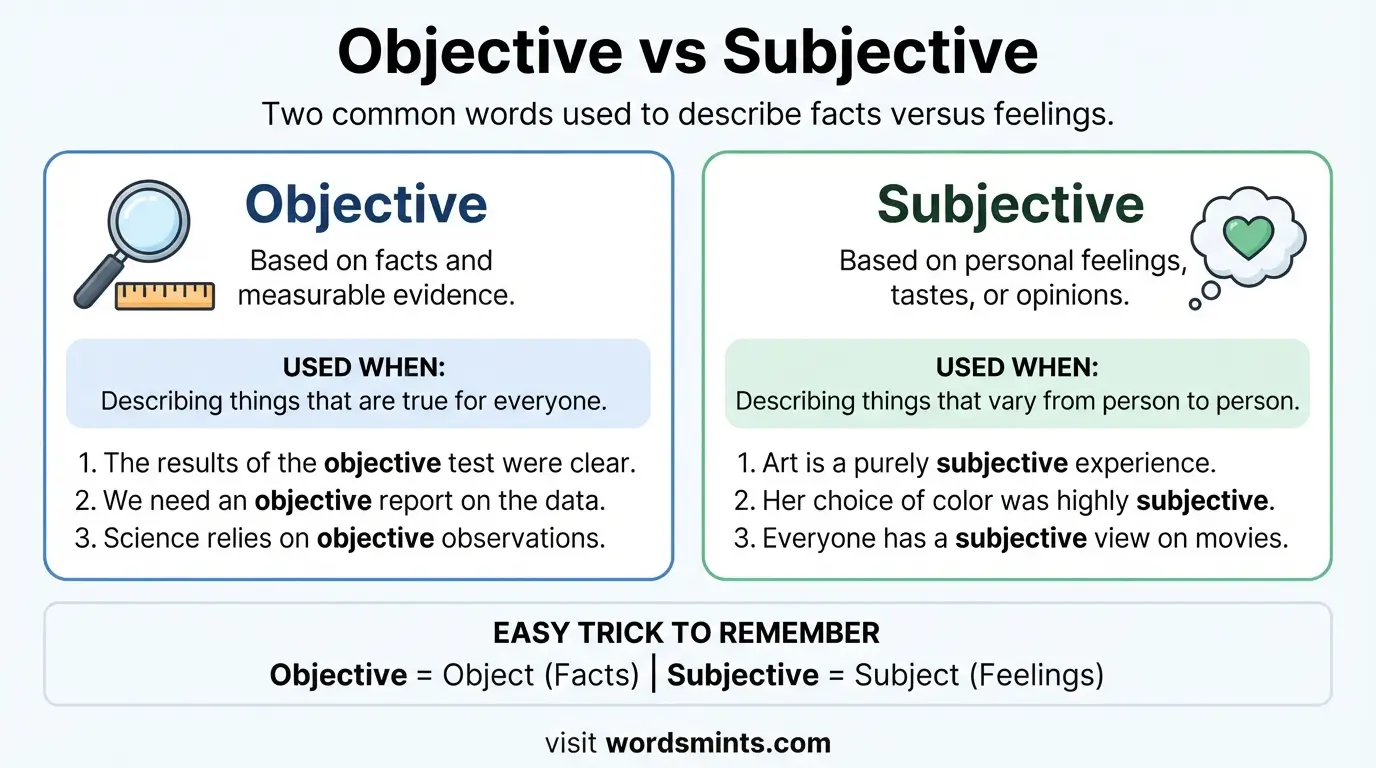
Have you ever wondered whether an opinion is objective or subjective?
These two words are common in school, work, journalism, reviews, and daily conversations. Yet, many people confuse them because both describe ways of looking at information.
The key difference is simple. Objective means based on facts that can be checked or measured. Subjective means based on personal feelings, opinions, views, or experiences.
For example, “The movie is 120 minutes long” is an objective statement because its length can be measured. “The movie is amazing” is subjective because it expresses a personal opinion.
People often search for “objective or subjective” because they want to know which word fits a sentence.
They may also want to understand the difference between objective facts and subjective opinions in writing, news, research, or communication.
This guide explains the meaning, origin, spelling, common mistakes, everyday use, and popularity of both words.
By the end, you will know exactly when to use objective and when to use subjective.
Objective or Subjective Quick Answer
Objective means based on facts, evidence, or information that does not depend on personal feelings.
Subjective means based on personal opinions, feelings, tastes, or experiences.
Simple Difference
| Word | Meaning | Example |
| Objective | Based on facts or evidence | The temperature is 30°C. |
| Subjective | Based on personal opinion or feeling | The weather is too hot. |
Easy Way to Remember
Think of objective as fact.
Think of subjective as opinion.
Objective example:
The book has 300 pages.
This can be checked.
Subjective example:
The book is very interesting.
This depends on the reader’s opinion.
However, the difference is not always completely black and white. A statement can include both factual information and personal judgment.
For example:
The restaurant has 50 seats, and it is the best restaurant in town.
The first part is objective. The second part is subjective.
The Origin of Objective or Subjective
The words objective and subjective have different forms but are closely related.
Objective comes from Latin roots connected with an object or something presented to the mind. The English word developed through philosophical and academic use.
Subjective comes from the Latin subjectivus, which relates to the subject. It developed as a term for something connected with a person’s thoughts, feelings, or individual experience.
Both words became especially important in philosophy, where writers needed to distinguish between the observer and the thing being observed.
Over time, their meanings became common in many areas. Today, we use them in education, science, journalism, business, reviews, psychology, and everyday speech.
Why Do People Confuse These Words?
The words look and sound similar:
- objective
- subjective
They both end in -jective, which can make them easy to mix up.
Their meanings, however, point in different directions:
- Objective → facts and evidence
- Subjective → personal views and feelings
There is no British-versus-American spelling change between these words. Both varieties of English use objective and subjective.
British English vs American English Spelling
Unlike words such as colour/color or favour/favor, there is no spelling difference between objective and subjective in British and American English.
The spelling remains the same in both varieties.
| Word | British English | American English | Difference |
| Objective | objective | objective | None |
| Subjective | subjective | subjective | None |
| Objectively | objectively | objectively | None |
| Subjectively | subjectively | subjectively | None |
Examples
British English:
The report should provide an objective view.
American English:
The report should provide an objective view.
The sentence is spelled exactly the same.
British English:
Her response was subjective.
American English:
Her response was subjective.
Again, there is no spelling change.
Comparison Table: Objective vs Subjective
| Feature | Objective | Subjective |
| Main idea | Fact or evidence | Personal view |
| Based on | Data, proof, observation | Feelings, beliefs, experience |
| Can be checked? | Usually yes | Not in the same factual way |
| Common in | Science, reports, news | Reviews, opinions, personal writing |
| Example | The test lasted one hour. | The test was difficult. |
| Related adverb | Objectively | Subjectively |
Which Spelling Should You Use?
You do not need to choose a British or American spelling for these words.
Use objective and subjective in both British and American English.
For US English
Use:
- objective
- subjective
- objectively
- subjectively
These spellings are standard in American English.
For UK and Commonwealth English
Use the same spellings:
- objective
- subjective
- objectively
- subjectively
Countries such as the UK, Australia, and Canada may follow different spelling rules for some words, but objective and subjective are not affected.
For Global English
If you write for an international audience, these spellings are safe.
The more important issue is not spelling. It is choosing the correct word based on meaning.
If you are describing verifiable information, use objective.
If you are describing personal judgment or experience, use subjective.
Common Mistakes with Objective or Subjective
1. Using “objective” for an opinion
Incorrect:
Pizza is objectively the best food.
The word “best” usually expresses judgment. Unless you have a clear and accepted measure for “best,” this is subjective.
Better:
Pizza is my favorite food.
2. Using “subjective” for a measurable fact
Incorrect:
The building is 20 meters tall, so that is subjective.
The height can be measured.
Correct:
The building is 20 meters tall, so that is objective.
3. Thinking “objective” means “always true”
An objective statement should be based on evidence or observable facts. But a claim can still be wrong if the information or evidence is incorrect.
For example:
The company has 500 employees.
This is intended as an objective claim, but it should still be checked.
4. Confusing “objective” with “object”
The word objective can have several meanings.
As an adjective:
We need an objective review.
As a noun:
Our main objective is to improve customer service.
Here, “objective” means a goal or aim.
5. Confusing “subjective” with “subject”
“Subjective” is related to the perspective of the person experiencing or judging something.
For example:
Pain can be a subjective experience.
The experience of pain can differ from person to person.
Objective or Subjective in Everyday Examples
Understanding these words becomes easier when you see them in real situations.
In Emails
Objective:
The meeting starts at 10 a.m. on Monday.
This gives factual information.
Subjective:
I think Monday’s meeting will be very useful.
This expresses an opinion.
In News
A news report may include objective information such as:
The storm reached the city on Tuesday.
A statement such as:
It was the worst storm in the city’s history.
may require evidence or a defined comparison before it can be treated as an objective claim.
News writing often aims to separate facts from opinions.
On Social Media
Subjective:
This is the best phone ever!
This is a personal opinion.
Objective:
This phone has a 6.7-inch display.
This is measurable information.
In Product Reviews
Objective:
The laptop has 16 GB of RAM.
Subjective:
The laptop feels fast and smooth.
The first statement can be verified through specifications. The second describes a personal experience.
In Formal Writing
Academic and professional writing often uses objective language.
Instead of:
I think this method is really good.
A more formal version may be:
The results suggest that this method is effective.
The second sentence focuses on evidence rather than personal feeling.
In Daily Conversation
The coffee contains two teaspoons of sugar.
Objective.
The coffee tastes too sweet.
Subjective.
Both statements can be valid. They simply describe different types of information.
Objective or Subjective Google Trends & Usage Data
Search interest for “objective or subjective” is closely linked to education and language questions.
People commonly look up the phrase when they need to understand the difference between facts and opinions.
The words themselves have much broader use than the exact search phrase. Objective and subjective appear frequently in:
- Education
- Academic writing
- Journalism
- Research
- Psychology
- Business communication
- Product reviews
- Social media discussions
- Workplace communication
Search interest can also vary by country because English-learning needs differ across regions. The United States, United Kingdom, Canada, Australia, India, Pakistan, and other English-speaking or English-learning markets commonly use these terms.
However, Google Trends shows relative search interest, not the exact number of searches. Interest can also change over time because of school assignments, exams, news topics, or popular online discussions.
For this reason, it is better to view Google Trends as a measure of search popularity rather than as a precise count of how often people use the words.
Which Word Is More Common?
Objective and subjective are both widely used. Their frequency depends heavily on context.
For example:
- Objective is common in research, reports, journalism, and workplace writing
- Subjective is common in reviews, personal opinions, psychology, and discussions about perception
The phrase “objective or subjective” is especially useful for people learning English because it directly compares two opposite ways of describing information.
Objective or Subjective: Key Variations Side by Side
| Form | Meaning | Example |
| Objective | Based on facts or evidence | The exam lasted two hours. |
| Subjective | Based on personal opinion | The exam was difficult. |
| Objectively | In a factual or impartial way | The issue should be judged objectively. |
| Subjectively | From a personal point of view | She viewed the situation subjectively. |
| Objectivity | Quality of being impartial or fact-based | The report aims for objectivity. |
| Subjectivity | Influence of personal views or feelings | Art often involves subjectivity. |
FAQs About Objective or Subjective
What is the difference between objective and subjective?
Objective refers to facts, evidence, or information that can usually be checked. Subjective refers to personal opinions, feelings, beliefs, or experiences.
Is an opinion objective or subjective?
An opinion is usually subjective because it reflects a person’s judgment or feelings.
For example:
Chocolate ice cream tastes better than vanilla.
This is subjective.
Is a fact objective?
Yes, a fact is generally considered objective when it can be verified with reliable evidence.
For example:
Water freezes at 0°C under standard atmospheric pressure.
Is “objective or subjective” spelled differently in British English?
No. Both objective and subjective have the same spelling in British and American English.
Is “the movie is good” objective or subjective?
It is subjective because “good” expresses a personal judgment.
Can something be both objective and subjective?
Yes. A statement can contain both factual and personal elements.
For example:
The restaurant opened in 2010, and it is the best restaurant in town.
The opening year is objective. The claim that it is the best restaurant is subjective unless supported by a clear standard.
How can I remember objective vs subjective?
Use this simple rule:
Objective = observable or verifiable information.
Subjective = personal opinion or experience.
If you can ask, “Can this be checked with evidence?” the answer may be objective. If the answer depends mainly on someone’s feelings or judgment, it is likely subjective.
Conclusion
Understanding objective or subjective is important because the two words describe two different ways of looking at information.
Objective refers to facts, evidence, measurements, and information that can usually be verified. Subjective refers to personal feelings, opinions, beliefs, tastes, and experiences.
The spelling is simple because there is no British-American difference. Both British and American English use objective and subjective.
The real challenge is choosing the word that matches the meaning.
When writing a report, academic paper, news article, or professional email, use objective language when you are presenting facts and evidence.
When discussing personal preferences, reviews, or feelings, subjective language is often appropriate.
Remember the easiest rule: objective is about facts, while subjective is about personal views.
Once you understand this difference, you can use both words with confidence in everyday conversation and formal writing.

welcome to Words Mints! I’m Halay Sultan, a web developer and AI-Powered SEO content writer.