
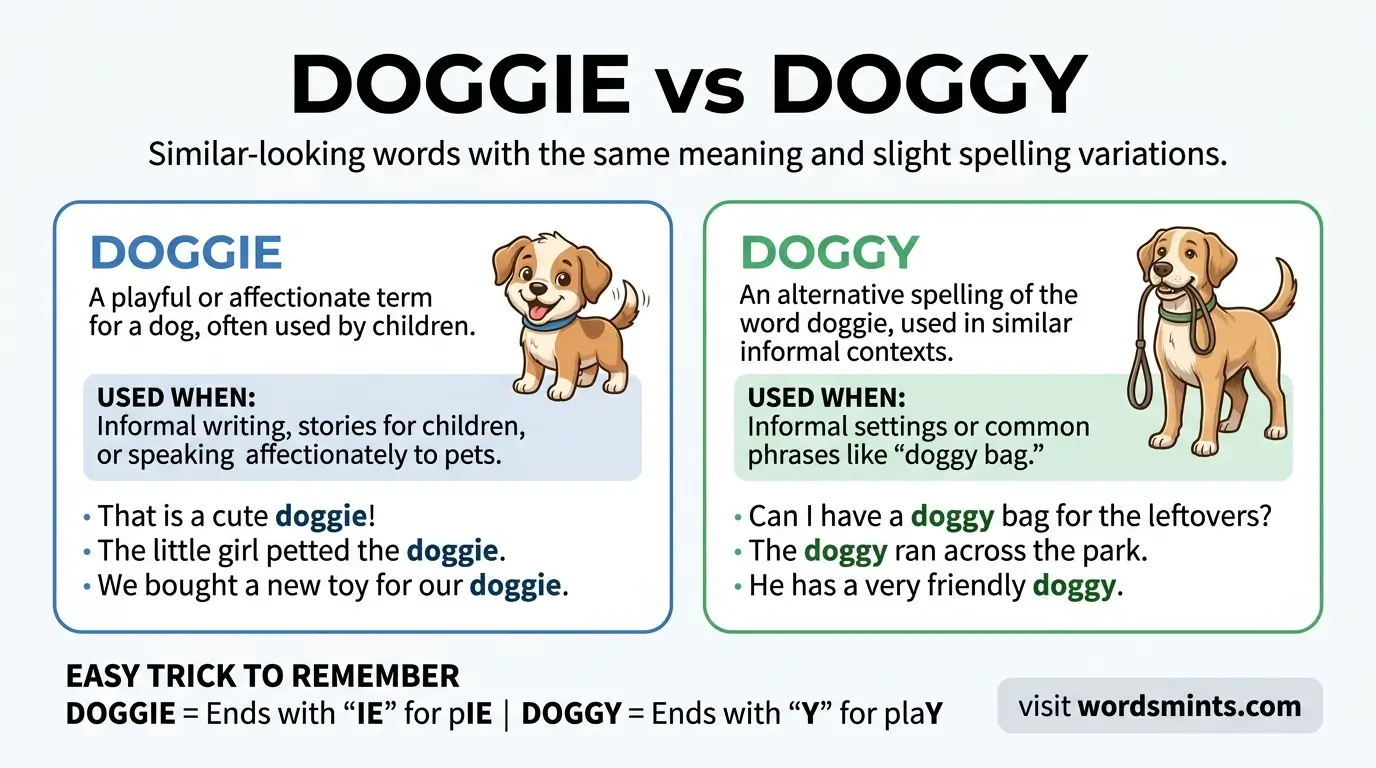
Have you ever stopped while writing and wondered whether it should be doggie or doggy? You are not alone.
Both spellings appear in books, dictionaries, pet names, social media posts, and everyday conversations. This makes it easy to think that one spelling must be wrong.
The good news is simple: both doggie and doggy are correct. They are informal words used to refer to a dog, often in a cute, friendly, or child-like way.
Major dictionaries list both forms, although doggy is commonly treated as the main form and doggie as a variant.
People search for “doggie or doggy” because the two spellings look different but have almost the same meaning.
The confusion is mainly about spelling, tone, and usage rather than grammar.
In this guide, you will learn where these words came from, how British and American English use them, which spelling is safer for different audiences, and when a more formal word such as dog is better.
Doggie or Doggy Quick Answer
Doggy and doggie are both correct spellings.
Both can describe a dog in an informal, affectionate, or child-friendly way. Cambridge defines doggy as a child’s word for a dog and lists doggie as an alternative.
Oxford also lists doggie as another form of doggy.
Doggy
Doggy is the spelling many writers choose for general informal use.
Examples:
- Look at that cute doggy!
- The little doggy is sleeping
- She bought a new doggy toy
- The children love playing with the doggy
Doggie
Doggie is also correct. It can sound more playful, cute, or child-like.
Examples:
- Come here, doggie!
- The child hugged her doggie
- He bought doggie treats
- The doggie was waiting by the door
So, if you are asking “Is it doggie or doggy?”, the answer is both.
The Origin of Doggie or Doggy
The word doggy comes from the word dog with the ending -y. Collins dates the word to around 1815–1825 and gives its formation as dog + -y.
The ending -y is common in English words that express familiarity, smallness, or affection.
For example:
- dog → doggy
- pig → piggy
- cat → kitty
- child → childy in older or special uses
The spelling doggie developed as a variant. The -ie ending is also common in affectionate and child-like words.
For example:
- doggie
- birdie
- sweetie
- cookie
Over time, both doggy and doggie remained in use. Modern dictionaries recognize both spellings.
The difference is therefore not a case of one spelling being correct and the other being incorrect.
Today, both forms are often used in casual speech, children’s language, pet writing, and affectionate expressions.
British English vs American English Spelling
There is no strict British English vs American English rule that says one country must use doggy while the other must use doggie.
Both spellings are understood and used in British and American English. Cambridge lists doggy as the main entry and identifies doggie as another form.
Collins also records both forms in British and American English.
British English
British English uses doggy and doggie.
Examples:
- The child called the doggy
- What a lovely doggie!
- The doggy was sitting outside
American English
American English also uses both forms.
Examples:
- The doggy is sleeping
- Look at that cute doggie!
- She bought a doggie toy
The main difference is often style and personal preference, not national spelling rules.
Comparison Table
| Feature | Doggy | Doggie |
| Correct spelling | Yes | Yes |
| British English | Used | Used |
| American English | Used | Used |
| Meaning | Informal word for a dog | Informal word for a dog |
| Tone | Cute and casual | Cute, playful, or child-like |
| Formality | Informal | Informal |
| Common plural | Doggies | Doggies |
| Formal writing | Usually avoid | Usually avoid |
If you need a neutral word for professional writing, dog is usually better than either doggy or doggie.
Which Spelling Should You Use?
Your choice should depend on your audience and the type of writing.
For American English
Doggy is a safe general choice.
Example:
The children were playing with the doggy.
You can also use doggie in friendly, playful, or child-focused writing.
For British English
Both spellings are acceptable.
Example:
The little doggy followed the children.
Or:
The little doggie followed the children.
British readers will understand both.
For Commonwealth English
Readers in countries such as Canada, Australia, and New Zealand can understand both forms.
If you want a simple and neutral informal choice, doggy works well.
For Social Media
Either spelling can work.
Doggy may look simple and natural:
My doggy knows exactly when dinner time is!
Doggie can create a softer or more playful tone:
Look at my happy doggie!
For Professional Writing
Neither word is usually the best choice for formal writing.
Use:
- dog
- puppy
- pet
- canine
For example:
Informal:
The doggy was treated by the vet.
More professional:
The dog was treated by the veterinarian.
Both doggy and doggie are informal terms, so professional writing usually benefits from the simpler word dog.
Oxford identifies doggy as informal, while Cambridge describes it as a child’s word.
Common Mistakes with Doggie or Doggy
Several mistakes can happen when people are unsure about these spellings.
1. Writing “dogy”
❌ Look at that dogy!
✅ Look at that doggy!
The standard spelling has two g’s.
2. Assuming “doggie” is wrong
❌ Doggie is an incorrect spelling.
✅ Doggie is an accepted spelling variant of doggy.
Major dictionaries recognize doggie.
3. Thinking one spelling is only British
❌ Doggie is British, while doggy is American.
✅ Both spellings are used in British and American English.
The difference is mainly about style and preference.
4. Using “doggy” in formal writing
❌ The study examined doggy behavior.
Better:
✅ The study examined dog behavior.
The word doggy is informal, so dog is usually more suitable for academic or professional writing.
5. Confusing “doggy” with “doggie” as different words
In most everyday uses, they have the same basic meaning. They are spelling variants rather than two completely different words.
Doggie or Doggy in Everyday Examples
The best spelling can depend on the setting.
In Emails
Casual email:
The kids were excited to see the new doggy.
A more professional email:
The dog will remain at home during the event.
In News Writing
News writing normally prefers the simpler word dog.
Less formal:
The doggy was rescued from the house.
More neutral:
The dog was rescued from the house.
On Social Media
Both spellings can sound natural:
My doggy loves going for walks!
Or:
My little doggie is ready for a nap!
Social media allows more playful language, so either form can work.
In Children’s Writing
Doggie and doggy are both useful.
Examples:
Where is the doggie?
The doggy wants a treat.
In Formal Writing
Use dog instead.
Example:
The researchers observed the dog’s behavior.
This sounds clearer and more professional than:
The researchers observed the doggy’s behavior.
Doggie or Doggy Google Trends & Usage Data
Search interest for doggie or doggy can change over time and across countries.
Google Trends measures relative search interest, not the total number of words used in everyday writing. Search results can also vary by country, time period, and search category.
For this reason, it is safer to avoid treating a single Google Trends graph as proof that one spelling is universally correct or always more popular.
Dictionary and corpus evidence gives a clearer picture of usage. Cambridge lists doggy as the main dictionary entry and doggie as an alternative. Oxford also lists doggie as another form.
In real-world writing, both spellings appear in:
- Children’s books
- Pet websites
- Social media
- Casual messages
- Pet product names
- Conversations about dogs
- Informal articles
The spelling can also depend on the phrase. For example, both doggy bag and doggie bag are used. Cambridge specifically gives examples of both forms in its dictionary material.
The key point is that usage varies by context, so search popularity alone should not decide which spelling you use.
Doggie vs Doggy: Comparison Table
| Word | Correct? | Meaning | Tone | Best Use |
| Doggy | Yes | An informal word for a dog | Cute and casual | General informal writing |
| Doggie | Yes | An informal word for a dog | Playful and child-like | Children and affectionate writing |
| Dog | Yes | Standard word for a dog | Neutral | General and formal writing |
| Puppy | Yes | A young dog | Neutral/cute | When referring to a young dog |
| Canine | Yes | A dog or member of the dog family | Formal | Academic and professional writing |
FAQs About Doggie or Doggy
1. Is doggie or doggy correct?
Both doggie and doggy are correct. They are informal forms used to refer to a dog, often in a cute or child-friendly way.
2. Is doggie a real word?
Yes. Doggie is a recognized English word and a variant of doggy. Major dictionaries list it.
3. Which is more correct, doggy or doggie?
Neither is more grammatically correct. Both are accepted. Doggy is a useful general informal spelling, while doggie can sound more playful or child-like.
4. Is doggy British or American?
Doggy is used in both British and American English. It is not limited to one variety of English.
5. Is doggie childish?
Doggie can sound cute, playful, or child-like, but adults also use it in casual speech and writing.
6. What is the plural of doggy and doggie?
The usual plural is doggies.
Examples:
- Two doggies were playing outside
- The children wanted to pet the doggies
7. Should I use doggy or doggie in formal writing?
Usually, use dog instead. Doggy and doggie are informal words, so dog is clearer and more suitable for academic, business, and professional writing.
Conclusion: Doggie or Doggy?
So, doggie or doggy? Both spellings are correct. They are informal ways to refer to a dog and often add a cute, friendly, or child-like tone.
Major dictionaries recognize both forms, with doggy commonly appearing as the main entry and doggie as a variant.
There is also no strict British-versus-American rule that separates the two. Both forms can be found in British and American English. Your choice is mostly about tone, audience, and personal style.
For casual writing, social media, pet conversations, and children’s content, either doggy or doggie can work well. If you want a simple, neutral informal choice, doggy is a good option.
For professional, academic, or formal writing, however, dog is usually better. It is direct, standard, and neutral.
The easiest rule to remember is this: doggy and doggie are both correct, but dog is best when your writing needs a formal or neutral tone.

welcome to Words Mints! I’m Halay Sultan, a web developer and AI-Powered SEO content writer.