
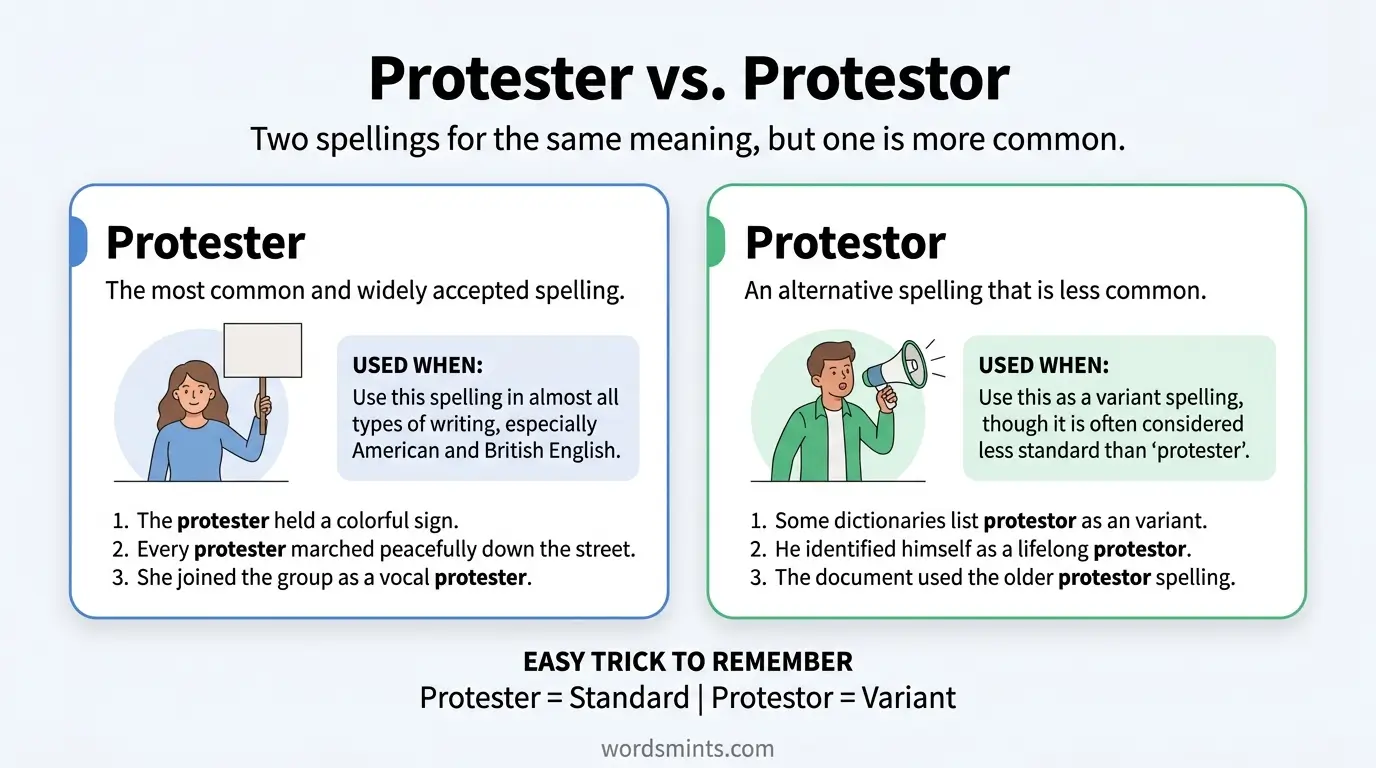
When you write about a march, demonstration, or public gathering, you may stop and wonder: should it be protester or protestor?
The two words look almost identical, sound nearly the same, and have the same basic meaning.
This makes the spelling easy to mix up, especially when you see both forms in books, news reports, and online writing.
The good news is that both protester and protestor are recognized English spellings. However, they are not used equally often.
Protester is the more common and widely preferred form in modern English. Cambridge Dictionary lists protester as the main entry and gives protestor as an alternative spelling.
This guide explains the difference between protester and protestor, their origins, British and American usage, common mistakes, and examples.
It also explains which form is best for formal writing, online content, journalism, and everyday communication.
Protester or Protestor Quick Answer
Both protester and protestor are correct spellings.
Protester is the more common and preferred form in modern English. Protestor is an accepted alternative, but it is less common.
A protester is a person who publicly shows disagreement with something or takes part in a protest.
Examples with “protester”
- The protesters gathered outside the building
- Several protesters marched through the city
- The newspaper interviewed a protester after the event
Examples with “protestor”
- The protestors gathered near the main entrance
- Several protestors spoke to reporters
- The organization released a statement about the protestors
The meaning does not change. The main difference is spelling and frequency.
Cambridge Dictionary lists protester as the main form and protestor as an alternative. Collins also lists protestor as an alternative spelling.
Quick rule: If you need to choose one form, use protester.
The Origin of Protester or Protestor
The word protest has a long history. It comes from Latin protestari, meaning to declare or testify publicly.
The word entered English through French and developed into the modern English word protest.
The noun protester was formed from the verb protest with the common English -er ending.
This pattern is very common in English:
- teach → teacher
- work → worker
- speak → speaker
- drive → driver
- protest → protester
English also contains many nouns ending in -or, such as actor, editor, operator, and creator.
Because both -er and -or are used to form nouns referring to people, the alternative spelling protestor also developed.
The two forms therefore have a historical basis rather than one simply being a random misspelling.
However, usage has favored protester. The Cambridge Guide to English Usage notes that American writers strongly prefer protester, while British writers have used both forms.
It also reports that protester outnumbers protestor by more than 2:1 in British National Corpus data.
So, the spelling difference is mainly a matter of historical word formation and usage preference.
British English vs American English Spelling
Unlike spelling pairs such as colour/color or centre/center, protester and protestor are not a clear British-versus-American spelling pair.
Both forms can appear in British and American English.
American English
American English strongly favors:
protester
For example:
Thousands of protesters gathered outside the building.
The alternative protestor can still be found, but it is much less common.
British English
British English also commonly uses:
protester
However, protestor appears more often in British writing than it does in American English.
This means it would be inaccurate to say that protestor is the British spelling and protester is the American spelling. Both varieties can use both forms.
Comparison Table
| Feature | Protester | Protestor |
| Meaning | A person who protests | A person who protests |
| Spelling | More common | Less common |
| American English | Preferred | Alternative |
| British English | Commonly preferred | Also used |
| Formal writing | Recommended | Acceptable but less common |
| Journalism | Very common | Less common |
| Academic writing | Common | Less common |
| Pronunciation | Nearly identical | Nearly identical |
| Plural | Protesters | Protestors |
The main point is simple: there is no strict US-versus-UK rule here. Protester is widely used in both forms of English.
Which Spelling Should You Use?
Your choice can depend on your audience and the type of writing.
For American Readers
Use protester.
It is the familiar and widely preferred form in American English. It works well in essays, news writing, websites, reports, and professional communication.
Example:
The protesters gathered outside the courthouse.
For British and Commonwealth Readers
Protester is also a strong choice.
British English uses both forms, but protester is very common. If you want a clear and familiar spelling, use protester.
For Global English
If your content is written for an international audience, protester is the safest choice.
It is easy for readers to recognize and is widely used across English-language publishing.
For SEO and Web Content
Use protester in normal sentences because it is the more familiar form.
However, you can mention protestor when discussing the spelling question itself. This helps readers who searched for the alternative form.
For example:
Is it protester or protestor? Both spellings exist, but protester is the more common choice.
For Consistency
Choose one spelling and use it consistently.
Do not switch randomly between protester and protestor in the same article.
Common Mistakes with Protester or Protestor
Several mistakes can make this spelling question more confusing.
1. Saying “protestor” Is Always Wrong
This is not accurate.
Protestor is an accepted alternative spelling. Major dictionaries recognize it as an alternative to protester.
Better:
Protestor is acceptable, but protester is more common.
2. Assuming They Have Different Meanings
They do not.
Both words describe someone who protests.
Correct:
The protesters gathered outside.
Also correct:
The protestors gathered outside.
The meaning remains the same.
3. Treating It as a US vs UK Rule
It is not like color and colour.
Both protester and protestor can appear in British and American English.
4. Mixing the Forms
Avoid writing:
The protesters and protestors gathered together.
This may be grammatically possible, but it creates unnecessary inconsistency when both words refer to the same group.
Better:
The protesters gathered together.
5. Confusing Protest, Protester, and Protested
These words have different grammatical roles.
- Protest – noun or verb
- Protester – a person who protests
- Protested – past tense of the verb protest
Examples:
The protest began at noon.
Residents protested against the decision.
The protesters left the area.
The group protested the new policy.
Protester or Protestor in Everyday Examples
Both spellings can appear in different types of writing. However, protester is generally the more natural choice for modern general writing.
In an Email
Several protesters gathered near the main entrance this morning.
This is a clear and professional choice.
In News Writing
Police said the protesters remained in the area during the afternoon.
News writing commonly uses protesters.
On Social Media
Thousands of protesters joined the march today.
The spelling is short, familiar, and easy to understand.
In Formal Writing
The report examined the actions of protesters during the demonstration.
For reports, essays, and other formal documents, protester is a strong default.
Using “Protestor”
You may also see:
The organization released a statement about the protestors.
This is understandable and recognized as an alternative spelling. It is simply less common than protesters.
Protester or Protestor Google Trends & Usage Data
Search interest can change over time, especially when major demonstrations or public events receive widespread media coverage.
For this reason, Google Trends results can rise and fall based on current events, country, and search behavior.
The more useful point for spelling is the difference in overall usage.
Dictionary and corpus evidence shows that protester is the dominant form.
Cambridge lists protester as the main dictionary entry and protestor as an alternative.
Historical British corpus evidence also shows that protester occurs more frequently than protestor.
The Cambridge Guide to English Usage reports a ratio of more than 2:1 in British National Corpus data.
Usage by Country and Context
| Country/Context | More Common Form |
| United States | Protester |
| United Kingdom | Protester |
| Commonwealth English | Protester generally preferred |
| International English | Protester |
| Journalism | Protester |
| Academic writing | Protester |
| Formal writing | Protester |
| Informal writing | Both may appear |
This does not mean protestor is incorrect. It means protester has stronger general usage and recognition.
If you are writing for a broad audience, protester is usually the clearest choice.
Protester vs Protestor: Side-by-Side Comparison
| Protester | Protestor |
| More common spelling | Less common spelling |
| Standard modern choice | Accepted alternative |
| Used in US English | Used in US English |
| Used in UK English | Used in UK English |
| Common in news writing | Less common in news writing |
| Common in formal writing | Less common in formal writing |
| Same meaning | Same meaning |
| Same basic pronunciation | Same basic pronunciation |
| Plural: protesters | Plural: protestors |
Simple Example
More common:
The protesters gathered outside the building.
Alternative:
The protestors gathered outside the building.
Both sentences have the same meaning.
FAQs About Protester or Protestor
1. Is “protester” or “protestor” correct?
Both are recognized spellings. Protester is the more common and widely preferred form.
2. Is “protestor” a real word?
Yes. Protestor is an accepted alternative spelling of protester. It is not automatically a spelling mistake. Cambridge and Collins both recognize it.
3. Is “protester” American or British English?
It is used in both American and British English. There is no rule that limits protester to American English.
4. Is “protestor” British English?
Protestor can be used in British English, but it is not exclusively British. British English also commonly uses protester.
5. Which spelling is better for formal writing?
Protester is generally the better choice for formal writing because it is more common and familiar.
6. Are protester and protestor pronounced differently?
They are generally pronounced almost the same. The main difference is in spelling rather than meaning or pronunciation.
7. What is the plural of protester?
The plural is protesters.
Example:
Hundreds of protesters gathered in the city.
The plural of protestor is protestors.
Conclusion
When deciding between protester or protestor, remember that both spellings are recognized in English.
They describe a person who publicly protests or takes part in a protest. The main difference is not meaning but usage frequency.
Protester is the more common and widely preferred spelling.
It is used in both American and British English and works well in news reports, academic writing, websites, emails, social media, and formal documents.
Protestor is also acceptable, but it is less common.
The two forms should not be treated as a strict British-versus-American spelling difference. Both can occur in either variety of English.
Historical and corpus evidence also shows stronger use of protester, including a more than 2:1 preference in British National Corpus data.
So, if you are unsure which form to choose, protester is the simple and reliable option.
Use protestor when you are following an existing source, quotation, or preferred house style. Most importantly, stay consistent throughout your writing.

welcome to Words Mints! I’m Halay Sultan, a web developer and AI-Powered SEO content writer.