
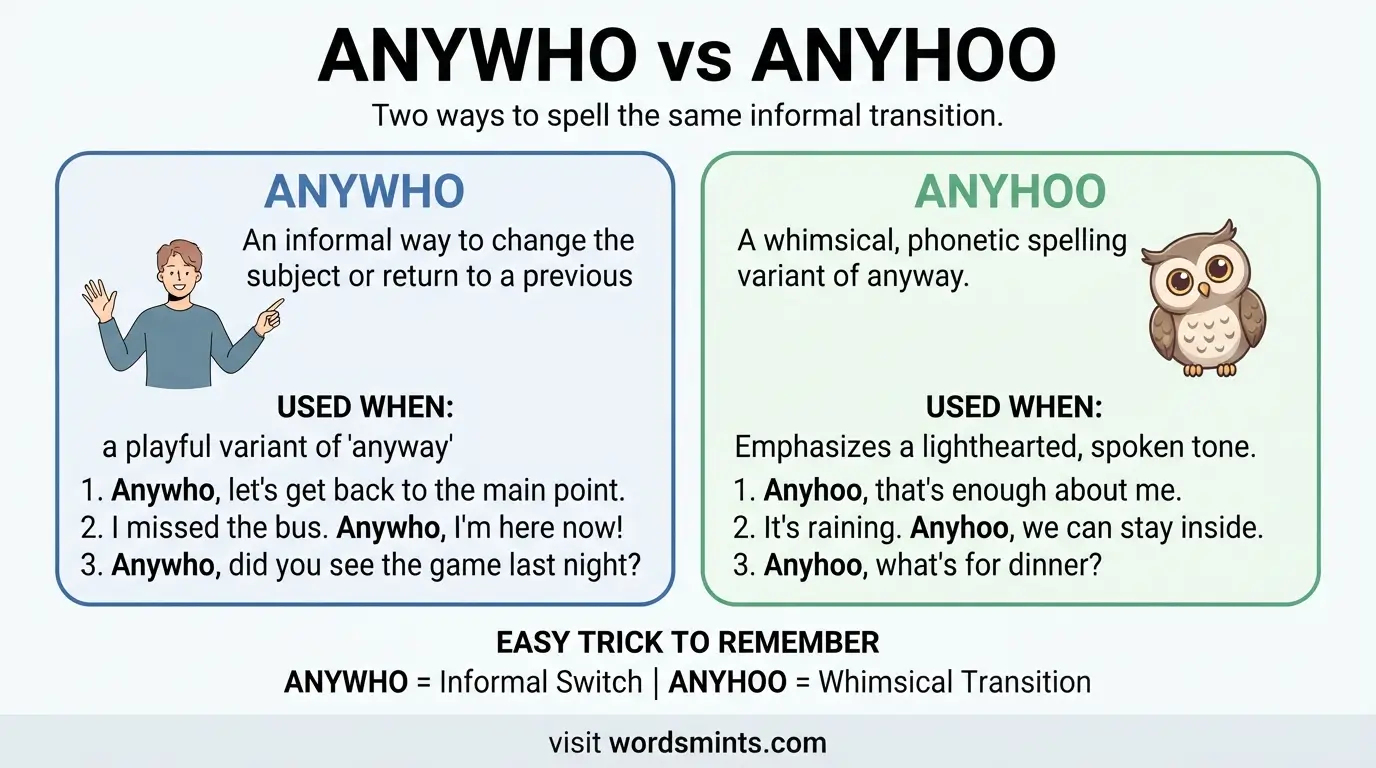
Language often changes in small but interesting ways. “Anywho” and “anyhoo” are good examples.
Both forms appear in casual English, especially in speech, emails, texts, blogs, and social media.
But if you have ever wondered which spelling is correct, you are not alone. People often search for “anywho or anyhoo” because the two words sound almost the same and are used in similar ways.
The good news is simple: both “anywho” and “anyhoo” are used as informal expressions, but “anywho” is generally more common and is often treated as the standard spelling.
Both can mean something like “anyway,” “in any case,” or “moving on.”
This guide explains the difference between anywho and anyhoo, where these forms came from, how they are used in American and British English, and which one you should choose.
You will also see clear examples, common mistakes, usage advice, and answers to frequently asked questions.
Anywho or Anyhoo Quick Answer
Anywho and anyhoo are informal words that usually mean “anyway,” “in any case,” or “moving on.”
Of the two, anywho is the more common spelling.
Examples
- Anywho, let’s get back to work
- Anywho, what were you saying?
- Anyhoo, I should probably go home
- Anyhoo, where were we?
Both spellings are casual. Neither is a good choice for highly formal writing.
Quick comparison
| Spelling | Meaning | Use |
| Anywho | Anyway; in any case | Common informal use |
| Anyhoo | Anyway; in any case | Informal, playful use |
| Anyway | In any case | Standard and widely accepted |
If you need one safe choice for casual writing, anywho is usually the better option.
The Origin of Anywho or Anyhoo
The exact history of anywho and anyhoo is not completely clear. Both forms appear to have developed as playful or informal variations of anyway.
The word anyway has a much older history. It combines any with way and has been used in English for centuries.
Over time, speakers created humorous or altered versions of common words. Anywho and anyhoo fit this pattern.
They are often used to change the subject, return to an earlier point, or end a side discussion.
The ending “-who” may sound like a playful replacement for the ending of “anyway.” The “-hoo” spelling adds an even more playful sound.
These forms are mainly associated with informal English. They are not simply British and American versions of the same standard word.
Instead, they are casual alternatives that can appear in different English-speaking communities.
Because informal words often spread through speech, popular culture, television, online conversations, and social media, spelling can vary.
British English vs American English Spelling
Unlike pairs such as colour/color or centre/center, anywho and anyhoo are not a clear British-versus-American spelling pair.
Both forms can be understood in different English-speaking regions. However, anywho is widely seen in informal American English, while anyhoo can have a more playful or conversational feel.
Neither spelling follows a special British or American spelling rule.
Comparison table
| Feature | Anywho | Anyhoo |
| Meaning | Anyway; in any case | Anyway; in any case |
| Style | Informal | Informal and playful |
| Common in speech | Yes | Yes |
| Common online | Yes | Yes |
| Formal writing | Avoid | Avoid |
| American English | Used | Used |
| British English | Understood and used | Understood and used |
| Safest casual choice | Yes | Less common |
For professional or academic writing, use anyway instead.
Which Spelling Should You Use?
Your choice depends on your audience and the type of writing.
For a US audience
Anywho is a good informal choice.
Anywho, let’s move on to the next topic.
It sounds casual and conversational.
For a UK or Commonwealth audience
Both forms can be understood, but anyway is usually a better choice in standard writing. If you want a deliberately casual or humorous tone, anywho or anyhoo may work.
For a global audience
Choose anyway if clarity matters most.
If you are writing a casual post, message, or personal email, anywho is easy to understand.
For formal writing
Avoid both anywho and anyhoo.
Instead, use:
- Anyway
- In any case
- Nevertheless
- Regardless
- Moving on
Common Mistakes with Anywho or Anyhoo
1. Treating anywho as formal English
Incorrect style:
Anywho, the company will announce its annual results.
In a formal report, anyway or in any case would be better.
Better:
In any case, the company will announce its annual results.
2. Assuming anyhoo is a spelling error
Anyhoo is not simply a typing mistake. It is an informal variant used intentionally.
Anyhoo, let’s talk about the trip.
It gives the sentence a playful tone.
3. Using the word in academic writing
Academic writing usually needs a formal tone.
Too casual:
Anywho, this study shows an important trend.
Better:
In any case, this study shows an important trend.
4. Confusing meaning
Anywho and anyhoo usually mean “anyway” or “in any case.”
They do not normally mean “any person” or “whoever.”
5. Overusing the expression
Because these words are casual, using them too often can make writing sound forced.
Use them when they fit the tone.
Anywho or Anyhoo in Everyday Examples
These words are most useful in casual communication.
In emails
Casual email:
Anywho, I have attached the updated file. Let me know what you think.
For a professional email, this is better:
Anyway, I have attached the updated file.
In news writing
Professional news writing usually avoids these expressions.
Less suitable:
Anywho, the meeting continued for another hour.
Better:
The meeting continued for another hour.
On social media
Both forms can work well.
Anywho, here’s what happened next.
Or:
Anyhoo, who else is excited for the weekend?
Here, the playful tone is often part of the point.
In text messages
They are very natural in casual messages.
Anywho, are you coming tonight?
Anyhoo, I need to go now!
In formal writing
Avoid both forms.
Instead of:
Anyhoo, the results were surprising.
Write:
Nevertheless, the results were surprising.
Anywho or Anyhoo Google Trends & Usage Data
Search interest for anywho and anyhoo is generally much smaller than interest in the standard word anyway.
This is expected because anywho and anyhoo are informal expressions.
People are more likely to use them in conversations, social media, forums, texts, and personal writing than in formal documents.
Usage can also vary by country and audience. English-speaking regions such as the United States, United Kingdom, Canada, and Australia may show interest in these forms, but the exact level changes over time.
It is also important to separate search popularity from correctness. A word can receive many searches because people are unsure how to spell it.
Likewise, a less common spelling can still be valid in informal use.
For SEO content, it is useful to mention both anywho and anyhoo, while clearly explaining that anyway remains the standard form for formal English.
Anywho vs Anyhoo: Comparison Table
| Variation | Meaning | Tone | Best Use |
| Anywho | Anyway | Casual | Informal conversations and posts |
| Anyhoo | Anyway | Casual, playful | Humorous or friendly writing |
| Anyway | In any case | Neutral | Everyday and formal writing |
| In any case | Regardless | Formal | Professional and academic writing |
| Moving on | Change of topic | Neutral | Conversations and presentations |
FAQs About Anywho or Anyhoo
Is anywho a real word?
Yes. Anywho is an informal English expression. It is commonly used to mean “anyway” or “in any case.”
Is anyhoo a real word?
Yes. Anyhoo is also used as an informal and playful variation of “anyway.”
Which is correct, anywho or anyhoo?
Both are used, but anywho is generally the more common spelling. Anyhoo is more playful and informal.
Is anywho formal English?
No. Anywho is mainly informal. Use anyway or in any case in formal writing.
5. Can I use anyhoo in an email?
Yes, if the email is casual. Avoid it in formal business, academic, or official emails.
Does anywho mean anyway?
Yes. In most contexts, anywho means something close to “anyway” or “in any case.”
Is anywho more common than anyhoo?
Generally, yes. Anywho is more widely used, while anyhoo often has a playful or humorous feel.
Conclusion
When deciding between anywho or anyhoo, remember that both forms are informal variations of anyway.
They can be used to change the subject, return to the main point, or move a conversation forward. Anywho is generally the more common spelling, while anyhoo often sounds more playful or humorous.
Neither form is a strict British or American spelling equivalent. Both can appear in casual English across different English-speaking regions. However, usage may vary by audience and context.
For social media, text messages, friendly emails, and casual conversations, anywho can be a natural choice.
Anyhoo can work when you want an extra light or playful tone. For professional, academic, legal, or formal writing, it is better to use anyway, in any case, or another standard expression.
In short, anywho is the safer informal choice, anyhoo is a playful alternative, and anyway is the best choice when you want standard English.

welcome to Words Mints! I’m Halay Sultan, a web developer and AI-Powered SEO content writer.