
Have you ever wondered whether the correct spelling is hayday or heyday? You are not alone. Many people type “hayday” when they mean “heyday.”
This small spelling mistake can cause confusion in emails, schoolwork, and online writing.
The word “heyday” describes a time when someone or something was at its best. For example, “The singer was famous during the heyday of pop music.”
But why do people spell it “hayday”? The answer comes from how the word sounds.
In this guide, we will explain the difference between hayday and heyday. You will learn the correct spelling, its origin, British and American English usage, and common mistakes.
We will also share simple examples to help you use the word with confidence.
Whether you are a student, blogger, teacher, or professional writer, this article will help you choose the right spelling. By the end, you will know why heyday is correct and how to use it in everyday English.
Hayday or Heyday Quick Answer
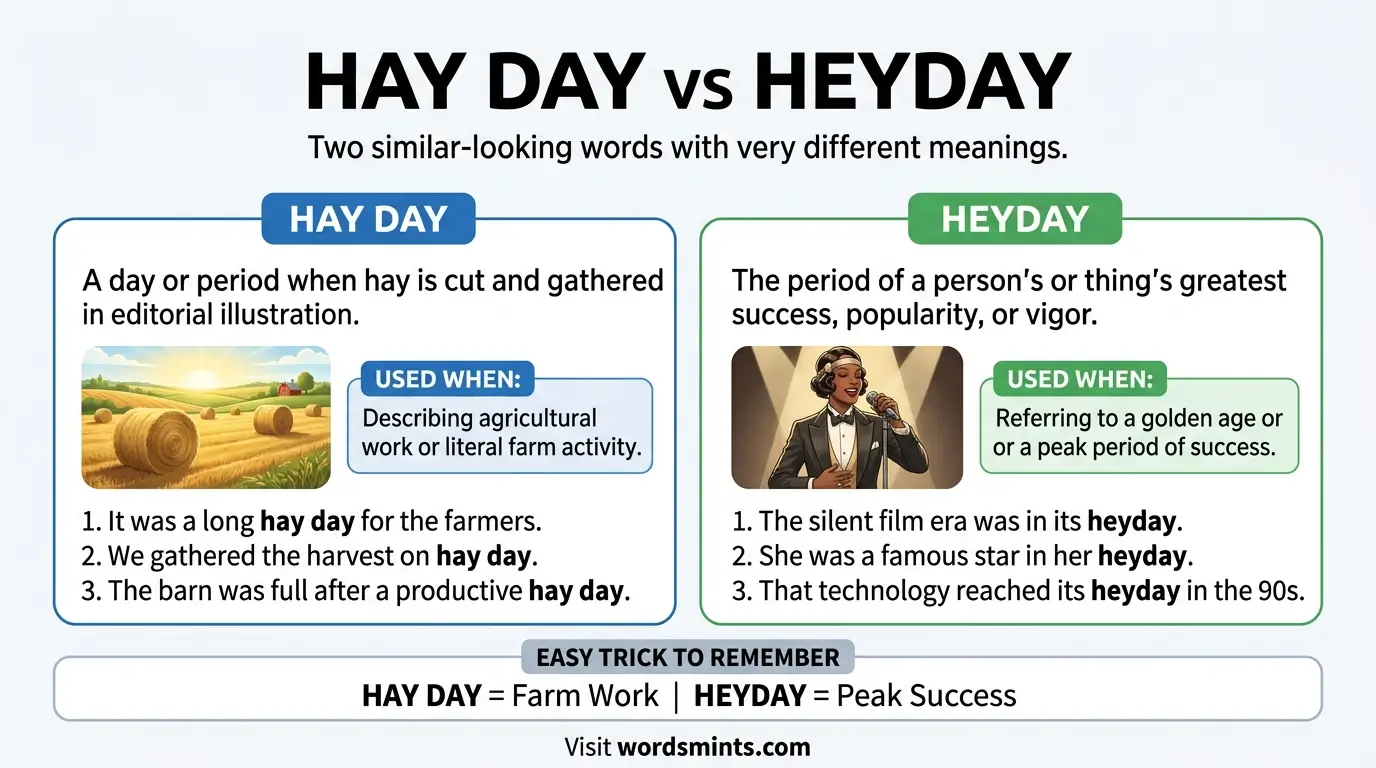
Heyday is the correct spelling. Hayday is a common spelling mistake when referring to a period of great success, popularity, or power.
Use “heyday” when talking about the best time in someone’s life, a business’s success, or a popular trend.
Correct spelling: Heyday
Examples:
- The band was popular during its heyday
- The 1990s were the heyday of video rental stores
- She enjoyed the heyday of her acting career
Incorrect spelling: Hayday
“Hayday” is not the standard spelling of the word meaning a time of success.
Quick tip: Remember “heyday” with an “e,” not “hayday” with an “a.”
The Origin of Hayday or Heyday
The word “heyday” has an interesting history. It comes from an old English expression used to show joy, surprise, or excitement.
Where did “heyday” come from?
“Heyday” began as an exclamation in English. People used “heyday!” to express happiness, excitement, or surprise.
Over time, the word developed a new meaning. It came to describe a time of great success, strength, or popularity.
The word has been used in English since the 16th century. Writers used it to describe joyful moments and periods of prosperity.
Why do people spell it “hayday”?
The main reason is pronunciation. “Heyday” sounds like “hay day.” Both “hey” and “hay” have a similar sound in many English accents.
People often spell words based on how they sound. This can lead to mistakes.
For example:
- Heyday → Correct spelling
- Hayday → Common misspelling
The word “hay” is a real English word. It means dried grass used as animal food. But it does not mean a period of success.
What does heyday mean?
“Heyday” means the time when someone or something was most successful, popular, or powerful.
Example:
The actor was at the height of his career during the heyday of television dramas.
Here, “heyday” means the actor’s best and most successful period.
British English vs American English Spelling
British English and American English sometimes use different spellings. However, heyday is spelled the same way in both varieties of English.
There is no standard British spelling “hayday” and American spelling “heyday.”
| English variety | Correct spelling | Example |
| British English | Heyday | The company had its heyday in the 1980s. |
| American English | Heyday | The company had its heyday in the 1980s. |
| Australian English | Heyday | The team enjoyed its heyday. |
| Canadian English | Heyday | The singer was famous in her heyday. |
| Global English | Heyday | The brand was popular during its heyday. |
Does British English use “hayday”?
No. British English uses “heyday” when referring to a period of success.
Example:
- Correct: The shop was popular in its heyday
- Incorrect: The shop was popular in its hayday
Does American English use “hayday”?
No. American English also uses “heyday.”
Example:
- Correct: The company enjoyed its heyday
- Incorrect: The company enjoyed its hayday
Spelling rule to remember
Some English words change between British and American English. For example:
- Colour → Color
- Favourite → Favorite
- Centre → Center
But “heyday” does not change. Use the same spelling in both varieties.
Which Spelling Should You Use?
The correct spelling depends on your audience, but the answer is simple: use heyday everywhere.
For American English
Use “heyday” in school assignments, work emails, blogs, and social media.
Example:
The company was in its heyday during the early 2000s.
For British and Commonwealth English
Use “heyday” in essays, reports, articles, and professional writing.
Example:
The town was famous during the heyday of the railway industry.
For global English
If you write for an international audience, “heyday” is the safest choice. It is the standard spelling in English.
Professional writing advice
Avoid “hayday” in formal writing. A spelling mistake can make your writing look less polished.
Before publishing an article or sending an email, check the spelling of “heyday.”
Common Mistakes with Hayday or Heyday
Many people confuse “hayday” and “heyday” because they sound alike. Here are some common mistakes and corrections.
Mistake 1: Writing “hayday”
Incorrect:
The company was in its hayday.
Correct:
The company was in its heyday.
Mistake 2: Writing “hey day” as two words
Incorrect:
The singer was famous in her hey day.
Correct:
The singer was famous in her heyday.
“Heyday” is usually written as one word.
Mistake 3: Using “heyday” for dried grass
Incorrect meaning:
The farmer stored heyday for the horses.
Correct:
The farmer stored hay for the horses.
“Hay” means dried grass. “Heyday” means a period of success.
Mistake 4: Confusing “heyday” with “prime”
These words have similar meanings, but they are not always interchangeable.
- Heyday: A period of great success or popularity
- Prime: The best or most active period of someone’s life
Example:
The actor was in his prime.
The actor enjoyed his heyday in Hollywood.
Mistake 5: Using “heyday” for a single day
“Heyday” does not mean one special day. It refers to a period of time.
Incorrect:
Yesterday was my heyday.
Correct:
My heyday was during my college years.
Hayday or Heyday in Everyday Examples
The word “heyday” is common in everyday English. You can use it in emails, news articles, social media posts, and formal writing.
1. In emails
Our company was in its heyday when we had more than 100 employees.
I remember the heyday of our old office.
These examples describe a successful period in the past.
2. In news writing
The city enjoyed its heyday as a major trading center.
Experts say the industry may return to its heyday.
News writers use “heyday” to discuss the rise and fall of businesses, cities, and industries.
3. On social media
The heyday of early social media was full of fun memories.
Take me back to the heyday of classic video games!
Social media users often use “heyday” when talking about nostalgia.
4. In formal writing
The museum displays artifacts from the heyday of the Roman Empire.
The report examines the heyday of the manufacturing industry.
Formal writing often uses “heyday” to describe history, culture, and business.
5. In everyday conversation
Those were the heyday years of my career.
This was the heyday of rock music.
The word works well in casual and professional conversations.
Hayday or Heyday Google Trends & Usage Data
People often search for “hayday or heyday” because they want to confirm the correct spelling. The two spellings sound alike, but they have different levels of standard usage.
Which spelling is more popular?
“Heyday” is the standard English spelling. “Hayday” appears mainly as a spelling mistake or in unrelated names.
The exact popularity of each spelling can change by country, language, and search period. Without a live Google Trends check, it would be misleading to give exact search volumes or percentages.
Why do people search for “hayday or heyday”?
Common reasons include:
- The words sound the same
- People are unsure whether to use “a” or “e”
- They want to write correctly in school or work
- They see the word in books, news, or online posts
- They want to check spelling before publishing content
Usage by country
The spelling “heyday” is standard in major English-speaking countries, including:
| Country | Standard spelling | Common context |
| United States | Heyday | Career, business, history |
| United Kingdom | Heyday | Culture, history, writing |
| Canada | Heyday | Everyday and formal English |
| Australia | Heyday | Popularity and success |
| New Zealand | Heyday | Historical and everyday use |
| Pakistan | Heyday | Education, SEO, and English writing |
Search context
People may search for “heyday” when looking for:
- Word definitions
- Spelling checks
- Synonyms
- Grammar examples
- Historical writing
- Business success stories
Key takeaway: “Heyday” is the correct word. “Hayday” is usually a spelling error in this context.
Hayday or Heyday Comparison Table
| Variation | Correct? | Meaning or use |
| Heyday | Yes | A period of great success or popularity |
| Hayday | No, for this meaning | Common misspelling of heyday |
| Hey day | Usually no | Incorrect spacing for the standard noun |
| Hay day | Sometimes | A day involving hay, depending on context |
| Heyday’s | Yes | Possessive form of heyday |
| Heydays | Yes | Plural form, used when discussing several peak periods |
Example comparison
Heyday:
The company was in its heyday during the 1990s.
Hay:
The farmer collected hay for the animals.
Hay day:
The farm had a busy hay day.
The last phrase can work as two words if it literally describes a day involving hay. It does not mean a period of success.
FAQs About Hayday or Heyday
Is it hayday or heyday?
“Heyday” is correct when you mean a period of great success, popularity, or power. “Hayday” is a common spelling mistake.
What does heyday mean?
Heyday means the best or most successful period of someone or something’s life.
Example:
The singer was famous during her heyday.
Is heyday one word or two?
“Heyday” is normally written as one word.
Correct: The heyday of cinema.
Incorrect: The hey day of cinema.
Is hayday a real word?
“Hayday” is not the standard spelling of the word meaning a period of success. “Hay” is a real word for dried grass, but “hayday” is generally a misspelling in this context.
Is heyday used in British English?
Yes. British English uses “heyday.” American English uses the same spelling.
What is another word for heyday?
Common synonyms include:
- Prime
- Peak
- Golden age
- Best years
- Height of success
Example:
The company was at its peak.
Can I use heyday in formal writing?
Yes. “Heyday” is suitable for formal essays, reports, articles, and professional writing.
Example:
The city reached its heyday during the industrial revolution.
Conclusion:
Choosing the correct spelling is easy once you understand the difference between “hayday” and “heyday.”
The correct word is heyday, and it means a period of great success, popularity, or power.
“Hayday” is a common spelling mistake because both words sound alike. However, the standard English spelling uses “e,” not “a.”
This rule applies to British English, American English, and other major English varieties.
Remember that “hay” means dried grass, while “heyday” describes someone’s or something’s best period.
Keeping these meanings separate will help you avoid mistakes in schoolwork, emails, social media, and formal writing.
If you are writing for a global audience, always choose “heyday.” It is clear, correct, and widely understood.
You can use it to describe a successful career, a popular business, a famous historical period, or a cultural trend.
The next time you wonder, “hayday or heyday?”, remember this simple rule: Heyday is the correct spelling for a time of success.

welcome to Words Mints! I’m Halay Sultan, a web developer and AI-Powered SEO content writer.