
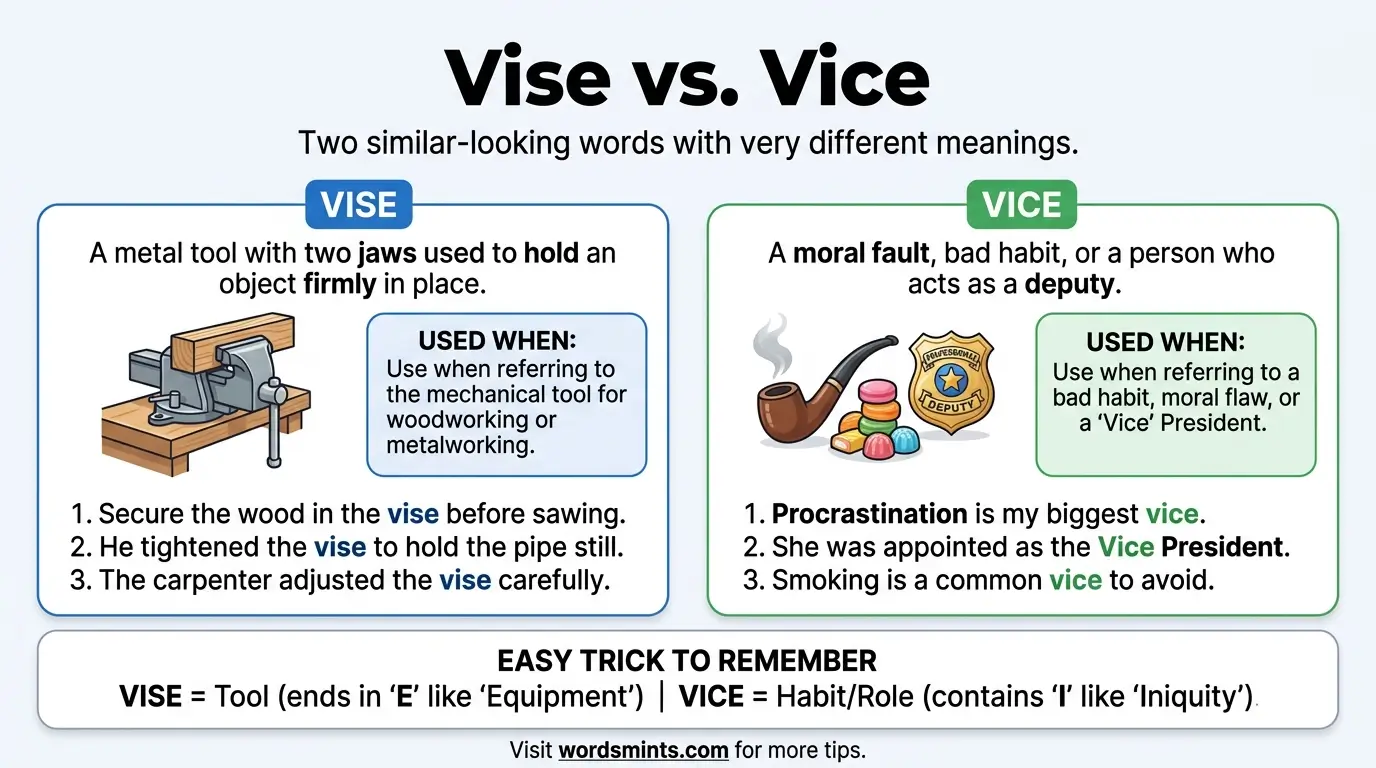
A single letter can change the meaning of a word. That is why many people search for “vise or vice”
when they need to describe a tool, write about bad habits, or choose the right spelling for their audience.
Although these words look almost the same and sound the same, they do not always mean the same thing.
The main difference is simple. Vise is the usual American English spelling for a tool that holds an object firmly while you work on it.
In British English, the same tool is usually spelled vice. The word vice also has a separate meaning: a bad habit, immoral behavior, or a weakness in someone’s character.
This spelling difference can cause problems in schoolwork, technical writing, emails, manuals, and professional documents. Understanding the context makes the choice much easier.
In this guide, you will learn the meaning, origin, spelling, regional differences, common mistakes, and everyday uses of vise or vice.
You will also learn which form to use in American, British, and international English.
Vise or Vice Quick Answer
Vise and vice can both refer to a tool used to hold an object firmly.
- Vise is the standard spelling in American English
- Vice is the standard spelling for the tool in British English and many other varieties of English
- Vice also means a bad habit or immoral behavior
Examples:
- American English: Clamp the metal in the vise
- British English: Clamp the metal in the vice
- Moral meaning: Gambling became his greatest vice
So, if you mean the workshop tool, vise is common in American English, while vice is common in British English.
If you mean a bad habit or immoral behavior, use vice.
Both spellings of the tool are pronounced /vaɪs/.
The Origin of Vise or Vice
The two spellings have different historical roots, even though they now refer to the same workshop tool.
The word vice, when it means a bad habit or immoral behavior, comes through Middle English and Old French from the Latin word vitium, meaning a fault or defect.
This is the source of the moral sense of vice.
The tool meaning has a different origin. Oxford traces this sense to Middle English, through Old French vis, meaning a screw, and ultimately to Latin vitis, meaning “vine.”
The connection comes from the twisting shape of a screw.
Over time, English developed regional spelling differences for the tool. American English commonly uses vise, while British English generally uses vice.
This is similar to other spelling differences between American and British English. The language can use different spellings for the same object without either form being wrong.
The important point is that vice has two major meanings:
- A workshop tool in British English.
- A bad or immoral habit in both American and British English.
The spelling vise is mainly used for the workshop tool in American English.
British English vs American English Spelling
The main spelling rule is easy to remember.
| Meaning | American English | British English |
| Workshop tool | vise | vice |
| Bad habit | vice | vice |
| Immoral behavior | vice | vice |
| Pronunciation | /vaɪs/ | /vaɪs/ |
For example:
American English
- Put the pipe in the vise
- The mechanic tightened the vise
- The metal was held firmly in the vise
British English
- Put the pipe in the vice
- The mechanic tightened the vice
- The metal was held firmly in the vice
For the moral meaning, both varieties use vice:
- Smoking can become a harmful vice
- Greed is considered a vice
- He admitted that impatience was his greatest vice
Cambridge lists vise as the US spelling and vice as the UK spelling for the tool. Oxford gives the same regional distinction.
Vise or Vice: Side-by-Side Comparison
| Word | Meaning | Common Region | Example |
| vise | A tool for holding objects | American English | The wood is secured in the vise. |
| vice | A tool for holding objects | British English | The wood is secured in the vice. |
| vice | A bad habit | US and UK | Laziness can become a vice. |
| vice | Immoral behavior | US and UK | The story explores crime and vice. |
Which Spelling Should You Use?
Your choice depends on your audience.
If You Write American English
Use vise when you mean the workshop tool.
Example:
The technician placed the metal sheet in the vise.
Use vice when you mean a bad habit or immoral behavior.
Example:
Excessive drinking became his worst vice.
If You Write British English
Use vice for the workshop tool.
Example:
The technician placed the metal sheet in the vice.
Use vice for the moral meaning too.
Example:
Pride can become a serious vice.
If You Write for a Global Audience
Choose one variety of English and stay consistent.
For technical content aimed at American readers, use vise for the tool. For British readers, use vice.
If your audience is international, context usually makes the meaning clear. You can also use bench vise for an American audience or bench vice for a British audience.
Consistency matters more than trying to mix both spellings.
Common Mistakes with Vise or Vice
These words are easy to confuse because they sound identical.
Mistake 1: Using “vise” for a Bad Habit
Incorrect:
Lying is a serious vise.
Correct:
Lying is a serious vice.
The moral word is always vice.
Mistake 2: Using “vice” in American Technical Writing
This is not always grammatically wrong, but it may look unusual in American English when referring to the tool.
For American readers:
Secure the piece in the vise.
For British readers:
Secure the piece in the vice.
Mistake 3: Thinking “Vise” and “Vice” Are Always Different Words
The spelling depends on meaning and regional variety.
Vise and vice can both refer to the workshop tool. The difference is mainly regional.
Mistake 4: Confusing “Vice” with “Vice Versa”
The phrase vice versa means “the other way around.”
Example:
You can turn the key clockwise and vice versa.
Here, vice is part of the fixed Latin phrase. It does not refer to a tool or a bad habit.
Vise or Vice in Everyday Examples
Seeing the words in real sentences makes the difference easier to remember.
In Emails
American English:
Please place the part in the vise before making the cut.
British English:
Please place the part in the vice before making the cut.
In News Writing
The moral sense often appears in news and social discussions:
The report examined crime, corruption, and other forms of vice.
Here, vice means immoral or harmful behavior.
In Social Media
People may use vice when talking about personal habits:
Coffee is my only vice.
For a workshop post, an American user might write:
My new vise makes woodworking much easier.
A British user might write:
My new vice makes woodworking much easier.
In Formal Writing
Technical writing should follow the spelling used by the intended audience.
American style:
The workpiece must be secured in a vise before drilling.
British style:
The workpiece must be secured in a vice before drilling.
For the moral meaning:
The novel presents greed as a destructive vice.
Vise or Vice Google Trends & Usage Data
Google Trends can help show where people search for different spellings, but it is important to understand what the data means.
Google Trends does not provide exact total search counts. Instead, it uses a normalized scale from 0 to 100.
A score of 100 represents the highest relative search interest for the selected time and location. A lower number represents less relative interest, not a specific number of searches.
For vise or vice, regional language use is especially important. American English uses vise for the workshop tool, while British English normally uses vice.
This means searches for the two spellings can reflect both spelling questions and regional vocabulary.
The word vice also has meanings unrelated to tools. People may search for it when discussing bad habits, crime, morality, or the phrase vice versa.
Therefore, raw search interest for “vice” cannot be treated as interest in the workshop tool alone.
For SEO research, this distinction matters. A page targeting vise or vice should explain both the tool spelling and the separate meaning of vice.
That gives readers the context they need and matches several possible search intents.
Google also notes that low-volume terms may appear as zero in Trends, so a low displayed value does not mean that nobody searched for a term.
FAQs About Vise or Vice
1. Is it vise or vice?
Both can be correct when referring to the workshop tool. Vise is standard in American English, while vice is standard in British English.
2. Is a vise the same as a vice?
Yes, when the words refer to the workshop tool. They describe the same type of tool, but the spelling varies by English variety.
3. What is the difference between vise and vice?
Vise is the American spelling of the workshop tool. Vice is the British spelling of the tool and also means a bad habit or immoral behavior.
4. Is “vice” correct in American English?
Yes. American English uses vice for meanings such as a bad habit or immoral behavior. For the workshop tool, American English usually uses vise.
5. Is “vise” correct in British English?
Vise is recognized, but vice is the usual British spelling for the workshop tool.
6. How do you pronounce vise and vice?
Both are normally pronounced /vaɪs/, which sounds like “vice.”
7. Is “vice” the same as “vice versa”?
No. Vice can mean a bad habit or a workshop tool. Vice versa is a fixed expression meaning “the other way around.”
Conclusion
The choice between vise or vice becomes simple once you know the meaning and the type of English you are using.
For the workshop tool, vise is the usual American English spelling, while vice is the usual British English spelling.
Both forms refer to a tool that holds an object firmly while work is done on it.
The word vice has another important meaning. It can describe a bad habit, immoral behavior, or a weakness in someone’s character.
This meaning uses vice in both American and British English.
If you are writing for American readers, choose vise for the tool. If you are writing for British readers, choose vice.
For a global audience, follow the spelling style used by your target readers and remain consistent.
The easiest rule is this: American tool = vise; British tool = vice; bad habit = vice.
Once you remember that rule, you can use these words with confidence in everyday, academic, and professional writing.

welcome to Words Mints! I’m Halay Sultan, a web developer and AI-Powered SEO content writer.