
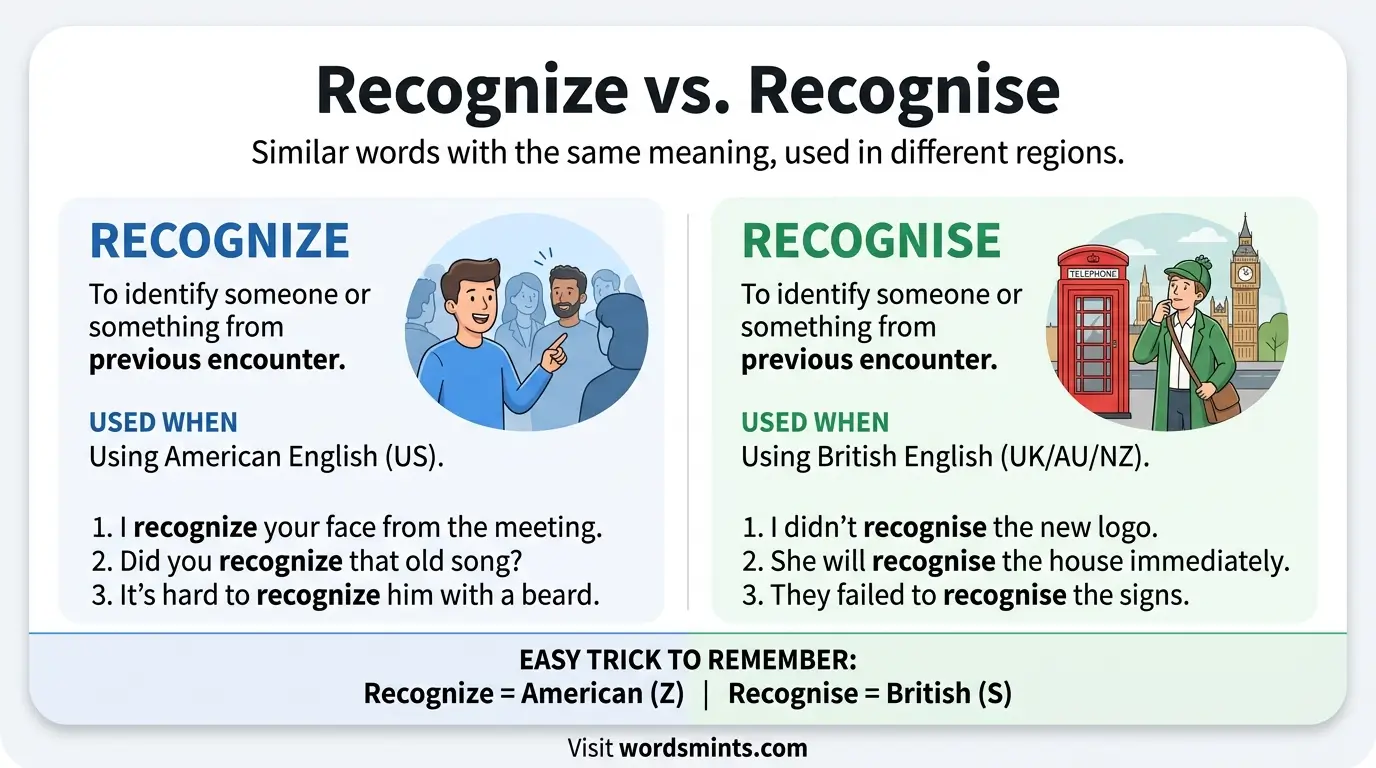
Seeing recognize and recognise can make even confident English writers stop and think. Are they different words, or is one simply a spelling mistake?
The answer is simple: both spellings are correct, but they belong to different varieties of English.
Recognize is the standard spelling in American English, while recognise is the usual spelling in British English and is also common in many other varieties that follow British spelling conventions.
Both words have the same meaning: to identify someone or something, to accept something as true, or to give official acknowledgment.
People often search for “recognize or recognise” when writing essays, emails, articles, applications, or professional documents.
The confusion usually comes from the -ize and -ise spelling difference. This difference does not change pronunciation or meaning.
In this guide, you will learn where these spellings came from, how British and American English treat them, which spelling to use for different audiences, and how to avoid common mistakes.
You will also see clear examples from everyday and formal writing.
Recognize or Recognise Quick Answer
Recognize and recognise are both correct spellings.
| Spelling | Main Usage | Example |
| recognize | American English | I recognize that name. |
| recognise | British English | I recognise that name. |
The meaning is exactly the same.
The verb recognize/recognise can mean to identify someone or something:
I recognized her voice immediately.
It can also mean to accept or acknowledge something:
The company recognized the need for change.
Oxford lists recognize as the American English form and notes recognise as the British English spelling.
So, neither spelling is wrong. The important point is to use the spelling that matches your chosen variety of English.
The Origin of Recognize or Recognise
The word has a long history. Recognize and recognise come from the same linguistic source, so the two spellings are not separate words.
The related noun recognition entered English in the late 15th century. It came from Latin recognitio, from recognoscere, meaning “know again” or “recall to mind.”
The word combines re- meaning “again” with cognoscere meaning “learn” or “know.”
Over time, English developed different spelling conventions on opposite sides of the Atlantic.
British English commonly uses -ise in words such as:
- recognise
- organise
- realise
- apologise
American English commonly uses -ize:
- recognize
- organize
- realize
- apologize
This difference became part of the broader spelling distinction between British and American English.
It is important to remember that the difference is mainly written. Recognize and recognise are pronounced the same in standard English.
British English vs American English Spelling
The main difference is the ending.
American English generally prefers -ize, while British English commonly uses -ise.
Comparison Table
| Meaning | American English | British English |
| Identify or acknowledge | recognize | recognise |
| Easy to identify | recognizable | recognisable |
| Organize | organize | organise |
| Realize | realize | realise |
| Apologize | apologize | apologise |
| Recognized | recognized | recognised |
| Recognizing | recognizing | recognising |
Oxford gives recognize as the American English spelling and lists recognise as the British English alternative. It also gives recognizable and recognisable as the corresponding adjective forms.
The same spelling pattern continues in related forms:
- American: recognized
- British: recognised
- American: recognizing
- British: recognising
The choice should remain consistent throughout a piece of writing.
Which Spelling Should You Use?
Your audience should guide your choice.
For American English
Use recognize if you are writing mainly for readers in the United States.
Example:
The teacher recognized the student’s improvement.
This form is also appropriate for American companies, schools, publications, and websites that follow US English.
For British English
Use recognise when writing for a British audience.
Example:
The teacher recognised the student’s improvement.
This spelling is commonly used in British English.
For Commonwealth English
Many English varieties outside the United States follow British spelling conventions. In these settings, recognise is often the expected form.
However, spelling preferences can vary by country, organization, and style guide. When writing professionally, follow the style guide used by your school, employer, publisher, or client.
For a Global Audience
Either spelling can work, but consistency matters most.
If your website uses American English, use recognize throughout your content. If it follows British English, use recognise throughout.
Do not switch between the two forms without a reason.
Common Mistakes with Recognize or Recognise
Mistake 1: Thinking one spelling is always wrong
Some writers assume that recognise is a spelling mistake because American dictionaries and software often prefer recognize.
That is not correct.
Both forms are established English spellings.
Mistake 2: Mixing spelling systems
A common problem is using American and British spellings in the same document.
For example:
The company will recognize the problem and organise a meeting.
This mixes American recognize with British organise.
A consistent American version would be:
The company will recognize the problem and organize a meeting.
A consistent British version would be:
The company will recognise the problem and organise a meeting.
Mistake 3: Changing the pronunciation
The spelling changes, but the pronunciation does not normally change.
Recognize and recognise have the same standard pronunciation.
Mistake 4: Using the wrong related form
Remember that related words follow the same spelling pattern.
American:
recognizable
British:
recognisable
Both are correct within their respective spelling systems.
Mistake 5: Assuming the meaning changes
The meaning does not change because the spelling changes.
I recognize the person.
and
I recognise the person.
Both sentences mean the same thing.
Recognize or Recognise in Everyday Examples
The word appears in many types of writing.
In Emails
American English:
I recognize the issue and will review it today.
British English:
I recognise the issue and will review it today.
In News Writing
American English:
Officials recognize the importance of public safety.
British English:
Officials recognise the importance of public safety.
On Social Media
American English:
Do you recognize this place?
British English:
Do you recognise this place?
In Formal Writing
American English:
The report recognizes the need for further research.
British English:
The report recognises the need for further research.
The word can also describe official acceptance or acknowledgment. For example:
The organization recognized her contribution.
Oxford notes that the verb can mean identifying someone or something, officially accepting something, or acknowledging someone’s achievement.
Recognize or Recognise Google Trends & Usage Data
Google Trends measures search interest on a relative scale. It can be used to compare search behavior by country, region, time period, and topic.
However, Trends does not provide a universal worldwide word-frequency count, so its numbers should not be treated as exact counts of how often people use each spelling.
For recognize or recognise, geography is especially important because the spelling follows regional English conventions.
In general:
- Recognize is associated with American English
- Recognise is strongly associated with British English and other varieties influenced by British spelling
- Search interest can vary depending on the country, educational system, publishing standards, and audience
- People may search both spellings when checking which form is appropriate for their audience
Google Trends also allows users to compare search interest across locations and time periods.
For content writers, the practical lesson is more useful than a single search number: choose the spelling that matches your target audience and keep it consistent.
Recognize vs Recognise: Side-by-Side Comparison
| Feature | Recognize | Recognise |
| Main variety | American English | British English |
| Meaning | Same | Same |
| Pronunciation | Same | Same |
| Present form | recognize | recognise |
| Past form | recognized | recognised |
| -ing form | recognizing | recognising |
| Adjective | recognizable | recognisable |
| Typical audience | US readers | UK and many Commonwealth readers |
| Correct spelling? | Yes | Yes |
FAQs About Recognize or Recognise
1. Is recognize or recognise correct?
Both are correct. Recognize is the standard American English spelling, while recognise is the common British English spelling.
2. Is recognise British or American?
Recognise is the British English spelling. It is also used in many English varieties that follow British spelling conventions.
3. Is recognize American English?
Yes. Recognize is the standard American English spelling.
4. Do recognize and recognise mean the same thing?
Yes. They have the same meaning and pronunciation. The difference is spelling.
5. Should I use recognize or recognise in an essay?
Use the form required by your school, university, publisher, or target audience. Use recognize for American English and recognise for British English.
6. Is recognized or recognised correct?
Both are correct. Recognized is American English, while recognised is British English.
7. Is recognizable or recognisable correct?
Both are correct. Recognizable follows American spelling, while recognisable follows British spelling.
Conclusion
The choice between recognize and recognise is mainly a matter of English variety, not meaning.
Recognize is the standard American English spelling, while recognise is commonly used in British English and many other varieties that follow British conventions.
Both forms mean the same thing. Both have the same pronunciation.
The difference appears in spelling and in related words such as recognized/recognised, recognizing/recognising, and recognizable/recognisable.
For American readers, choose recognize. For British readers and audiences using British spelling, choose recognise. If you are writing for a global audience, select one style and use it consistently.
The most important rule is consistency. Mixing -ize and -ise forms can make writing look uneven, especially in professional or academic work.
Once you know your audience and its preferred spelling system, choosing between recognize and recognise becomes simple.

welcome to Words Mints! I’m Halay Sultan, a web developer and AI-Powered SEO content writer.