
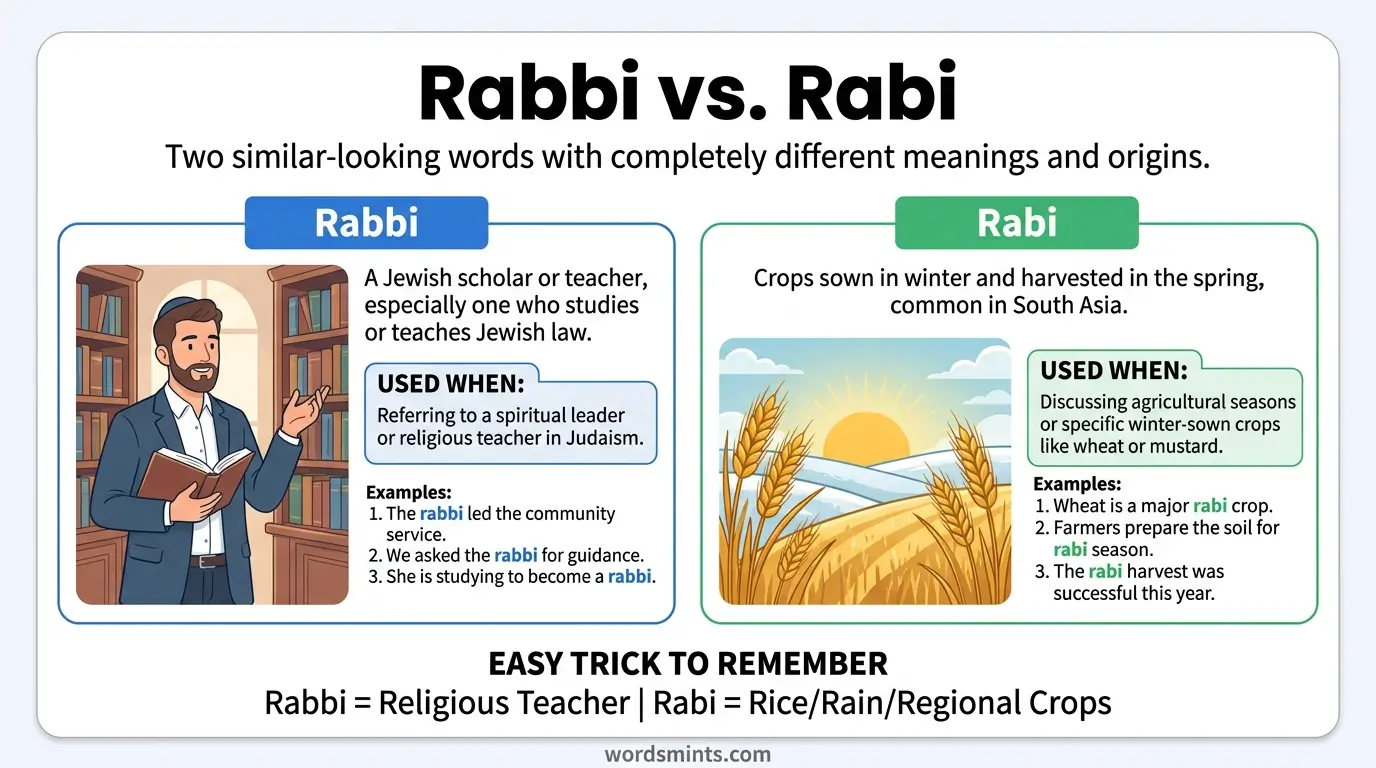
Have you ever written rabi or rabbi and stopped to wonder which spelling is correct? These two words look almost the same, but they can have different meanings.
This is why people often search for “rabi or rabbi” when writing about Jewish religious leaders, names, or other words that sound similar.
The correct spelling depends on what you mean. Rabbi is the standard English spelling for a Jewish religious teacher or leader.
For example, you might write, “The rabbi spoke to the congregation.” Rabi, with one “b,” is not normally the standard spelling for this meaning in English.
However, “Rabi” can appear as a name, transliteration, or part of a word in other languages and contexts.
Knowing the difference helps you avoid spelling mistakes in emails, articles, school work, news writing, and formal documents.
In this guide, we will explain the origin of both spellings, compare British and American English usage, show common mistakes, and give clear examples.
Rabi or Rabbi Quick Answer
Rabbi is the correct and standard English spelling when referring to a Jewish religious teacher or leader.
Rabi is generally not the standard English spelling for this meaning. It may appear as a personal name, a transliteration from another language, or in specific cultural contexts.
Examples
- Correct: The rabbi gave a speech after the service.
- Correct: We spoke with the local rabbi.
- Usually incorrect: The rabi gave a speech after the service.
The plural of rabbi is rabbis.
The Origin of Rabi or Rabbi
The word rabbi comes from Hebrew. It is related to the Hebrew word rav, meaning “great,” “master,” or “teacher.”
The form rabbi developed as a respectful title meaning roughly “my master” or “my teacher.”
The word entered English through Jewish religious and scholarly traditions. Over time, rabbi became the established English spelling.
The spelling rabi can appear because English speakers sometimes leave out one of the repeated consonants when writing the word by sound. In other cases,
Rabi may be a personal name or a transliteration of a word from another language.
The double b in rabbi is therefore important when the word refers to a Jewish religious leader.
British English vs American English Spelling
There is no major British-versus-American spelling difference for rabbi. Both British English and American English normally use rabbi.
Unlike words such as colour/color or centre/center, this word keeps the same spelling in both major varieties of English.
| Meaning or Use | British English | American English |
| Jewish religious leader | rabbi | rabbi |
| More than one rabbi | rabbis | rabbis |
| Possessive form | rabbi’s | rabbi’s |
| Personal name or transliteration | Rabi may occur | Rabi may occur |
| Standard spelling for religious title | rabbi | rabbi |
Examples
British English:
“The rabbi welcomed the visitors.”
American English:
“The rabbi welcomed the visitors.”
Both sentences use the same spelling.
Which Spelling Should You Use?
Your choice depends mainly on the meaning and context.
For US English
Use rabbi when referring to a Jewish religious teacher or leader.
The rabbi answered the community’s questions.
For UK and Commonwealth English
Use rabbi as well. British and Commonwealth English do not normally change this spelling.
The rabbi led the ceremony.
For Global English
If you are writing for an international audience, rabbi is the safest spelling when you mean a Jewish religious leader.
Use Rabi only when it is a person’s name, a specific transliteration, or part of a term where that spelling is established.
Common Mistakes with Rabi or Rabbi
Here are some common mistakes writers make:
| Incorrect or Context-Dependent | Correct Standard Form | Explanation |
| rabi | rabbi | Use rabbi for a Jewish religious leader. |
| rabby | rabbi | The standard spelling ends in -bi. |
| rabbi’s | rabbi’s | Correct possessive form. |
| rabbies | rabbis | The plural is normally rabbis. |
| Rabi | rabbi | Use lowercase unless it begins a sentence or is a proper name. |
Mistake 1: Using “rabi” for a religious leader
Wrong: The rabi spoke to the congregation.
Correct: The rabbi spoke to the congregation.
Mistake 2: Adding an extra ending
Wrong: Several rabbies attended the event.
Correct: Several rabbis attended the event.
Mistake 3: Confusing a name with the title
Rabi may be correct if it is someone’s actual name or a particular transliteration. Always consider the context before changing a person’s spelling.
Rabi or Rabbi in Everyday Examples
In Emails
Dear Rabbi Cohen,
Thank you for speaking with our group.
Here, Rabbi is used as a title before a person’s name.
In News Writing
The rabbi addressed the community during the evening service.
The lowercase form is used when the word is a common noun rather than a title directly before a name.
On Social Media
We enjoyed hearing the rabbi’s message today.
The standard spelling remains rabbi.
In Formal Writing
The rabbi explained the importance of the ceremony to the congregation.
Formal writing should use the established spelling rabbi.
As a Plural
Several rabbis attended the conference.
The plural is rabbis, not rabbies.
Rabi or Rabbi Google Trends & Usage Data
Searches for “rabi or rabbi” usually come from people checking spelling and meaning.
The term rabbi has much wider English-language usage because it is the established spelling for a Jewish religious leader.
Search interest can also vary by country and context. Countries with larger English-speaking Jewish communities may produce more searches and general usage of rabbi.
Educational, religious, historical, and news-related content can also increase searches for the word.
Rabi may appear in searches for personal names, transliterations, or words from other languages.
Because these uses are different, search volume for “rabi” does not always represent people looking for an alternative spelling of rabbi.
For everyday English writing, the practical rule is simple: if you mean a Jewish religious leader, use rabbi.
Rabi vs Rabbi: Side-by-Side Comparison
| Feature | Rabi | Rabbi |
| Standard English spelling for Jewish religious leader | No | Yes |
| Refers to a Jewish religious teacher | Usually no | Yes |
| May be a personal name | Yes | Yes |
| Common in English religious writing | No | Yes |
| Plural | Depends on context | rabbis |
| British English | Not standard for the title | rabbi |
| American English | Not standard for the title | rabbi |
| Best choice for the religious title | No | Yes |
FAQs About Rabi or Rabbi
1. Is it rabi or rabbi?
Rabbi is the standard English spelling when you mean a Jewish religious teacher or leader.
2. Is “rabi” a correct word?
Rabi can be correct in certain contexts, such as a personal name or a transliteration. It is not the standard spelling of the English religious title rabbi.
3. Why does rabbi have two Bs?
The spelling comes from the word’s Hebrew origin and its established development in English. The double b is part of the standard spelling.
4. What is the plural of rabbi?
The usual plural is rabbis.
Example: Several rabbis attended the meeting.
5. Is rabbi spelled differently in British English?
No. Rabbi is normally spelled the same way in British and American English.
6. Can Rabbi be capitalized?
Yes, when it is used as a title directly before a person’s name.
Example: Rabbi Cohen spoke at the event.
When used as a general noun, it is normally lowercase.
Example: The rabbi spoke to the group.
7. Is “Rabi” ever the right spelling?
Yes. Rabi can be correct when it is a person’s name or a specific transliteration. However, it should not replace rabbi when referring to the Jewish religious title.
Conclusion
The difference between rabi or rabbi is simple once you know the context. Rabbi is the standard English spelling for a Jewish religious teacher or leader.
It is used in both American and British English, so there is no US-versus-UK spelling difference to remember.
Rabi may still be correct in specific situations, especially when it is a personal name or a transliteration from another language.
For this reason, context matters before changing the spelling of someone’s name.
For everyday English, formal writing, news articles, emails, and educational content, use rabbi when referring to the religious title.
Its plural form is rabbis, and the title can be capitalized when it comes directly before a person’s name, such as “Rabbi Cohen.”
The easiest rule is this: If you mean a Jewish religious leader, spell it rabbi with two Bs.
This simple rule will help you write the word correctly and avoid one of the most common spelling confusions.

welcome to Words Mints! I’m Halay Sultan, a web developer and AI-Powered SEO content writer.