
Have you ever typed judgmental and wondered if it should be judgemental instead? You are not alone. These two spellings often confuse English learners, bloggers, students, and professionals.
The good news is that both judgmental and judgemental are accepted English spellings. The main difference is regional style.
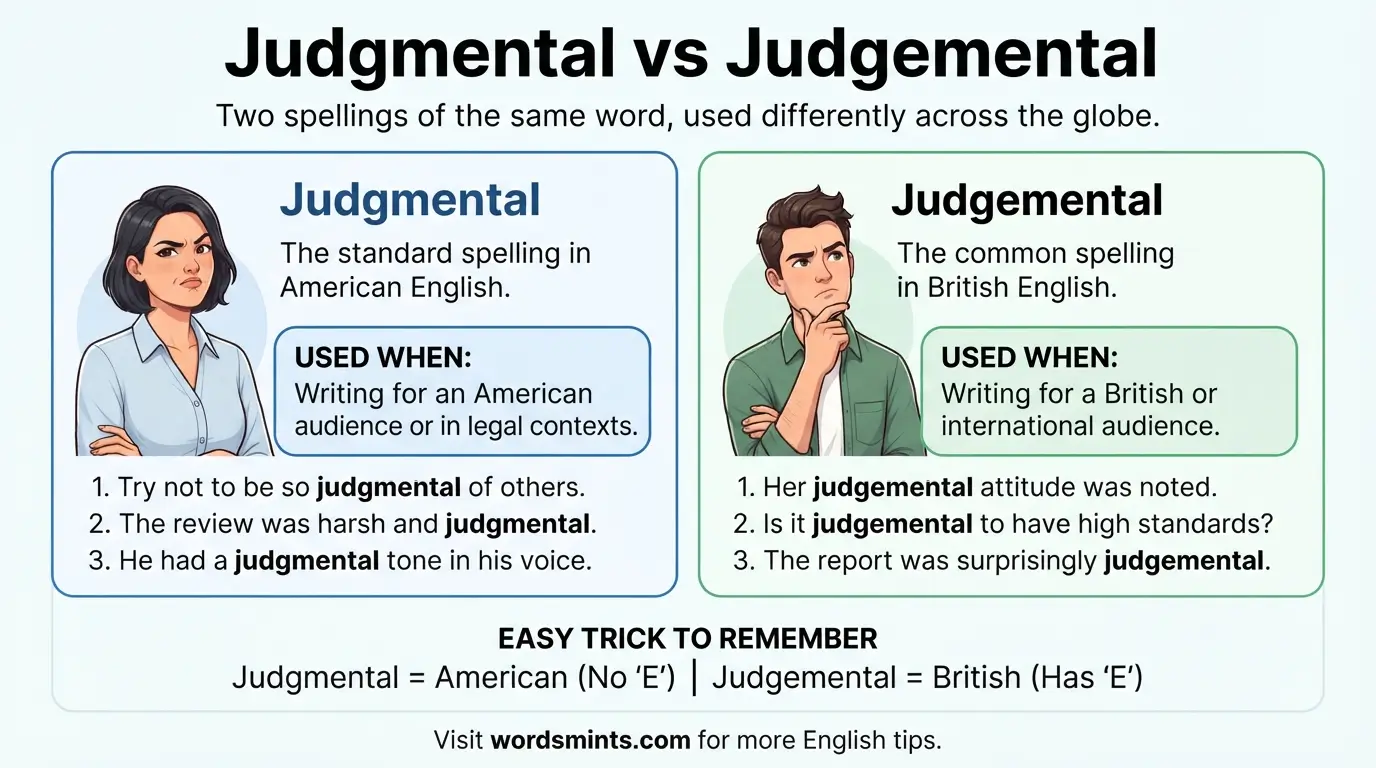
Judgmental is the usual spelling in American English. Judgemental is especially common in British English and other varieties that follow British spelling.
Both words have the same meaning: someone who forms opinions about people too quickly, often in a critical or negative way.
People search for “judgmental or judgemental” because English spelling changes between countries.
The extra e can make the British form look wrong to American readers, while the shorter American form can look unusual to British readers.
This guide explains the difference, origin, regional spelling rules, common mistakes, everyday examples, and which form you should use in professional writing.
Judgmental or Judgemental Quick Answer
Judgmental and judgemental are both correct.
- Judgmental → standard in American English
- Judgemental → especially common in British English
- Meaning → too quick to judge or criticize people
For example:
- US: She is very judgmental about other people’s choices.
- UK: She is very judgemental about other people’s choices.
The pronunciation and meaning are essentially the same. Cambridge lists judgemental as an alternative spelling, while Oxford describes it as especially British and gives judgmental as the North American form.
Easy rule
American English = judgmental
British English = judgemental
However, British English can also use judgmental, so the British form is not the only acceptable choice.
The Origin of Judgmental or Judgemental
The word judgmental comes from the noun judgment, with the suffix -al. Collins dates the adjective to around 1905–1910 and gives its formation as judgment + -al.
The base word has two common spellings:
- judgment — mainly American English
- judgement — common in British English
The adjective follows the spelling of the base word:
- judgment → judgmental
- judgement → judgemental
The word is connected to the idea of making a judgment or forming an opinion. Today, judgmental usually has a negative meaning. It often describes someone who criticizes people too quickly or unfairly. Cambridge defines it as being too quick to criticize people.
The spelling difference is therefore mainly a matter of regional English style, not a difference in meaning.
British English vs American English Spelling
The biggest difference is the extra e.
| Feature | American English | British English |
| Noun | judgment | judgement |
| Adjective | judgmental | judgemental |
| Common form | judgmental | judgemental |
| Meaning | Same | Same |
| Pronunciation | Same | Same |
| Extra “e” | No | Usually yes |
| Example | He is judgmental. | He is judgemental. |
Oxford lists judgemental as especially British and judgmental as especially North American.
American English
American writing normally removes the e:
- judgment
- judgmental
- judgmentally
- nonjudgmental
Example:
The teacher was not judgmental about the student’s mistake.
British English
British writing often keeps the e:
- judgement
- judgemental
- judgementally
- non-judgemental
Example:
The counsellor provided a non-judgemental space.
Both styles are understandable. The key is to match the spelling style of your audience.
Which Spelling Should You Use?
The best spelling depends on who will read your content.
If your audience is American
Use judgmental.
This is the safest choice for:
- US schools
- American businesses
- US newspapers
- American websites
- US academic writing
Example:
Try not to sound judgmental when giving advice.
If your audience is British
Use judgemental if you are following traditional British spelling.
This works well for:
- UK schools
- British publications
- UK businesses
- British-style academic writing
Example:
She did not want to appear judgemental.
If your audience is Commonwealth or international
Either form may be understood, but judgemental may fit contexts that follow British English. In global online writing, judgmental is also widely recognized and is especially common in American-influenced digital content.
For SEO content
If your website targets a specific country, use that country’s spelling.
For example:
- US audience → judgmental
- UK audience → judgemental
- Mixed global audience → choose one style and use it consistently
Do not switch between judgmental and judgemental randomly on the same page.
Common Mistakes with Judgmental or Judgemental
1. Thinking one spelling is completely wrong
Incorrect idea: “Judgemental is always wrong.”
That is not true. Major dictionaries recognize both forms.
Better: Treat them as regional spelling variants.
2. Mixing the two forms
Avoid writing:
She is very judgmental about people, but her judgemental comments are helpful.
The sentence is understandable, but mixing styles can look inconsistent.
Choose one style:
She is very judgmental about people, but her judgmental comments are helpful.
Or:
She is very judgemental about people, but her judgemental comments are helpful.
3. Using “judgmental” and “judgemental” as different words
They do not normally have different meanings.
The difference is mainly spelling, not definition.
4. Confusing “judgmental” with “judicious”
These words are not the same.
- Judgmental = too quick to criticize
- Judicious = showing good sense and careful judgment
Example:
She gave a judicious answer.
This does not mean she was judgmental.
5. Forgetting the base word
Remember:
judgment → judgmental
or
judgement → judgemental
This simple pattern can help you remember the spelling.
Judgmental or Judgemental in Everyday Examples
Both forms work in everyday writing. Only the spelling style changes.
In Emails
American English:
I hope my comments did not sound judgmental.
British English:
I hope my comments did not sound judgemental.
In News Writing
American style:
Critics called the remarks judgmental and unfair.
British style:
Critics called the remarks judgemental and unfair.
On Social Media
You may see either form:
Don’t be so judgmental.
or:
Don’t be so judgemental.
Social media is especially mixed because people from many countries use the same platforms.
In Formal Writing
American:
The report avoids judgmental language.
British:
The report avoids judgemental language.
With “Non-”
The same regional difference appears with the negative form:
- nonjudgmental — American style
- non-judgemental — British style
Oxford lists non-judgemental with the British spelling.
Judgmental or Judgemental Google Trends & Usage Data
Search interest can vary by country, so there is no single worldwide result that makes one spelling “correct.”
Dictionary and language sources consistently show a strong regional pattern:
- United States: judgmental is the standard form
- United Kingdom: judgemental is especially common, although judgmental is also accepted
- Other English-speaking countries: usage can vary depending on whether the writer follows American or British/Commonwealth English
Online usage also creates overlap. Global websites may use American spelling because their content reaches US readers, while local UK websites may retain British spelling.
It is also important not to confuse search popularity with correctness.
A spelling can receive more searches because of population size, search habits, or international website traffic. That does not make the other spelling incorrect.
For SEO, the best approach is to identify your target country first. Then use the spelling that matches your audience.
Judgmental vs Judgemental: Comparison Table
| Variation | Main Region | Meaning | Recommended Use |
| judgmental | US / North America | Too quick to judge or criticize | American English |
| judgemental | UK / British English | Too quick to judge or criticize | British English |
| nonjudgmental | US | Not quick to criticize | American English |
| non-judgemental | UK | Not quick to criticize | British English |
| judgmentally | Mainly US style | In a judgmental way | American English |
| judgementally | British style | In a judgemental way | British English |
FAQs About Judgmental or Judgemental
Is “judgmental” or “judgemental” correct?
Both are correct. “Judgmental” is standard in American English, while “judgemental” is especially common in British English.
Is “judgemental” British English?
Yes. Judgemental is especially associated with British English. Oxford lists it as the British form and gives judgmental as the North American alternative.
Do Americans spell it “judgmental”?
Yes. Judgmental is the normal American spelling.
Do British people use “judgmental”?
Yes. British English can use judgmental too. Collins specifically lists judgemental as an additional British form rather than treating it as the only British spelling.
Does “judgmental” have a different meaning from “judgemental”?
No. The two spellings normally have the same meaning. Both describe someone who tends to make quick or critical judgments.
Which spelling is better for SEO?
Use the spelling that matches your target audience. For a US audience, use judgmental. For a UK audience, judgemental may be more natural.
Is “nonjudgmental” correct?
Yes. Nonjudgmental is the common American form. British English commonly uses non-judgemental. Oxford lists the British form in its entry.
Conclusion
So, judgmental or judgemental, which one should you use? The answer is simple: both are correct, but they reflect different spelling traditions.
Judgmental is the standard American spelling, while judgemental is especially common in British English. Major dictionaries recognize the regional difference.
The meaning does not change. Both words describe someone who is too quick to form opinions or criticize others. The main difference is the extra e.
If you write for an American audience, choose judgmental. If you write for a British audience, judgemental is a natural choice. For international content, either can work, but consistency is important.
Remember the easiest rule: judgment → judgmental in American English, and judgement → judgemental in British English. Once you know your audience, choosing the right spelling becomes easy.

welcome to Words Mints! I’m Halay Sultan, a web developer and AI-Powered SEO content writer.