
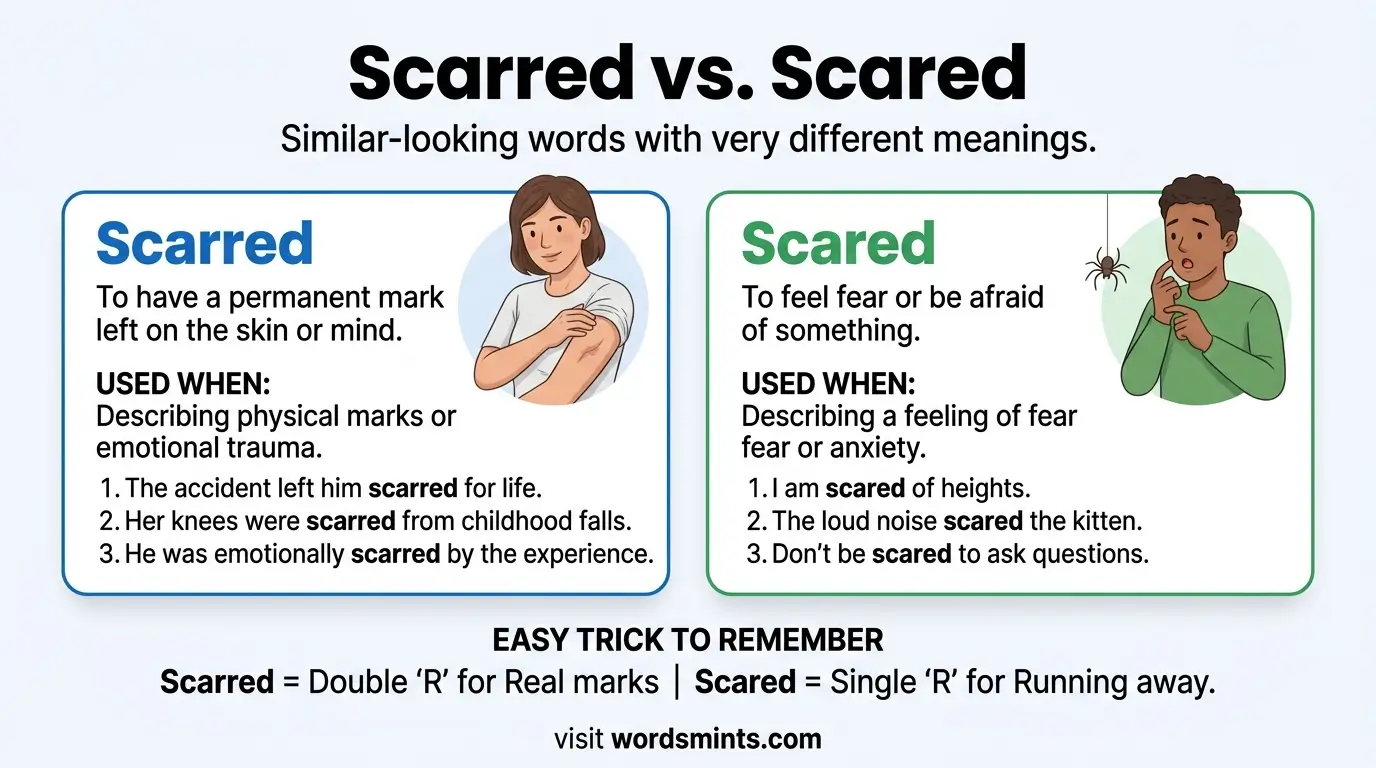
Have you ever wanted to write “I am scared” but typed “I am scarred” instead? These two words look almost the same, but their meanings are very different.
One describes fear. The other describes a lasting mark or deep emotional pain.
This guide explains scarred or scared in simple English. You will learn what each word means, where it comes from, how to use it, and how to avoid common mistakes.
Scarred or Scared Quick Answer
Scared means frightened or afraid. Scarred means marked by a scar or hurt deeply by an experience.
| Word | Meaning | Example |
| Scared | Feeling afraid | I am scared of the dark. |
| Scarred | Having a lasting mark or emotional hurt | The accident left him scarred. |
Scared
Use scared when someone feels fear or worry.
- I was scared during the storm.
- She is scared of dogs.
- He was scared to speak in public.
Scarred
Use scarred when someone or something has a lasting mark or has been deeply affected by harm.
- His face was scarred after the accident.
- The experience left her emotionally scarred.
- The old building was scarred by fire.
Easy memory tip: Scared is about fear. Scarred is about a scar or lasting damage.
The Origin of Scarred or Scared
The words scarred and scared come from different words. Their similar spelling is one reason learners confuse them.
The Origin of Scarred
Scarred comes from the verb scar.
A scar is a mark left on the skin after an injury heals. The word scar has roots in Old Norse skarð, linked to a cut or notch.
Over time, scar also gained a wider meaning. It can describe emotional pain or damage to a place.
Examples:
- The injury scarred his arm.
- The war scarred the town.
- The loss left her emotionally scarred.
The Origin of Scared
Scared comes from the verb scare, which means to frighten someone.
The word scare has roots in Old Norse skirra, meaning to frighten or drive away.
The adjective scared describes a person who feels fear.
Examples:
- The loud noise scared me.
- I felt scared during the exam.
- She was scared of the dark.
Why Are the Spellings Different?
The words have different roots and meanings:
- Scarred comes from scar + -ed.
- Scared comes from scare + -d.
The extra r in scarred is important. It connects the word to scar, not scare.
British English vs American English Spelling
Unlike words such as colour and color, scarred and scared are spelled the same in British and American English.
There is no British spelling scarrred or American spelling scard. Both varieties use the same standard forms.
Spelling Rules
1. Scarred = scar + red?
Not exactly. The correct word is formed by adding -ed to scar:
- scar → scarred
- scar → scarring
The final consonant is doubled.
2. Scared = scare + d
The word scare already ends in silent e. When adding -ed, the final e is removed:
- scare → scared
- scare → scaring
Comparison Table
| Feature | British English | American English |
| Fear | Scared | Scared |
| A lasting mark | Scarred | Scarred |
| Verb | Scare | Scare |
| Noun | Scar | Scar |
| Spelling difference | None | None |
| Example | I was scared. | I was scared. |
Pronunciation
The words sound different:
- Scared: /skɛərd/ or /skerd/ — sounds like “skaird.”
- Scarred: /skɑːd/ in British English and /skɑːrd/ in American English — sounds like “skard.”
The exact sound varies by accent, but the difference in meaning stays the same.
Which Spelling Should You Use?
You should use scared when talking about fear and scarred when talking about scars or lasting damage.
For American English
Use:
- I was scared of the movie.
- The accident left him scarred.
For British English
Use:
- She felt scared during the flight.
- His hand was badly scarred.
For Commonwealth English
Countries such as Pakistan, India, Australia, and Canada may use British English spelling in many formal settings. However, scared and scarred remain the same.
For Global English
Use the spelling that matches your meaning. These words do not change based on country.
Professional advice: Do not choose between scarred and scared based on British or American English. Choose based on what you want to say.
Common Mistakes with Scarred or Scared
Mistake 1: Using Scarred for Fear
Incorrect:
I am scarred of snakes.
Correct:
I am scared of snakes.
Why? Scared means afraid.
Mistake 2: Using Scared for a Physical Mark
Incorrect:
His face was scared after the accident.
Correct:
His face was scarred after the accident.
Why? Scarred describes a lasting mark on the skin.
Mistake 3: Confusing “Scared” with “Scary”
Incorrect:
The horror movie was scared.
Correct:
The horror movie was scary.
Why?
- Scared = feeling fear.
- Scary = causing fear.
Examples:
- I was scared.
- The movie was scary.
Mistake 4: Confusing “Scarred” with “Scarring”
Incorrect:
The wound is scarring me.
Correct:
The wound is leaving a scar.
Or:
The injury is scarring my skin.
Scarring is the process of forming scars. Scarred describes the result or condition.
Mistake 5: Adding Extra Letters
Incorrect:
I was scarrred.
Correct:
I was scarred.
Incorrect:
I was scard.
Correct:
I was scared.
Remember the spelling:
Scarred = S C A R R E D
Scared = S C A R E D
Scarred or Scared in Everyday Examples
Understanding real-life usage makes these words easier to remember.
In Emails
Scared:
I was scared that I might miss the interview.
Scarred:
The accident left me emotionally scarred, but I am working to recover.
In News
Scared:
Residents were scared when the storm hit the city.
Scarred:
The earthquake left several buildings scarred.
On Social Media
Scared:
I was so scared when I heard that noise!
Scarred:
That experience left me scarred for life.
In Formal Writing
Scared:
The child felt scared during the medical examination.
Scarred:
The injury left the patient with a permanently scarred arm.
In Daily Conversation
| Situation | Correct word | Example |
| Fear of heights | Scared | I am scared of heights. |
| A cut on the skin | Scarred | His knee is scarred. |
| Fear of an exam | Scared | She is scared about the test. |
| Emotional pain | Scarred | The experience left him scarred. |
| A frightening movie | Scared | I was scared by the movie. |
Scarred or Scared Google Trends & Usage Data
Many people search for “scarred or scared” because the words look similar and are easy to mix up. The main question is usually which spelling fits the sentence.
What Google Trends Shows
Google Trends compares search interest over time and across regions. It uses a relative scale from 0 to 100, not exact search counts.
For this keyword, search interest may vary by:
- Country
- Language
- Time period
- Search context
- Spelling questions
However, a reliable current country-by-country ranking or exact search volume for “scarred or scared” is not available in the information reviewed for this article.
Why People Search This Keyword
Common search intentions include:
- Checking whether scared or scarred is correct.
- Learning the difference in meaning.
- Finding the correct spelling for an email or school assignment.
- Understanding pronunciation.
- Learning whether British and American English use different spellings.
Usage by Context
Scared is common when discussing fear, worry, danger, and frightening events.
Scarred is common when discussing injuries, emotional pain, war, accidents, and lasting damage.
For exact search interest, use the official Google Trends tool and compare the terms “scarred” and “scared” for your chosen country and date range.
Scarred vs Scared: Comparison Table
| Feature | Scarred | Scared |
| Word type | Adjective / past participle | Adjective / past participle |
| Root word | Scar | Scare |
| Main meaning | Marked or deeply hurt | Afraid or frightened |
| Physical use | A scarred face | Not usually used for scars |
| Emotional use | Emotionally scarred | Feeling scared |
| British spelling | Scarred | Scared |
| American spelling | Scarred | Scared |
| Example | He was scarred by the event. | He was scared by the event. |
FAQs About Scarred or Scared
1. Is it scared or scarred?
Both are correct words. Use scared for fear and scarred for a scar or lasting damage.
- I am scared of spiders.
- His face was scarred.
2. What is the difference between scared and scarred?
Scared means frightened. Scarred means marked by a scar or deeply affected by harm.
3. Is “I am scarred” correct?
Yes. It is correct when you mean that you have a scar or have been deeply affected by something.
Example:
I am scarred by the accident.
4. Is “I am scared” correct?
Yes. It means you feel afraid.
Example:
I am scared of the dark.
5. Are scarred and scared pronounced the same?
No. They have different vowel sounds. Scared sounds like “skaird,” while scarred sounds like “skard.”
6. Do British and American English spell these words differently?
No. Both use scared and scarred. There is no standard US or UK spelling difference.
7. What is an easy way to remember the difference?
Think of the extra r in scarred as part of scar.
- Scar → scarred
- Scare → scared
Conclusion
The difference between scarred or scared is simple once you understand their meanings. Scared describes fear, while scarred describes a lasting mark or deep emotional hurt.
Use scared when someone feels frightened. For example, “I was scared during the storm.” Use scarred when talking about a physical scar or the lasting effect of a painful experience.
For example, “The accident left him scarred.”
Both words have the same spelling in British and American English. The key difference is not regional spelling but meaning, pronunciation, and the root word.
Remember that scared comes from scare, while scarred comes from scar. This small spelling clue can help you choose the right word every time.
Whether you are writing an email, school assignment, social media post, or formal article, using the correct word makes your writing clear and professional.
When in doubt, ask yourself: Am I talking about fear, or am I talking about a scar? The answer will guide you to the right spelling.

welcome to Words Mints! I’m Halay Sultan, a web developer and AI-Powered SEO content writer.