
Is it counselor or counsellor? If you have ever stopped while writing this word, you are not alone. Many students, English learners, and professional writers wonder which spelling is correct.
The difference is only one letter, but it can cause confusion when you are writing an email, preparing an assignment, or creating formal content.
The good news is that both counselor and counsellor are correct. They are two regional spellings of the same word.
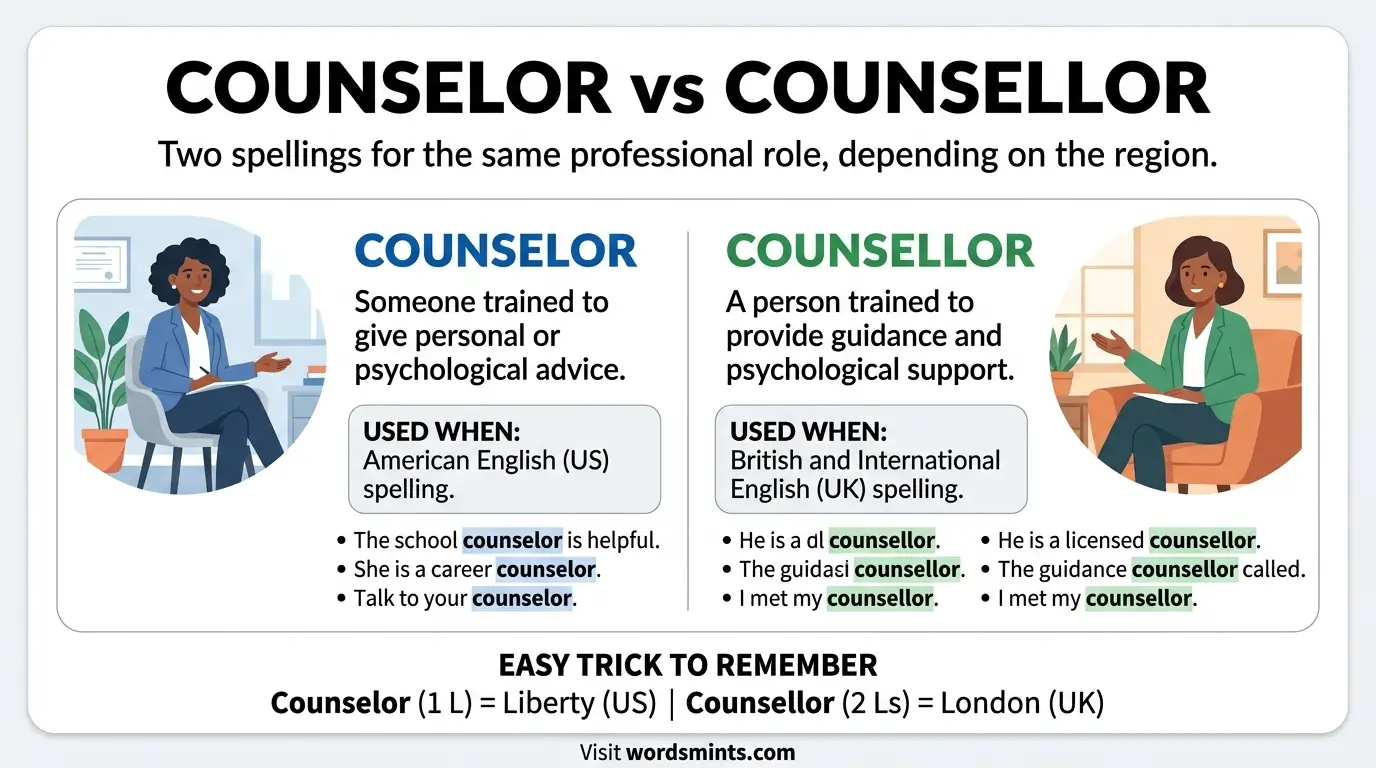
American English generally uses counselor, while British English generally uses counsellor. Both words refer to someone who gives advice, guidance, or support.
Understanding this difference helps you choose the right spelling for your audience. It also prevents confusion with similar words, such as councilor, which has a different meaning.
In this guide, we will explore the origin of counselor and counsellor, compare American and British English spelling, and explain which form to use in different situations.
You will also learn common mistakes, everyday examples, and answers to frequently asked questions.
By the end, you will know exactly when to use counselor and when to use counsellor.
Counselor or Counsellor Quick Answer
Counselor and counsellor are both correct spellings of the same noun.
The difference is based on regional English:
- Counselor: American English spelling
- Counsellor: British English spelling
Both words describe a person who gives advice, guidance, or support.
Examples
American English:
My school counselor helped me choose my subjects.
British English:
My school counsellor helped me choose my subjects.
Both sentences are correct. The spelling changes, but the meaning stays the same.
Counselor vs Counsellor
| Feature | Counselor | Counsellor |
| English variety | American English | British English |
| Spelling | One “l” | Two “l” letters |
| Meaning | A person who gives advice | A person who gives advice |
| School example | School counselor | School counsellor |
| Career example | Career counselor | Career counsellor |
| Correct spelling | Yes | Yes |
Easy rule: Use counselor in American English and counsellor in British English.
The Origin of Counselor or Counsellor
The word counselor comes from the word counsel, which means advice, guidance, or consultation.
The word counsel entered English through Old French and can be traced to the Latin word consilium, meaning advice or deliberation.
Over time, English speakers began using counselor for a person who gives counsel.
Why are there two spellings?
The difference developed through the spelling traditions of American and British English.
British English often keeps traditional spellings with double consonants. American English simplified some spellings over time.
For example:
| British English | American English |
| Counsellor | Counselor |
| Counselling | Counseling |
| Traveller | Traveler |
| Travelling | Traveling |
These differences developed as English spelling changed. Neither form is wrong.
What does counselor mean?
A counselor is a person who provides advice, guidance, or support.
The word can describe several types of professionals.
School counselor: Helps students with education, personal concerns, and career choices.
Career counselor: Helps people choose careers and plan their professional future.
Mental health counselor: Provides counseling and emotional support.
Camp counselor: Supervises and guides children at a camp.
The exact meaning depends on the context.
British English vs American English Spelling
The main difference between counselor and counsellor is the extra l.
American English spells the word:
Counselor
British English spells the word:
Counsellor
Both forms are standard in their respective varieties of English.
Related Spelling Differences
| American English | British English |
| Counselor | Counsellor |
| Counselors | Counsellors |
| Counseling | Counselling |
| Counseled | Counselled |
| School counselor | School counsellor |
| Career counselor | Career counsellor |
Why does American English use one “l”?
American English simplified some traditional spellings over time. British English often retained older double-l forms.
For example:
- Traveler → Traveller
- Traveling → Travelling
- Canceled → Cancelled
- Counselor → Counsellor
However, English spelling does not follow one rule for every word. Some words have different patterns.
The safest approach is to learn the standard spelling used by your audience.
Example Sentences
American English:
The counselor gave me helpful advice about college.
British English:
The counsellor gave me helpful advice about university.
Both sentences are grammatically correct.
Which Spelling Should You Use?
The best spelling depends on your audience, school, workplace, or country.
1. American English: Counselor
Use counselor when writing for readers in the United States.
Common examples include:
- School counselor
- College counselor
- Career counselor
- Mental health counselor
- Camp counselor
Example:
The school counselor met with the students.
This is the usual spelling in American English.
2. British English: Counsellor
Use counsellor when writing for readers in the United Kingdom.
Common examples include:
- School counsellor
- Career counsellor
- Student counsellor
- Mental health counsellor
Example:
The school counsellor met with the students.
This is the usual spelling in British English.
3. Commonwealth English
Many Commonwealth countries use British spelling, including counsellor.
However, spelling preferences can vary between countries, schools, and organizations. Some institutions use American English.
When writing for a specific institution, follow its preferred spelling.
4. International English
Both spellings are widely understood.
If your readers come from different countries, you can introduce both forms:
A counselor, also spelled counsellor, is a person who provides guidance.
After explaining the difference, choose one spelling and use it consistently.
A Simple Rule to Remember
| Audience | Preferred spelling |
| United States | Counselor |
| United Kingdom | Counsellor |
| Commonwealth countries | Often counsellor |
| International readers | Either spelling |
Common Mistakes with Counselor or Counsellor
These words are easy to misspell because they contain several similar letters.
Mistake 1: Writing Councellor
Incorrect: Councellor
Correct: Counsellor
The correct British spelling has two “l” letters but only one “c” after “coun.”
Mistake 2: Writing Councelor
Incorrect: Councelor
Correct: Counselor
The correct spelling uses sel, not cel.
Mistake 3: Writing Counsillor
Incorrect: Counsillor
Correct: Counselor or Counsellor
The word contains “sel,” not “sil.”
Mistake 4: Mixing American and British Spellings
Example:
The school counsellor provides counseling services.
This sentence mixes the common British noun spelling with the common American verb spelling.
American English:
The school counselor provides counseling services.
British English:
The school counsellor provides counselling services.
Both versions are correct when used consistently.
Mistake 5: Confusing Counselor with Councilor
These words have different meanings.
Counselor: A person who gives advice or guidance.
Councilor: A member of a council.
Examples:
The counselor helped me choose a career.
The councilor attended the city meeting.
Mistake 6: Using the Wrong Verb Spelling
American English:
Counseling
British English:
Counselling
Both forms are correct in their respective English varieties.
Counselor or Counsellor in Everyday Examples
The word appears in schools, workplaces, emails, news articles, and casual conversations.
1. In Emails
American English:
Dear Mr. Ahmed,
I would like to arrange a meeting with my school counselor.
Please let me know your available times.
Best regards,
Ali
British English:
Dear Mr Ahmed,
I would like to arrange a meeting with my school counsellor.
Please let me know your available times.
Best wishes,
Ali
Both examples are correct.
2. In News Articles
American English:
The school counselor spoke to students about career planning.
British English:
The school counsellor spoke to students about career planning.
The preferred spelling depends on the publication’s English style.
3. In Social Media Posts
My counselor gave me great advice today!
My counsellor helped me prepare for university.
Both spellings are acceptable in casual writing.
4. In Formal Writing
American English:
The counselor provides guidance to students.
British English:
The counsellor provides guidance to students.
Both sentences are grammatically correct.
5. In School Assignments
American English:
I spoke with my school counselor.
British English:
I spoke with my school counsellor.
Use the spelling preferred by your teacher or school.
6. In Job Applications
American English:
I am applying for the position of school counselor.
British English:
I am applying for the position of school counsellor.
Both forms are correct.
Counselor or Counsellor Google Trends & Usage Data
The keyword “counselor or counsellor” is a common spelling question. People search for it when they want to know which form is correct.
Why do people search for this keyword?
Common reasons include:
- Checking school assignments
- Writing professional emails
- Preparing job applications
- Comparing American and British English
- Learning English spelling
- Choosing the right word for formal writing
Which spelling is more popular?
The answer depends on the country and context.
Counselor is generally more common in American English, especially in the United States.
Counsellor is generally more common in British English, especially in the United Kingdom.
The spelling used in a particular industry can also vary.
For example:
- American education websites often use school counselor.
- British education websites often use school counsellor.
- Career websites may use either form, depending on their audience.
What does Google Trends measure?
Google Trends shows relative search interest over time. It can help compare search terms in different countries.
However, search interest is not the same as total word usage.
A word may receive fewer searches and still be common in everyday writing.
How can you compare the spellings?
You can compare these terms in Google Trends:
- Counselor
- Counsellor
- Counselor or counsellor
You can also compare countries such as:
- United States
- United Kingdom
- Canada
- Australia
- Pakistan
Exact search volumes and percentages change over time. Current figures should be checked directly before making specific claims about popularity.
What is the main takeaway?
American English generally favors counselor, while British English generally favors counsellor. Both spellings are correct.
Counselor vs Counsellor Comparison Table
| Feature | Counselor | Counsellor |
| Main English variety | American English | British English |
| Spelling | One “l” | Two “l” letters |
| Meaning | Person who gives advice | Person who gives advice |
| Plural | Counselors | Counsellors |
| Verb form | Counseling | Counselling |
| Past tense | Counseled | Counselled |
| School example | School counselor | School counsellor |
| Career example | Career counselor | Career counsellor |
| Correct spelling? | Yes | Yes |
Easy Memory Trick
US = One L
UK = Two Ls
- Counselor = American English
- Counsellor = British English
This simple trick makes the difference easy to remember.
Frequently Asked Questions About Counselor or Counsellor
Is counselor or counsellor correct?
Both spellings are correct. Counselor is the usual American spelling, while counsellor is the usual British spelling.
Is counselor American or British?
Counselor is primarily the American English spelling. British English generally uses counsellor.
Is counsellor a correct English word?
Yes. Counsellor is the standard British English spelling of the word.
What is the difference between counselor and counsellor?
The difference is spelling, not meaning. Both words refer to a person who gives advice, guidance, or support.
Should I use counselor or counsellor in an essay?
Follow the English variety required by your school or teacher. Use counselor for American English and counsellor for British English.
Is counseling or counselling correct?
Both are correct. Counseling is the American spelling, and counselling is the British spelling.
Is councilor the same as counselor?
No. A counselor gives advice or guidance. A councilor is a member of a council.
Is counselor a noun or a verb?
Counselor is a noun. It names a person who gives advice.
The verb is counsel.
Example:
The counselor counseled the student.
Can I use both spellings in one article?
Yes. You can explain the difference between them. However, use one spelling consistently in the main text.
Which spelling is used in Pakistan?
Both forms may be understood. British English spelling is common in many Pakistani educational settings, but usage can vary by institution.
Conclusion:
The difference between counselor and counsellor is simple once you understand the spelling rule.
Both words are correct, and both have the same meaning. They describe a person who gives advice, guidance, or support.
American English generally uses counselor, while British English generally uses counsellor. The same pattern appears in related words, such as counseling and counselling.
Choosing the right spelling depends on your audience. Use counselor for American readers and counsellor for British readers.
In Commonwealth countries, spelling preferences may vary, so follow the conventions used by your school, workplace, or institution.
It is also important to avoid common mistakes. Words such as councellor, councelor, and counsillor are incorrect. Remember that counselor and councilor have different meanings.
The easiest rule to remember is one “l” for American English and two “l” letters for British English.
Once you learn this difference, you can use either spelling with confidence. Neither is wrong. The correct choice depends on the English variety you follow.

welcome to Words Mints! I’m Halay Sultan, a web developer and AI-Powered SEO content writer.