
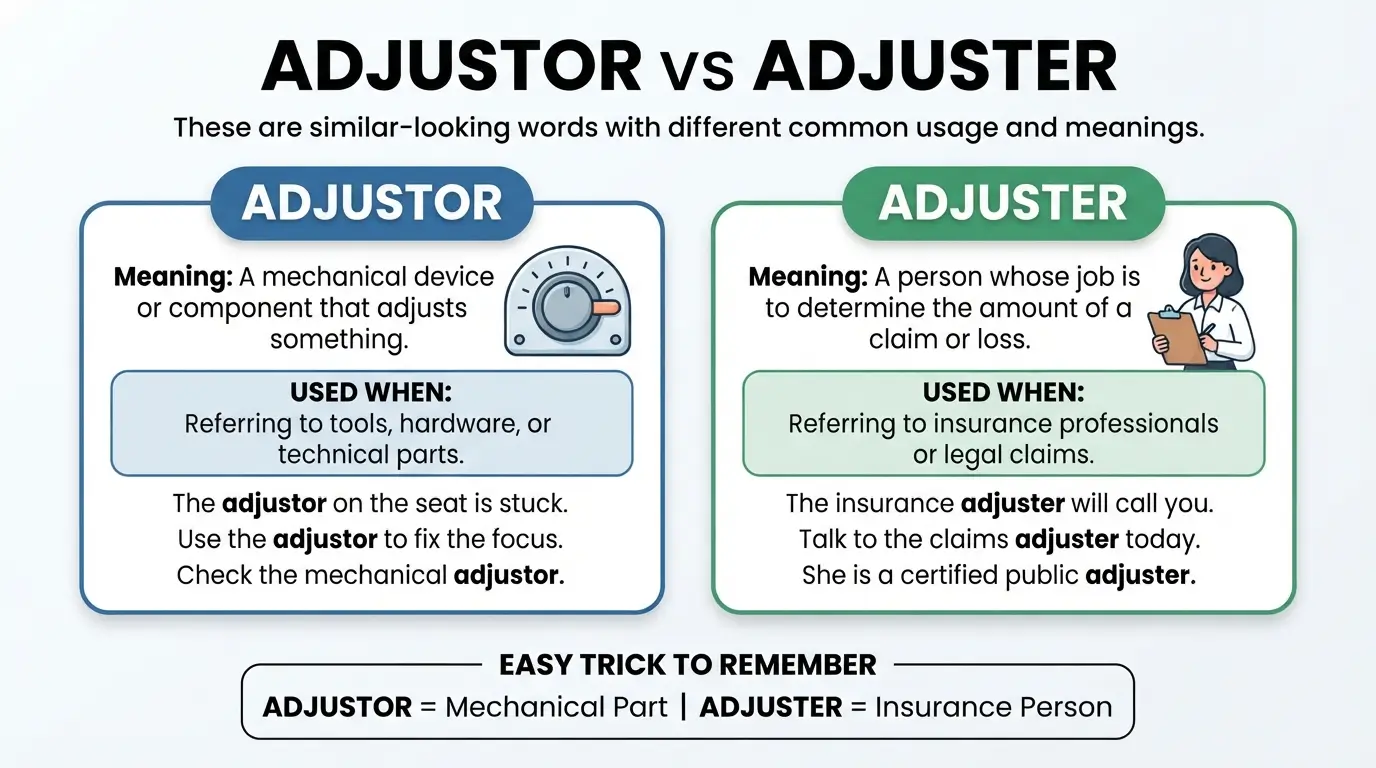
If you have ever written the word adjustor or adjuster and stopped to wonder which one is correct, you are not alone.
Both spellings appear in English, especially when talking about insurance, claims, and people who make changes or assessments.
This makes the choice confusing for writers, students, job seekers, and professionals.
The good news is simple: adjuster is the standard and far more common spelling, especially in American English.
Adjustor is also a valid word, but it is much less common and is often seen in specific professional or technical contexts.
People often search for “adjustor or adjuster” because both forms look natural. The difference is not mainly about grammar. It is about usage, history, and regional preference.
Knowing which form is standard can help you write clearer emails, resumes, articles, reports, and business documents.
In this guide, we will explain the difference between adjustor and adjuster, where the words came from, how British and American English use them, common mistakes, real-life examples, and which spelling you should choose.
Adjustor or Adjuster Quick Answer
Adjuster is the preferred spelling in most modern English, especially in American English.
Adjustor is also a recognized spelling, but it is much less common.
Both words refer to a person or thing that adjusts something. In insurance, an adjuster is a person who investigates and evaluates insurance claims.
Examples
- The insurance adjuster inspected the damage.
- She works as a claims adjuster.
- The company sent an adjuster to review the accident.
- The insurance adjustor reviewed the claim. (Less common)
| Spelling | Correct? | Commonness | Typical use |
| Adjuster | Yes | Very common | General and professional English |
| Adjustor | Yes | Less common | Technical or specialized usage |
Quick rule: When in doubt, use adjuster.
The Origin of Adjustor or Adjuster
Both adjuster and adjustor come from the verb adjust.
The verb adjust entered English through French and ultimately traces back to Latin roots related to making something right or bringing it into proper order.
English commonly creates nouns for people who perform an action by adding a suffix such as -er.
For example:
- teach → teacher
- write → writer
- manage → manager
- adjust → adjuster
The -or ending is also used in English to form nouns, often influenced by Latin or French forms:
- act → actor
- inspect → inspector
- supervise → supervisor
- adjust → adjustor
This explains why both adjuster and adjustor can appear in English.
However, spelling patterns do not always mean that two forms become equally popular. Over time, adjuster became the dominant form in general usage.
The word adjuster is especially established in the insurance industry, where an adjuster investigates claims and helps determine the amount of a loss.
British English vs American English Spelling
Unlike some spelling differences between British and American English, such as colour and color, adjustor vs adjuster is not a strict British-versus-American spelling rule.
Both forms can be found in different varieties of English.
However, adjuster is much more widely used in American English, especially in insurance.
British English also commonly uses adjuster, although related professional terms can vary by country and industry.
Comparison
| Feature | American English | British English |
| Preferred general form | Adjuster | Adjuster |
| Alternative form | Adjustor | Adjustor |
| Insurance usage | Adjuster | Adjuster |
| Frequency of “adjuster” | Very high | High |
| Is “adjustor” wrong? | No | No |
Examples
American English:
The insurance adjuster called me yesterday.
British English:
The insurance adjuster contacted the customer.
The important point is that adjuster is safe for both American and British audiences.
Which Spelling Should You Use?
Your choice should depend on your audience and the type of writing.
For US audiences
Use adjuster.
This is especially important for:
- Insurance documents
- Job descriptions
- Resumes
- Business emails
- Legal documents
- News articles
- Websites
For example:
We are looking for an experienced insurance adjuster.
For UK and Commonwealth audiences
Adjuster is still a good choice.
Do not assume that British English requires adjustor. It does not.
For global audiences
Use adjuster because it is more familiar and widely recognized.
For SEO writing
If your target keyword is “adjustor or adjuster,” you can discuss both forms. But use adjuster naturally throughout the article when referring to the standard modern term.
Do not fill your article with repeated variations just to target keywords. Natural language is clearer for readers.
Common Mistakes with Adjustor or Adjuster
People make several common mistakes when using these words.
Mistake 1: Thinking “adjustor” is always wrong
Incorrect assumption:
Adjustor is not a real English word.
Correction:
Adjustor is a valid but less common word.
Mistake 2: Using “adjustor” when “adjuster” is expected
For professional insurance writing, adjuster is usually the better choice.
Less common:
The adjustor examined the insurance claim.
Preferred:
The adjuster examined the insurance claim.
Mistake 3: Treating them as completely different words
In most contexts, adjuster and adjustor have essentially the same basic meaning.
The main difference is frequency and preference, not meaning.
Mistake 4: Assuming every “-or” word is more formal
The ending does not automatically make a word more professional.
Adjuster is the standard professional term in many industries.
Mistake 5: Changing the spelling in the same document
Avoid switching between the two forms without a reason.
For example, do not write:
The adjuster reviewed the claim. Later, the adjustor contacted the customer.
Choose one form and stay consistent.
Adjustor or Adjuster in Everyday Examples
Here are examples showing how the word appears in different types of writing.
In an Email
Dear Mr. Khan,
The insurance adjuster will contact you to discuss your claim.
In a News Article
An insurance adjuster visited the property after the storm.
On Social Media
The insurance adjuster finally approved my claim.
In Formal Writing
The claims adjuster reviewed the evidence before making a recommendation.
In a Resume
Worked with insurance adjusters to process and evaluate customer claims.
In a Job Description
We are seeking a qualified insurance adjuster with strong communication skills.
Using the Less Common Form
The adjustor reviewed the technical changes.
This sentence is understandable, but adjuster would usually sound more natural to modern readers.
Adjustor or Adjuster Google Trends & Usage Data
Search interest for spelling questions often reflects a simple problem: people encounter both forms and want to know which one is standard.
In general usage, adjuster has a much stronger presence than adjustor, particularly in American English and insurance-related searches.
The difference is especially clear in contexts such as:
- Insurance claims
- Auto insurance
- Property damage
- Claims processing
- Insurance careers
- Professional documents
The term claims adjuster is a well-established professional phrase. This makes adjuster much more common in searches and written content related to insurance.
Usage can vary by country and industry. Adjustor may appear in technical, legal, historical, or specialized material, but it is not normally the first choice for everyday writing.
Because search popularity changes over time, Google Trends results should be viewed as a measure of relative search interest, not as proof that one spelling is grammatically correct.
For practical writing, the safest conclusion is clear: adjuster is the more common and broadly accepted form.
Adjustor vs Adjuster: Comparison Table
| Variation | Meaning | Correct? | Popularity | Best choice |
| Adjuster | A person or thing that adjusts | Yes | Very high | Yes |
| Adjustor | A person or thing that adjusts | Yes | Low | Usually no |
| Claims adjuster | Person who handles insurance claims | Yes | Very high | Yes |
| Insurance adjuster | Person who evaluates insurance claims | Yes | Very high | Yes |
| Insurance adjustor | Alternative form | Yes | Low | Usually avoid |
FAQs About Adjustor or Adjuster
Is “adjuster” or “adjustor” correct?
Both are valid words, but adjuster is much more common. It is the preferred choice in most modern writing.
Is “adjustor” a real word?
Yes. Adjustor is a recognized English word, although it is much less common than adjuster.
Which is correct for insurance: adjuster or adjustor?
Use adjuster. Terms such as insurance adjuster and claims adjuster are widely established.
Is “adjuster” American or British English?
Adjuster is used in both American and British English. It is not limited to one variety.
Is “adjustor” wrong in English?
No. It is not wrong, but it is uncommon. In most situations, adjuster will sound more natural.
Why does “adjustor” exist?
English uses both -er and -or suffixes to create nouns. Adjustor developed as an alternative form, while adjuster became much more common.
Should I use “adjuster” in formal writing?
Yes. Adjuster is the safest choice for formal, professional, academic, and business writing, especially when discussing insurance.
Conclusion
When deciding between adjustor or adjuster, the simplest answer is to choose adjuster in most situations. Both forms are valid, but they are not equally common.
Adjuster is the standard and widely preferred form in modern English, especially in insurance and business contexts.
Adjustor is also an accepted word, but it appears far less often.
Its existence comes from English’s use of different noun-forming suffixes, including -er and -or. It does not mean that adjustor is more formal or that adjuster is incorrect.
For American readers, British readers, and global audiences, adjuster is the clearest and safest choice. Use phrases such as insurance adjuster and claims adjuster when discussing insurance professionals.
If you are writing an email, resume, article, report, or professional document, consistency also matters.
Pick adjuster and use it throughout your writing unless a specific source or organization uses adjustor.

welcome to Words Mints! I’m Halay Sultan, a web developer and AI-Powered SEO content writer.