
Have you ever stopped while writing and wondered whether to say “unsatisfied” or “dissatisfied”?
You are not alone. These two words look almost the same, and both can mean that someone is not satisfied. However, they can sound different depending on the situation.
The good news is that both unsatisfied and dissatisfied are correct English words. They are not different British and American spellings. Instead, they often differ in meaning, tone, and typical usage.
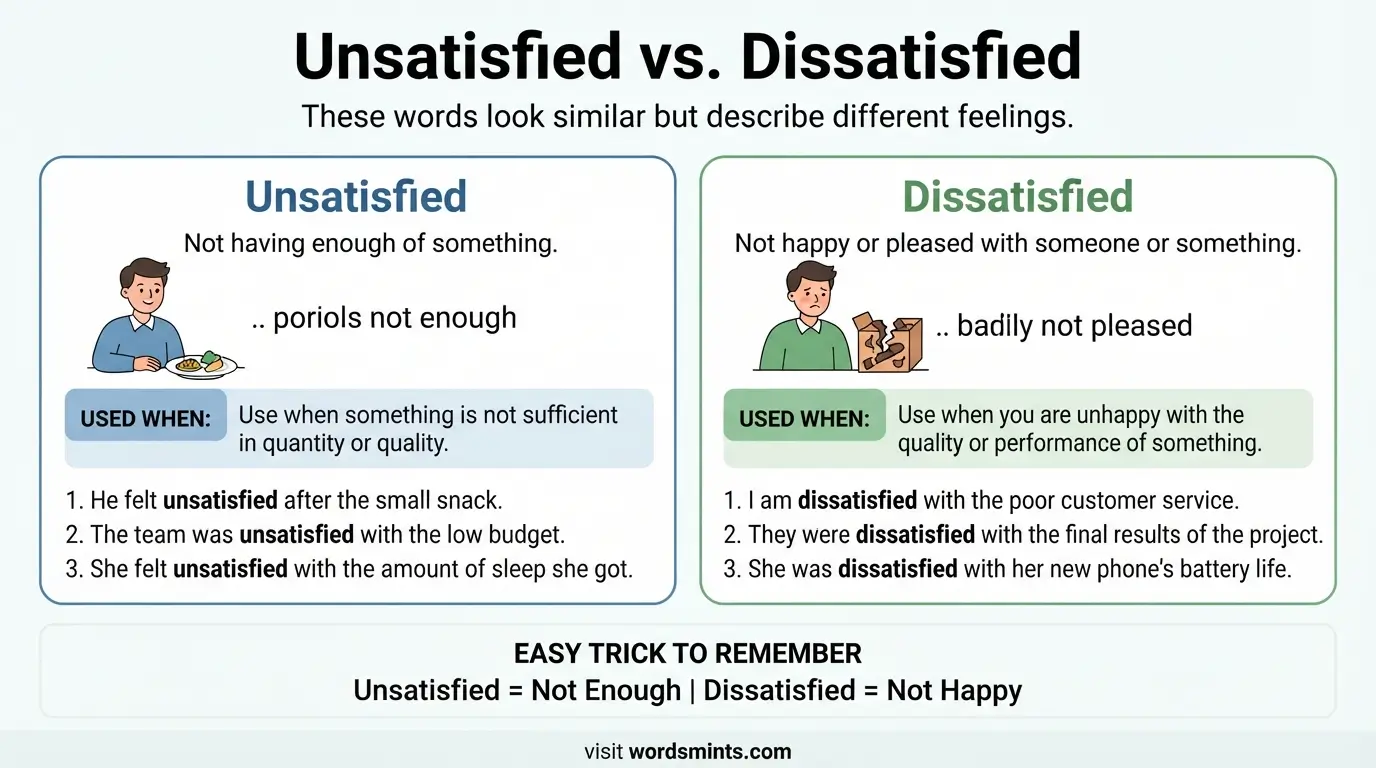
In simple terms, dissatisfied is usually used when someone is unhappy, disappointed, or displeased with something.
Unsatisfied often describes something that has not been fulfilled, completed, or met. For example, you can be dissatisfied with a service, while a need can remain unsatisfied.
Understanding this small difference can make your emails, essays, reviews, reports, and everyday English much clearer. In this guide,
we will explain unsatisfied or dissatisfied, their origins, common mistakes, regional usage, examples, and which word you should choose.
Unsatisfied or Dissatisfied Quick Answer
Both unsatisfied and dissatisfied are correct.
The main difference is usually context.
- Dissatisfied = unhappy, disappointed, or displeased.
- Unsatisfied = not fulfilled, not met, or still lacking.
Examples
Dissatisfied:
The customer was dissatisfied with the poor service.
This means the customer was unhappy or displeased.
Unsatisfied:
Her curiosity remained unsatisfied.
This means her curiosity was not fulfilled.
Another example:
I am dissatisfied with my hotel room.
Here, the speaker is unhappy with the hotel room.
The demand for affordable housing remains unsatisfied.
Here, the demand has not been met.
There is some overlap between the two words. Dictionaries can define unsatisfied as a synonym of dissatisfied, especially when referring to people.
Therefore, the difference is not an absolute grammar rule. Context matters.
For most complaints, reviews, customer feedback, and personal disappointment, dissatisfied is the safer choice.
For unmet needs, demands, desires, expectations, or goals, unsatisfied can be more precise.
The Origin of Unsatisfied or Dissatisfied
The difference becomes easier to understand when we look at how the two words are formed.
The Origin of “Unsatisfied”
Unsatisfied is formed from:
un- + satisfied
The prefix un- commonly means “not” or indicates the absence of a quality.
For example:
- happy → unhappy
- clear → unclear
- finished → unfinished
- satisfied → unsatisfied
So, unsatisfied literally means “not satisfied.”
It can describe a person, feeling, need, desire, demand, or condition that has not reached satisfaction.
For example:
His hunger was still unsatisfied.
The customer’s needs remained unsatisfied.
She felt unsatisfied with the result.
The Origin of “Dissatisfied”
Dissatisfied is formed from:
dis- + satisfied
The prefix dis- can express opposition, separation, reversal, or a negative condition.
Similar formations include:
- agree → disagree
- approve → disapprove
- connect → disconnect
- satisfy → dissatisfy
Therefore, dissatisfied developed as a word for a lack of satisfaction, especially a feeling of displeasure or discontent.
Today, dictionaries recognize dissatisfied as meaning unhappy or displeased with someone or something.
Why Are They So Easy to Confuse?
Both words contain satisfied, and both can mean “not satisfied.”
That is why English learners often use them interchangeably.
However, common usage has created a useful distinction:
Dissatisfied → displeased
Unsatisfied → unfulfilled
This is a helpful memory trick, but it is not a strict rule. In real English, the meanings can overlap.
British English vs American English Spelling
Unlike words such as colour/color or centre/center, unsatisfied and dissatisfied do not have separate British and American spellings.
The spelling is the same in both varieties:
- British English: unsatisfied
- American English: unsatisfied
- British English: dissatisfied
- American English: dissatisfied
The main difference is not spelling. It is context and preferred usage.
| Word | British English | American English | Main Meaning |
| Unsatisfied | Unsatisfied | Unsatisfied | Not fulfilled or not satisfied |
| Dissatisfied | Dissatisfied | Dissatisfied | Unhappy or displeased |
| Satisfaction | Satisfaction | Satisfaction | A feeling of being satisfied |
| Dissatisfaction | Dissatisfaction | Dissatisfaction | Lack of satisfaction |
| Satisfied | Satisfied | Satisfied | Content or pleased |
Examples in Both Varieties
British English:
The customer was dissatisfied with the service.
American English:
The customer was dissatisfied with the service.
British English:
Several needs remain unsatisfied.
American English:
Several needs remain unsatisfied.
There is no spelling change based on the country.
So, if you are wondering whether unsatisfied is British and dissatisfied is American, the answer is no.
Which Spelling Should You Use?
The best word depends more on your meaning than your location.
For Complaints and Reviews
Use dissatisfied.
I am dissatisfied with the service.
Several customers were dissatisfied with the product.
This is especially natural in business communication.
For Unmet Needs or Demands
Use unsatisfied.
The patient’s needs remain unsatisfied.
There is an unsatisfied demand for affordable housing.
Here, the focus is on something that has not been fulfilled.
For Formal Writing
Both words can be used in formal writing.
Choose dissatisfied when discussing:
- customer complaints
- disappointment
- poor service
- employee dissatisfaction
- public dissatisfaction
- negative opinions
Choose unsatisfied when discussing:
- needs
- demands
- desires
- conditions
- requirements
- expectations that remain unmet
For US English
American readers understand both words.
For complaints, dissatisfied is usually the clearest choice.
For UK and Commonwealth English
British and Commonwealth readers also use both words.
Again, the choice depends on meaning rather than spelling.
For Global English
If you write for an international audience, dissatisfied is often the safest choice when you mean “unhappy or displeased.”
Use unsatisfied when you clearly mean “not fulfilled” or “not met.”
Common Mistakes with Unsatisfied or Dissatisfied
These words are often confused because their meanings overlap. Here are some common mistakes.
Mistake 1: Using “Unsatisfied” for a Complaint
Incorrect or less natural:
I am unsatisfied with your rude customer service.
Better:
I am dissatisfied with your rude customer service.
Why?
The sentence describes displeasure with a service, so dissatisfied sounds more natural.
Mistake 2: Using “Dissatisfied” for an Unmet Need
Less suitable:
The family’s needs were dissatisfied.
Better:
The family’s needs were unsatisfied.
A person can be dissatisfied, but a need is normally satisfied or unsatisfied.
Mistake 3: Thinking One Word Is Wrong
Some writers believe that only dissatisfied is correct.
That is not true.
Unsatisfied is a valid English word.
For example:
The project left several important questions unsatisfied.
Mistake 4: Thinking They Are British and American Spellings
This is also incorrect.
They are not like:
- colour/color
- organise/organize
- travelling/traveling
Both unsatisfied and dissatisfied are used in British and American English.
Mistake 5: Always Treating Them as Completely Different
The meanings overlap.
For example:
She was unsatisfied with the result.
This sentence is grammatically correct and can mean that she was unhappy with the result.
However:
She was dissatisfied with the result.
is often more direct when the intended meaning is disappointment or displeasure.
Unsatisfied or Dissatisfied in Everyday Examples
The easiest way to learn the difference is to see both words in real situations.
In Emails
Complaint:
I am dissatisfied with the service I received.
Unmet requirement:
The requested changes remain unsatisfied.
In professional customer-service emails, dissatisfied is usually a natural choice when expressing a complaint.
In News Writing
Dissatisfied:
Thousands of workers remain dissatisfied with the new policy.
This focuses on people’s feelings.
Unsatisfied:
Several demands remain unsatisfied after the negotiations.
This focuses on demands that have not been met.
On Social Media
People often use dissatisfied when talking about products and services.
I am seriously dissatisfied with this update.
Many users are dissatisfied with the new design.
Unsatisfied can also appear when talking about personal fulfillment.
I finished the book but still felt unsatisfied.
In Formal Writing
Dissatisfied:
The survey showed that many participants were dissatisfied with the process.
Unsatisfied:
Several conditions remained unsatisfied at the end of the review.
In Academic Writing
Both words can work, but precision matters.
Participants reported feeling dissatisfied with the results.
The study identified several unsatisfied research needs.
In Business Writing
Dissatisfied is especially common when discussing:
- customers
- employees
- clients
- consumers
- complaints
Example:
The company contacted dissatisfied customers.
Unsatisfied is useful when discussing:
- market demand
- customer needs
- requirements
- expectations
Example:
The company identified an unsatisfied demand for affordable products.
Unsatisfied or Dissatisfied Google Trends & Usage Data
Google Trends can help writers understand search interest and compare how people search for words.
However, Google Trends does not provide a simple worldwide monthly search-volume number for every phrase. Its data is presented as relative search interest, usually on a normalized scale.
For this keyword, search interest is driven by several groups:
- English-language learners
- students
- bloggers
- professional writers
- customer-service workers
- people writing complaints
- people checking grammar and vocabulary
The two words also appear in different contexts.
Dissatisfied is strongly associated with:
- customer complaints
- reviews
- service quality
- workplace satisfaction
- employee feedback
- public opinion
Unsatisfied is often associated with:
- unmet needs
- unmet demand
- desires
- requirements
- expectations
- personal fulfillment
Search behavior can vary by country because English usage differs across regions. The United States, United Kingdom, Canada, Australia, India, Pakistan, and other English-using markets all use both words.
However, country alone does not determine which word is correct. Meaning and context are more important than geography.
Google Trends should therefore be used as a guide to search interest, not as a grammar rule.
Unsatisfied vs Dissatisfied Side by Side Comparison
| Feature | Unsatisfied | Dissatisfied |
| Basic meaning | Not satisfied | Unhappy or displeased |
| Usually describes | Unmet needs or desires | Negative feelings |
| Can describe a person? | Yes | Yes |
| Can describe a need? | Yes | Usually no |
| Common in complaints? | Sometimes | Very common |
| Common in customer service? | Less common | Very common |
| Common with “needs”? | Yes | No |
| Common with “demands”? | Yes | No |
| British spelling | Unsatisfied | Dissatisfied |
| American spelling | Unsatisfied | Dissatisfied |
| Correct English? | Yes | Yes |
Easy Memory Trick
Remember:
Dissatisfied = displeased
Unsatisfied = unfulfilled
For example:
The customer was dissatisfied.
But:
The customer’s needs were unsatisfied.
This simple trick will help in most everyday situations.
FAQs About Unsatisfied or Dissatisfied
Is “unsatisfied” a correct word?
Yes. Unsatisfied is a correct English adjective. It means not satisfied, not fulfilled, or not met. It can sometimes be used as a synonym for dissatisfied.
Is “dissatisfied” a correct word?
Yes. Dissatisfied is a standard English word. It commonly means unhappy, disappointed, or displeased with something.
Which is better: unsatisfied or dissatisfied?
Neither word is always better. Use dissatisfied when you mean unhappy or displeased. Use unsatisfied when you mean something has not been fulfilled or met.
Should I say “dissatisfied customer” or “unsatisfied customer”?
Dissatisfied customer is usually the more natural phrase.
Example:
We apologized to the dissatisfied customer.
It clearly communicates that the customer was unhappy with the service or product.
Should I say “unsatisfied needs” or “dissatisfied needs”?
Use unsatisfied needs.
Example:
The program aims to meet the needs of underserved communities.
A need can remain unmet or unsatisfied, but dissatisfied normally describes the person who has the need.
Are unsatisfied and dissatisfied British or American spellings?
Neither is a regional spelling.
Both unsatisfied and dissatisfied are spelled the same in British and American English.
Can a person be unsatisfied?
Yes.
For example:
She was unsatisfied with the result.
This is grammatically correct. However, dissatisfied may sound more natural when the sentence focuses on a person’s disappointment or displeasure.
Is “dissatisfied with” correct?
Yes.
Dissatisfied with is a very common construction.
I am dissatisfied with the service.
They were dissatisfied with the decision.
Is “unsatisfied with” correct?
Yes.
He was unsatisfied with the answer.
This means the answer did not fully meet his expectations. In some contexts, dissatisfied with may sound more natural if the intended meaning is strong displeasure.
Which word should I use in a formal complaint?
Use dissatisfied when you want to clearly express disappointment or displeasure.
Example:
I am dissatisfied with the way my complaint was handled.
It sounds clear and professional.
Conclusion
The choice between unsatisfied or dissatisfied is mainly about meaning and context, not British versus American spelling. Both words are correct, and both are used in modern English.
Use dissatisfied when you want to describe someone who is unhappy, disappointed, or displeased.
It is especially common in customer complaints, product reviews, workplace discussions, and formal feedback.
Use unsatisfied when something remains unfulfilled, unmet, or incomplete. It works well with words such as needs, demands, desires, requirements, and expectations.
Remember the simple rule: dissatisfied means displeased, while unsatisfied often means unfulfilled. This distinction is not absolute because the two words can overlap. Still, it is a useful guide for clear writing.
Whether you are writing an email, article, academic paper, business report, review, or social media post, choosing the word that matches your intended meaning will make your English more precise.
When in doubt, ask yourself: Am I describing a person’s displeasure, or something that has not been fulfilled?

welcome to Words Mints! I’m Halay Sultan, a web developer and AI-Powered SEO content writer.