
Have you ever typed “honey” and wondered if “hunny” might also be correct? You are not alone.
The phrase “honey or hunny” often appears in searches because both spellings look familiar, especially in texts, social media posts, songs, and casual messages.
However, they do not have the same status in standard English.
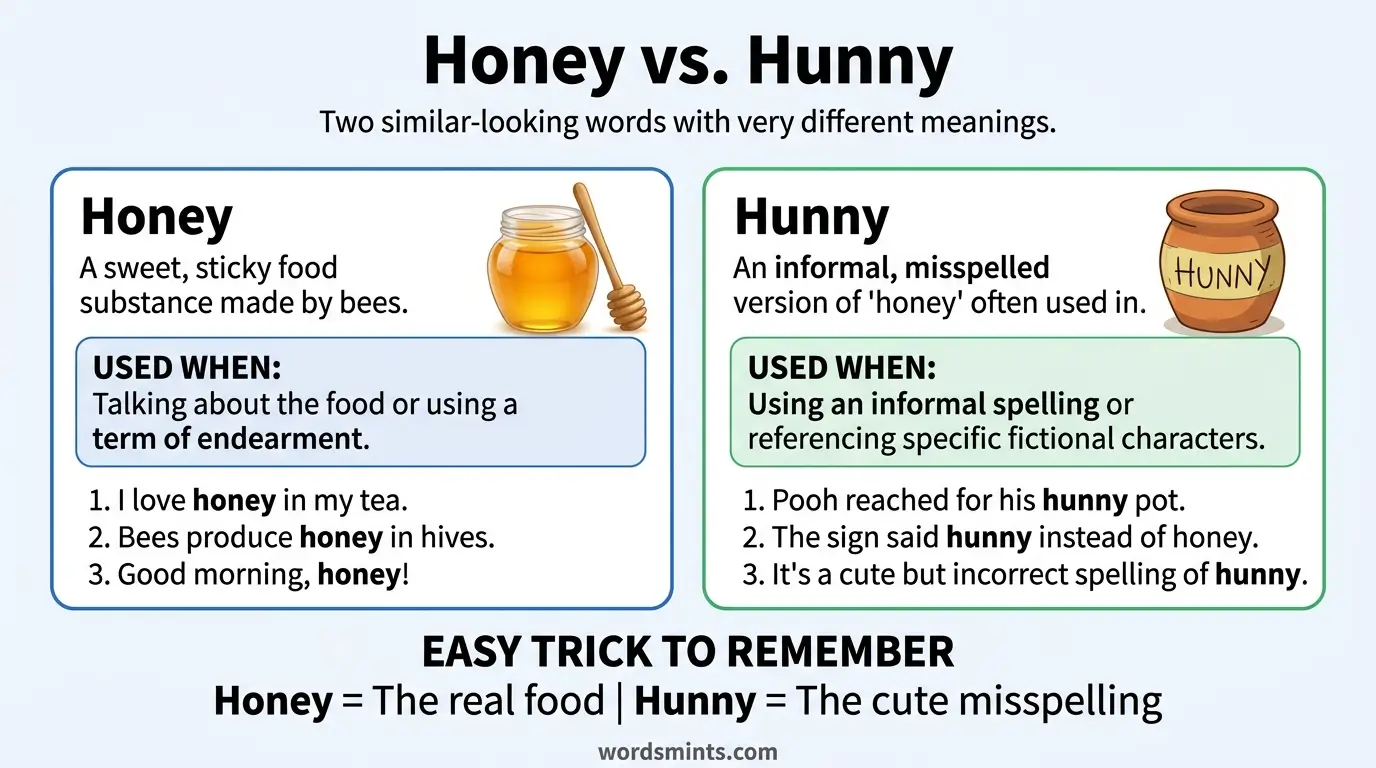
Honey is the standard English spelling. It can refer to the sweet food made by bees, a person you love, or someone you address in a warm and friendly way.
Hunny is not the standard spelling of the word. It is mainly used as an informal, playful, or stylized spelling.
Knowing the difference can help you write clearly. This guide explains the meaning, history, spelling, and everyday use of honey and hunny.
You will also see examples from casual messages, emails, news writing, and formal English. By the end, you will know which spelling to choose and when the informal form may appear.
Honey or Hunny Quick Answer
Honey is the correct standard spelling in English.
Hunny is usually a playful or informal spelling. It may appear in text messages, usernames, social media, songs, or creative writing, but it is not the standard spelling for formal English.
Examples
- Correct standard English: I added honey to my tea
- Correct standard English: Honey, can you help me?
- Informal/stylized: Hey hunny, how are you?
If you are writing an essay, email, article, report, application, or other formal text, use honey.
The Origin of Honey or Hunny
The word honey has a very old history. It comes from Old English hunig, which referred to the sweet substance produced by bees.
Similar words are found in other Germanic languages.
Over time, the spelling changed as English developed. The modern form honey became the standard spelling.
The spelling hunny does not represent a separate standard English word with a different dictionary meaning. Instead, it is generally a nonstandard or playful variation of honey.
People may use it to make a message sound cute, affectionate, humorous, or informal.
For example:
Thanks, honey!
is standard English, while:
Thanks, hunny!
has a more playful or personal feel.
The different spellings exist because English speakers often change words in casual communication. Social media, texting, music, and online culture have made these creative spellings more common.
British English vs American English Spelling
There is no major British-American spelling difference between honey and hunny.
Both British and American English use honey as the standard spelling. Hunny remains an informal or stylized variation in both varieties.
| Variety | Standard Spelling | Informal Variation | Example |
| American English | honey | hunny | Honey, are you ready? |
| British English | honey | hunny | Honey, are you ready? |
| Canadian English | honey | hunny | Thanks, honey. |
| Australian English | honey | hunny | Hi, honey! |
| Formal English | honey | Not recommended | The recipe uses honey. |
So, unlike words such as color/colour or center/centre, honey/hunny is not a standard American-versus-British spelling difference.
Which Spelling Should You Use?
Your choice depends on the situation.
For American English
Use honey in standard writing. It works in everyday speech, professional writing, schoolwork, and formal documents.
For British English and Commonwealth English
Use honey as well. British and Commonwealth English do not normally change the spelling to hunny.
For Global English
If you want your writing to be understood clearly by readers around the world, choose honey.
Use hunny only when you intentionally want an informal, playful, affectionate, or stylized tone.
Common Mistakes with Honey or Hunny
Mistake 1: Treating hunny as the standard spelling
Incorrect in standard writing: I put hunny in my tea.
Correct: I put honey in my tea.
Mistake 2: Using hunny in formal writing
Less suitable: Dear hunny, I am writing to…
Better: Dear [Name], I am writing to…
If you are using the word as a term of affection in a personal message, honey is still the standard spelling.
Mistake 3: Assuming hunny is the British spelling
Some writers think hunny is British English. It is not a standard British spelling.
Honey is used in both British and American English.
Mistake 4: Thinking the two words have different meanings
In most casual uses, hunny is simply a playful spelling of honey, rather than a separate standard word with a different meaning.
Honey or Hunny in Everyday Examples
The word can appear in many types of writing.
In Emails
For professional emails, use standard language:
Please find the honey production report attached.
In a personal email, you might write:
Thanks for your help, honey.
In News
News writing normally uses the standard spelling:
Local farmers reported a rise in honey production.
Hunny would be unusual unless a person’s name, quote, brand, or social media post specifically used that spelling.
On Social Media
Both forms can appear:
This honey is amazing!
or:
Good morning, hunny! ❤️
The second example has a deliberately casual and affectionate tone.
In Formal Writing
Use honey:
Honey contains natural sugars and is commonly used as a sweetener.
Avoid hunny in academic papers, business reports, official documents, and other formal writing unless it is part of a proper name or quotation.
Honey or Hunny Comparison Table
| Word | Standard English? | Common Use | Example |
| Honey | Yes | Formal and informal writing | I bought some honey. |
| Hunny | No, generally informal/stylized | Texting, social media, creative use | Hi, hunny! |
| Honey | Yes | Term of affection | Thanks, honey. |
| Hunny | Informal variation | Playful messages | Love you, hunny! |
The safest choice is honey.
Honey or Hunny Google Trends & Usage Data
Search interest for “honey or hunny” usually comes from people checking whether the two spellings are interchangeable.
The standard form honey is far more established in dictionaries, books, news writing, and everyday English.
Search behavior can vary by country and context. Honey is used globally because it has two common roles: it names a food and can also be used as a term of affection.
Hunny, by contrast, tends to appear in informal digital communication and creative contexts.
Google Trends can also reflect temporary interest caused by songs, celebrities, social media posts, memes, usernames, or other cultural events.
Therefore, search popularity does not by itself determine whether a spelling is standard English.
For professional writing, dictionary usage and established English spelling rules are more useful than search volume alone. When in doubt, honey is the standard choice.
FAQs About Honey or Hunny
1. Is honey or hunny correct?
Honey is the correct standard English spelling. Hunny is usually an informal or playful variation.
2. Is hunny a real word?
Hunny can appear as a stylized or informal spelling, but it is not the standard spelling of the common English word honey.
3. Is hunny British English?
No. Hunny is not the standard British spelling. British English uses honey.
4. Can I use hunny in a text message?
Yes. In casual texting, hunny can be used intentionally as a cute, playful, or affectionate spelling.
5. Should I use honey in formal writing?
Yes. Honey is the appropriate spelling for formal and professional writing.
6. Does honey mean a term of affection?
Yes. Honey can refer to a sweet substance made by bees, and it can also be used as a warm term of affection.
7. Are honey and hunny pronounced differently?
Usually, no. When hunny is used as a playful spelling of honey, the intended pronunciation is generally the same.
Conclusion
When choosing between honey or hunny, remember one simple rule: honey is the standard English spelling.
It is correct in American English, British English, and other major varieties of English. It can describe the sweet food produced by bees or serve as a warm term of affection.
Hunny is different. It is mainly a playful, informal, or stylized spelling. You may see it in text messages, social media, songs, usernames, and creative writing.
It can make a message feel more personal or cute, but it is not the spelling to choose for formal English.
If you are writing an essay, report, professional email, website article, or official document, use honey.
If you are writing a casual message and want a deliberately playful tone, hunny may appear naturally.
In short, honey is the safe and standard choice. Understanding this small spelling difference helps you communicate clearly while still recognizing why the informal version appears online.

welcome to Words Mints! I’m Halay Sultan, a web developer and AI-Powered SEO content writer.