
Have you ever written “dilemna” and wondered if it looks right? You are not alone.
Many people search for dilemna or dilemma when they need to choose the correct spelling for an email, essay, or professional document.
The two spellings look almost the same. They sound similar, too. But only one is correct in standard English.
This small spelling mistake can make your writing look less polished, especially when you use the word in formal work.
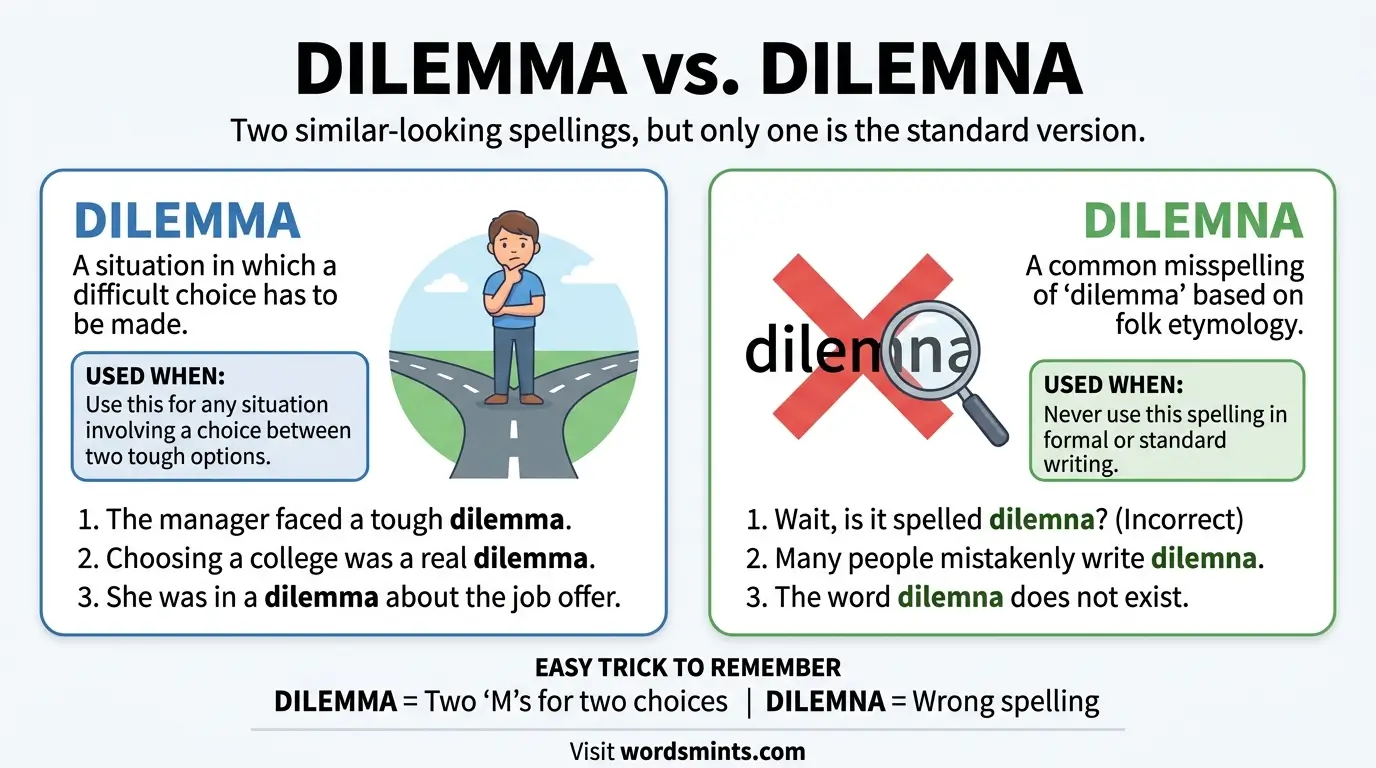
The correct spelling is dilemma. It means a difficult choice between two or more options. “Dilemna” is a common misspelling, not a different English word.
Why does this mistake happen? The word contains a silent “m” sound pattern that can confuse writers. People may also mix up the letters “mn” and “mm” when spelling it.
In this guide, you will learn the difference between dilemna and dilemma, the word’s origin, spelling rules, common mistakes, and everyday examples.
You will also discover which spelling to use in British and American English.
Dilemna or Dilemma Quick Answer
Dilemma is the correct spelling. Dilemna is incorrect.
The word dilemma is a noun. It describes a hard choice or a situation where you must choose between difficult options.
Correct spelling
Dilemma
Incorrect spelling
Dilemna
Examples
- Correct: I faced a dilemma when choosing between two jobs.
- Incorrect: I faced a dilemna when choosing between two jobs.
Here is a quick comparison:
| Spelling | Correct or Incorrect? | Meaning |
| Dilemma | Correct | A difficult choice |
| Dilemna | Incorrect | No standard English meaning |
Easy way to remember: Dilemma has two “m” letters together.
D I L E M M A
Not:
D I L E M N A
The Origin of Dilemna or Dilemma
The word dilemma comes from Ancient Greek. It was formed from two parts:
- Di- means “two.”
- Lemma means “assumption” or “premise.”
The original Greek word referred to an argument with two possible points or choices. Over time, the meaning changed. Today, a dilemma usually means a difficult situation where a person must choose between options.
The word entered English through Latin and French before becoming part of modern English vocabulary.
Why Do People Spell It “Dilemna”?
The spelling “dilemna” is a common error. It may happen because people hear a sound that seems to fit the letters “mn.”
Another reason is that English has many words with unusual letter patterns. Writers may remember the pronunciation but forget the exact spelling.
For example:
- Dilemma → Correct
- Dilemna → Incorrect
- Dilemmas → Correct plural
- Dilemna’s → Incorrect spelling
The silent or less noticeable sound in the middle of dilemma can make the word hard to spell. But the correct spelling always uses mm, not mn.
British English vs American English Spelling
The good news is that British English and American English use the same spelling for this word.
Both varieties write:
Dilemma
There is no standard British spelling “dilemna” and no standard American spelling “dilemna.”
Comparison Table
| Feature | British English | American English |
| Correct spelling | Dilemma | Dilemma |
| Incorrect spelling | Dilemna | Dilemna |
| Plural | Dilemmas | Dilemmas |
| Meaning | Difficult choice | Difficult choice |
| Pronunciation | dih-LEM-uh | dih-LEM-uh |
| Spelling difference | None | None |
Examples in British English
- She faced a dilemma at work.
- The team had to solve several dilemmas.
- This dilemma was hard to explain.
Examples in American English
- He was in a dilemma about college.
- The decision created a serious dilemma.
- We discussed the ethical dilemma.
Key point: Unlike words such as colour and color, the word dilemma does not change between British and American English.
Which Spelling Should You Use?
Use dilemma in all forms of standard English.
Your audience does not change the correct spelling. Whether you write for a British reader, an American reader, or an international audience, dilemma is the right choice.
For American English Writers
Use dilemma in:
- School assignments
- Business emails
- Reports
- Articles
- Social media posts
Example:
I am facing a dilemma about my career choice.
For British and Commonwealth English Writers
Use dilemma in:
- Academic writing
- Office communication
- News articles
- Personal writing
- Formal documents
Example:
The committee faced a dilemma over the new policy.
For Global English Writers
If your readers come from different countries, dilemma is the safest choice. It is widely understood and accepted in standard English.
Professional Advice
When writing professionally, always check the spelling before publishing. A simple spell-check can catch “dilemna” and suggest “dilemma.”
Common Mistakes with Dilemna or Dilemma
Many spelling mistakes happen because the wrong version looks familiar. Here are some common errors and their corrections.
1. Writing Dilemna Instead of Dilemma
Incorrect: I am in a dilemna.
Correct: I am in a dilemma.
Why? The correct spelling has “mm” in the middle.
2. Using Dilemma’s as the Plural
Incorrect: We discussed many dilemma’s.
Correct: We discussed many dilemmas.
Why? The plural of dilemma is dilemmas. An apostrophe is not needed.
3. Confusing Dilemma with Problem
A dilemma is not just any problem. It usually involves a difficult choice.
Example:
- Problem: My car has a flat tyre
- Dilemma: Should I repair my car or buy a new one?
A problem may have one clear solution. A dilemma often has two or more difficult options.
4. Using Dilemma for an Easy Choice
Incorrect: I had a dilemma about whether to drink water or not when I was thirsty.
Better: I had a simple choice about what to drink.
A dilemma is best used when the decision is hard, important, or confusing.
5. Misspelling the Word in Formal Writing
Incorrect: The company faced a serious dilemna.
Correct: The company faced a serious dilemma.
Always use the correct spelling in formal documents, essays, and business writing.
Dilemna or Dilemma in Everyday Examples
The word dilemma is common in daily speech and writing. It appears in emails, news stories, social media, and formal documents.
1. Dilemma in Emails
Subject: A Dilemma About the Project
Hi Sarah,
I am facing a dilemma about the project deadline. Should we submit the report today or ask for more time?
Please let me know what you think.
This example uses dilemma to describe a difficult work decision.
2. Dilemma in News Writing
The government faced a dilemma over how to reduce costs while protecting public services.
News writers often use dilemma when describing difficult choices faced by leaders, companies, or communities.
3. Dilemma in Social Media
Choosing between staying home and going out is my weekend dilemma.
This casual example shows how people use the word in everyday conversations.
4. Dilemma in Formal Writing
The ethical dilemma raised questions about fairness and responsibility.
Formal writing often uses dilemma in discussions about ethics, law, business, and society.
5. Dilemma in Academic Writing
The study examines the dilemma between economic growth and environmental protection.
In academic writing, dilemma can describe a conflict between two important goals.
6. Dilemma in Personal Conversations
I have a dilemma. Should I accept the new job or stay with my current employer?
This example shows the word’s most common meaning: a hard personal choice.
Dilemna or Dilemma Google Trends & Usage Data
People often search for “dilemna or dilemma” because they are unsure about the correct spelling. The search usually comes from students, professionals, bloggers, and English learners.
What Do Search Patterns Suggest?
Search interest in spelling questions often comes from:
- People checking a word before writing
- Students completing assignments
- Writers editing articles
- Professionals preparing emails
- English learners improving vocabulary
The search phrase dilemna or dilemma is useful because it includes both the incorrect and correct spellings. Search engines can help users find the answer quickly.
Country and Context
The correct spelling dilemma is used in standard English across countries, including:
- United States
- United Kingdom
- Canada
- Australia
- New Zealand
- India
- Pakistan
The word is common in both formal and informal writing.
Important Note About Google Trends
Google Trends can show search interest over time and compare regions. However, search interest is not the same as the number of people who use a word incorrectly.
There is no fixed worldwide percentage of people who misspell dilemma as dilemna. Exact popularity figures should be checked using Google Trends for a specific date range and country.
Search Intent Behind “Dilemna or Dilemma”
| Search Intent | What the User Wants |
| Spelling check | To know which spelling is correct |
| Meaning | To understand what dilemma means |
| Grammar | To use the word correctly |
| Professional writing | To avoid spelling mistakes |
| SEO content | To create useful spelling guidance |
For most searches, the answer is simple: Use dilemma, not dilemna.
Dilemna or Dilemma Spelling Variations Compared
The following table shows common versions of the word side by side.
| Word Variation | Status | Example |
| Dilemma | Correct | I faced a dilemma. |
| Dilemna | Incorrect | I faced a dilemna. |
| Dilemmas | Correct plural | We faced many dilemmas. |
| Dilemma’s | Correct possessive | The dilemma’s impact was clear. |
| Dilemnas | Incorrect plural | We faced many dilemnas. |
| Dilemna’s | Incorrect | The dilemna’s impact was clear. |
| Dilemmatic | Rare/technical | A dilemmatic argument. |
Correct Word Forms
Singular: Dilemma
Example: This is a difficult dilemma.
Plural: Dilemmas
Example: The team faced several dilemmas.
Possessive: Dilemma’s
Example: The dilemma’s solution was unclear.
Plural possessive: Dilemmas’
Example: The dilemmas’ effects were serious.
Remember that the spelling does not change between British and American English.
FAQs About Dilemna or Dilemma
Is it dilemna or dilemma?
Dilemma is the correct spelling. Dilemna is a common misspelling. Use dilemma in formal and informal writing.
Why do people spell dilemma as dilemna?
People may confuse the middle letters because of the word’s pronunciation. The “mm” pattern can be easy to forget, leading to the incorrect spelling “dilemna.”
What does dilemma mean?
A dilemma is a difficult choice between two or more options. For example, choosing between two good job offers can create a dilemma.
Is dilemma the same in British and American English?
Yes. Both British English and American English use dilemma. There is no standard spelling difference.
What is the plural of dilemma?
The plural is dilemmas.
Example: The students discussed several ethical dilemmas.
Is dilemna a real word?
“Dilemna” is not the standard English spelling of the word. It is generally treated as a misspelling of dilemma.
How can I remember the correct spelling of dilemma?
Remember this simple rule:
Dilemma has double M.
Think of the phrase: “A dilemma has two m’s.”
Conclusion:
When choosing between dilemna and dilemma, the answer is clear: dilemma is the correct spelling.
The word describes a difficult choice, and it is used in everyday conversations, professional emails, news reports, and academic writing.
The spelling stays the same in British English, American English, and other standard forms of English. There is no accepted spelling variation called “dilemna.”
The main reason people make this mistake is that the middle letters can be confusing. The best way to avoid it is to remember that dilemma contains two “m” letters together.
If you are writing an essay, email, article, or business report, always use dilemma. If you see dilemna, treat it as a spelling error and correct it.
A quick memory tip can help: Dilemma = difficult choice + double M.
Understanding this small spelling difference can make your writing clearer and more professional. Whenever you face a spelling dilemma, choose dilemma.

welcome to Words Mints! I’m Halay Sultan, a web developer and AI-Powered SEO content writer.