
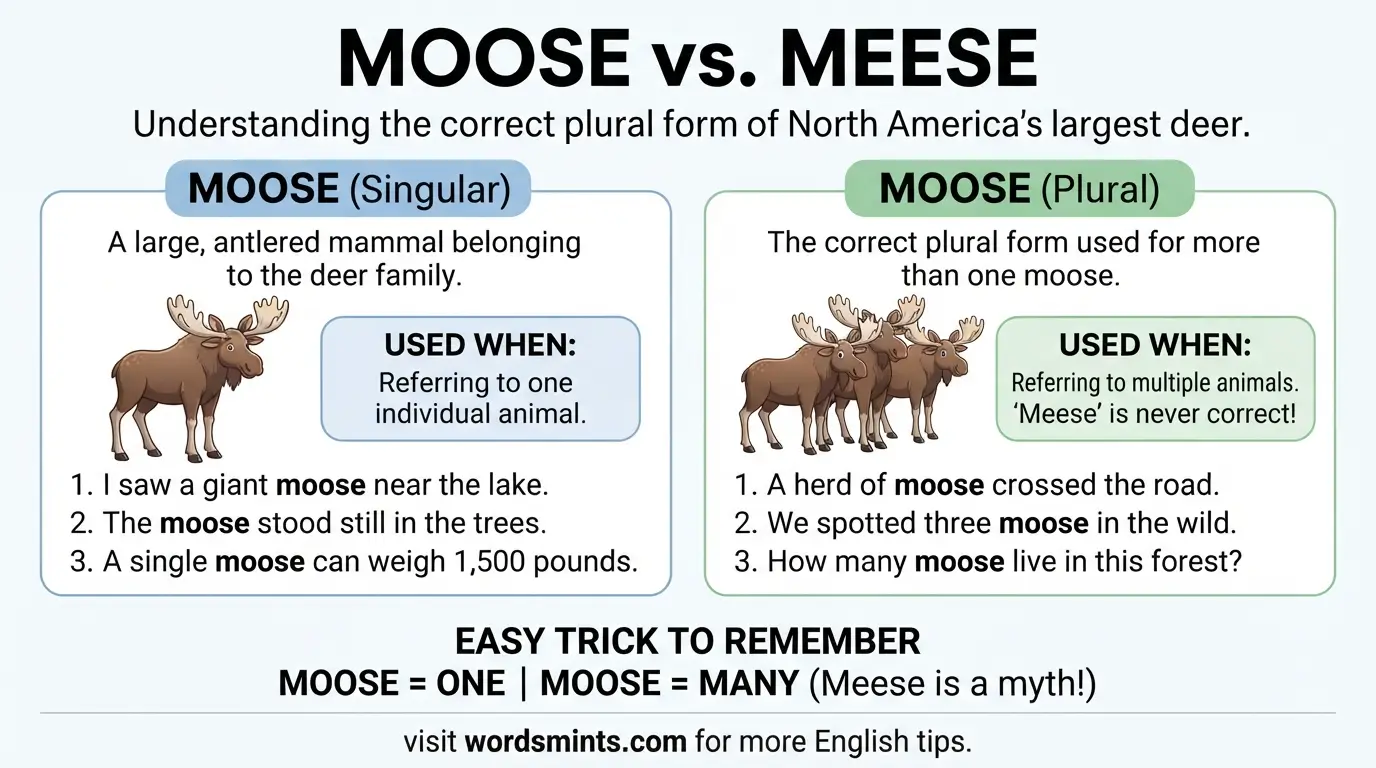
Have you ever wondered whether the plural of moose is meese, mooses, or simply moose? This question can be confusing because English has many irregular animal plurals.
Words such as goose become geese, so it may seem logical to change moose to meese. However, English does not always follow the same pattern.
The confusion becomes common when people write about more than one of these large animals.
Students, writers, ESL learners, and even native speakers may search for meese or moose because meese looks like a natural plural form. The good news is that the correct standard plural is simple: moose.
You can say, “I saw one moose,” or “I saw five moose.” The word stays the same in both singular and plural forms.
Meese is not the standard plural, and mooses is also generally avoided in normal English when referring to more than one animal.
This guide explains why moose does not change, where the word came from, common mistakes, and how to use it correctly in everyday and formal writing.
Meese or Moose Quick Answer
Moose is the correct word for both singular and plural.
- Singular: I saw one moose
- Plural: I saw three moose
- Plural: We watched several moose near the lake
Meese is not the standard plural of moose. Although it may look correct because goose becomes geese, moose follows a different pattern.
Mooses is also not the usual plural when talking about the animal. In standard English, moose works for both one animal and several animals.
| Form | Correct? | Example |
| moose | Yes | We saw two moose. |
| meese | No | We saw two meese. |
| mooses | Usually no | We saw two mooses. |
The easiest rule is: one moose, two moose, many moose.
The Origin of Meese or Moose
The word moose has a very different history from the word goose. It entered English in the early 1600s and came from an Algonquian language of North America.
Historical sources connect it with forms such as moos and moz.
This history helps explain why moose does not behave like goose. The two words only happen to look similar. They do not come from the same word family.
English has many nouns whose plural forms stay unchanged. Examples include:
- one deer → two deer
- one sheep → two sheep
- one fish → two fish
- one moose → two moose
The unchanged plural of moose developed as part of this pattern.
The word was not formed by taking an English word such as moose and applying the vowel-change pattern found in goose → geese.
So, meese is a logical guess, but it is not the standard English plural.
British English vs American English Spelling
There is no major British-versus-American spelling difference for moose. Both British English and American English use moose for the animal and its normal plural.
For example:
- American English: We saw four moose.
- British English: We saw four moose.
The same form is also used in Canadian English and other varieties of English.
| English variety | Singular | Plural | Example |
| American English | moose | moose | Five moose crossed the road. |
| British English | moose | moose | Five moose crossed the road. |
| Canadian English | moose | moose | Several moose live in the area. |
| Other standard English | moose | moose | We photographed two moose. |
The difference is therefore not about British versus American spelling. It is about understanding the word’s plural form.
Which Spelling Should You Use?
For American English
Use moose for both one and more than one.
We saw a moose in the forest.
We saw six moose in the forest.
For British English
Use moose in both singular and plural forms.
A moose was near the road.
Several moose were near the road.
For Canadian English
Moose is also the normal plural form. This is especially useful because moose are strongly associated with Canada and other northern parts of North America.
For global English
If you are writing for an international audience, moose is the safest standard form.
Avoid meese in professional, academic, educational, and formal writing. It may be understood, but it is not the standard plural.
Common Mistakes with Meese or Moose
1. Writing “meese”
Incorrect: We saw three meese.
Correct: We saw three moose.
The mistake often happens because people compare moose with goose.
2. Assuming every animal changes its vowel
English has some unusual plural patterns:
- goose → geese
- tooth → teeth
- foot → feet
But not every animal follows this pattern.
For example:
- moose → moose
- deer → deer
- sheep → sheep
3. Adding “-s” automatically
Incorrect or nonstandard in ordinary usage: We saw several mooses.
Standard: We saw several moose.
The unchanged plural is the normal choice when discussing the animals.
4. Using “meese” in formal writing
Because meese sounds playful or humorous, it may appear in jokes, informal discussions, or creative writing. However, it should not be used as the standard plural in school, business, or formal writing.
5. Confusing “moose” with “goose”
Remember:
goose → geese
but
moose → moose
The similar spelling does not mean the words share the same plural rule.
Meese or Moose in Everyday Examples
Knowing the correct form is useful in many types of writing.
In Emails
Correct:
We saw several moose during our trip to the national park.
Incorrect:
We saw several meese during our trip.
In News Writing
Correct:
Wildlife officials reported several moose near the highway.
News writing normally uses the standard plural moose.
On Social Media
Correct:
We spotted two moose today! What an amazing sight!
You can use moose naturally in casual posts and captions.
In Formal Writing
Correct:
Researchers observed several moose in the northern region.
This form is appropriate for reports, essays, articles, and academic writing.
In Everyday Conversation
Correct:
How many moose did you see?
Correct:
I saw three moose near the river.
The word does not change even when the number changes.
Meese or Moose Comparison Table
| Variation | Standard English? | Meaning | Example |
| moose | Yes | One animal | I saw one moose. |
| moose | Yes | More than one animal | I saw five moose. |
| meese | No | Intended as plural | I saw five meese. |
| mooses | Generally not used for the ordinary plural | Intended as plural | I saw five mooses. |
The key point is that moose can be both singular and plural.
Meese or Moose Google Trends & Usage Data
People search for “meese or moose” because the plural can seem unusual.
Google Trends is useful for examining search interest, but it does not automatically provide a fixed worldwide ranking of every spelling variant.
Google explains that Trends shows relative search interest and lets users compare searches by location and time.
Searches about meese or moose are likely to come from people checking grammar, spelling, vocabulary, animal facts, or plural forms.
Interest can also vary by country because moose are more familiar in places such as Canada and the United States.
The important distinction is between search interest and correct usage. A spelling can receive searches because people are unsure about it. That does not make the spelling standard.
For current search comparisons, Google Trends allows users to change the country, date range, and search terms. Its regional pages also show that search data can be examined across different locations.
FAQs About Meese or Moose
1. Is “meese” a word?
Meese is sometimes used humorously or informally as a supposed plural of moose, but it is not the standard plural form.
2. What is the plural of moose?
The standard plural is moose.
Example:
One moose → two moose.
3. Is “mooses” correct?
Mooses is not the normal plural of moose when referring to multiple animals. Standard English uses moose.
4. Why isn’t the plural of moose “meese”?
Moose does not follow the vowel-change pattern of goose → geese. The two words have different histories, so their plural forms are different.
5. Can I say “two moose”?
Yes. Two moose is completely correct.
6. Is “two meese” ever acceptable?
You may see meese used as a joke or playful word, but it should not be used as the standard plural in formal or professional writing.
7. Is moose singular or plural?
Moose can be both singular and plural.
- Singular: one moose
- Plural: two moose
The surrounding words show which meaning is intended.
Conclusion
When choosing between meese or moose, the correct standard form is simple: moose.
The word remains unchanged whether you are talking about one animal or several animals. You can write “one moose,” “two moose,” or “many moose.”
The confusion often comes from the word goose, whose plural is geese. However, moose has a different history.
It entered English from an Algonquian language of North America, and its standard plural developed without changing the word’s form.
This rule is the same in American and British English. It is also the standard form in Canadian English and is suitable for international writing.
For schoolwork, emails, news articles, social media, and professional documents, use moose rather than meese.
The easiest way to remember the rule is: one moose, two moose, three moose. Once you learn this pattern, the meese or moose question becomes much easier.

welcome to Words Mints! I’m Halay Sultan, a web developer and AI-Powered SEO content writer.