
Have you ever typed “theese” and wondered if it looks right? You are not alone.
The keyword “theese or these” often appears when writers, students, and English learners are unsure about the correct spelling of this common word.
The confusion is easy to understand because theese and these look almost identical, and the extra e can seem natural when typing quickly.
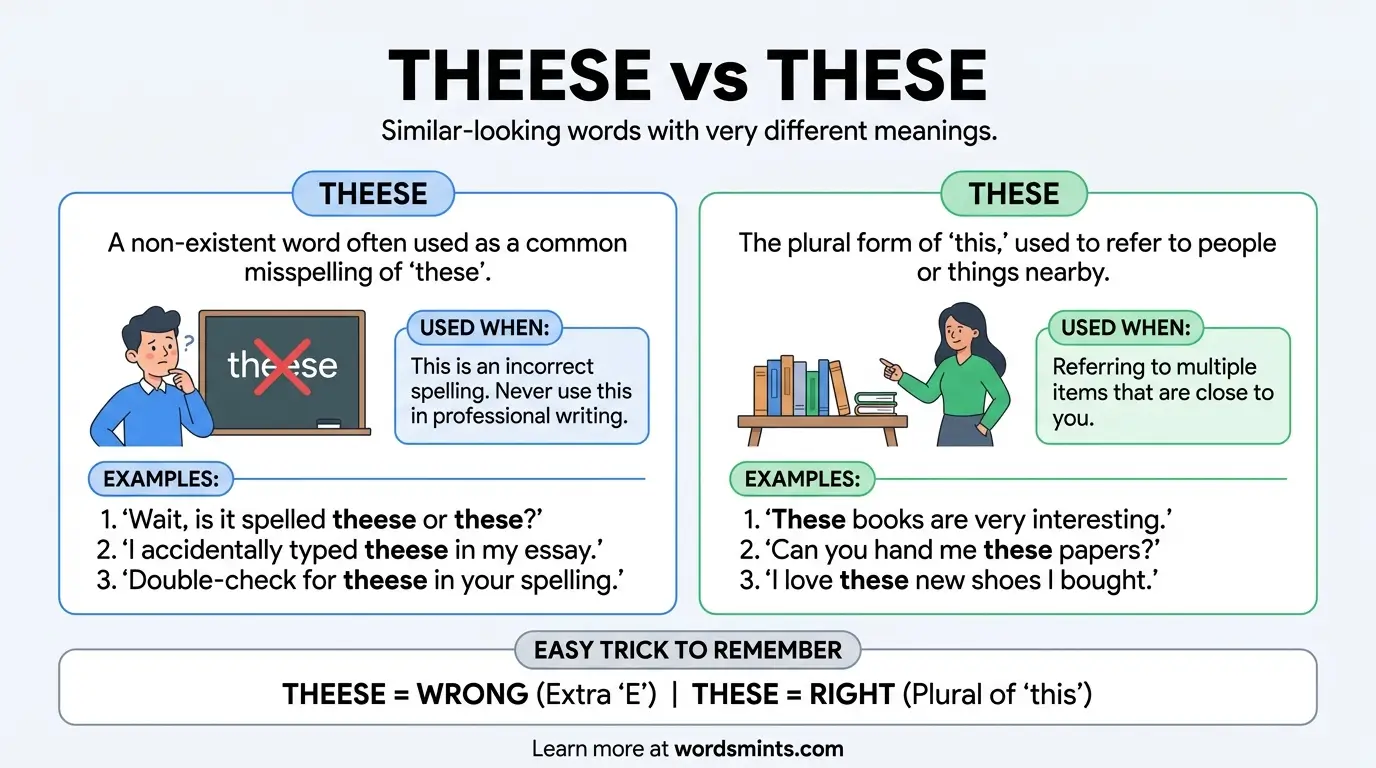
The correct spelling is these. It is a common English demonstrative pronoun and determiner used to point to two or more people, things, or ideas that are usually near the speaker or being discussed.
Theese is not a standard English word.
Knowing the difference helps you avoid simple spelling mistakes in emails, essays, social media posts, schoolwork, and professional writing.
In this guide, you will learn why these is correct, where the word comes from, how it is used in everyday English, and how to avoid the common typo theese.
Theese or These Quick Answer
These is the correct spelling.
Theese is an incorrect spelling and is usually a typing or spelling error.
Examples:
- Correct: These books are mine
- Incorrect: Theese books are mine
- Correct: I need these documents
- Incorrect: I need theese documents
These is the plural form of this.
| Spelling | Correct? | Meaning |
| These | ✅ Yes | Refers to two or more nearby people or things |
| Theese | ❌ No | Incorrect spelling |
Remember:
This → These
That → Those
The Origin of Theese or These
The word these has a long history in English. It comes from Old English þās, which was used as a plural form of a demonstrative word.
Over time, English spelling and pronunciation changed. Middle English forms developed, and eventually the modern spelling these became standard.
The extra e in theese does not represent a historical alternative spelling used in modern standard English. It is simply an incorrect form.
English has many words that can be confusing because their pronunciation does not always match their spelling.
In this case, the pronunciation of these can make some learners add an extra vowel when spelling it.
The modern word is simple:
These = correct
Theese = incorrect
British English vs American English Spelling
There is no British-American spelling difference between these and theese.
Both British English and American English use these.
| English variety | Correct spelling | Incorrect spelling |
| British English | these | theese |
| American English | these | theese |
| Canadian English | these | theese |
| Australian English | these | theese |
| General international English | these | theese |
Examples in both British and American English:
- These students are ready
- These shoes are new
- These ideas are useful
- These problems need attention
Unlike words such as colour/color or centre/center, these does not change based on the variety of English.
Which Spelling Should You Use?
Use these in all standard English writing.
For US English
Use these in schoolwork, business writing, emails, websites, and everyday communication.
Example:
These instructions are easy to follow.
For UK and Commonwealth English
Use these as well. The spelling does not change in British, Australian, or other major Commonwealth varieties.
Example:
These documents need to be signed.
For Global English
If you write for an international audience, these is also the correct choice.
There is no need to choose between different regional spellings. Simply use these.
Common Mistakes with Theese or These
The most common mistake is adding an extra e.
Mistake 1: Writing “theese”
❌ Theese examples are helpful.
✅ These examples are helpful.
Mistake 2: Confusing “these” with “this”
This refers to one person or thing.
- This book is interesting
These refers to two or more people or things.
- These books are interesting
Mistake 3: Confusing “these” with “those”
These usually points to things that are near.
- These shoes are beside me
Those usually points to things that are farther away.
- Those shoes are across the room
Mistake 4: Adding an extra vowel while typing
Some people write theese because the pronunciation can make the spelling feel longer. Slow down and remember the simple form:
T-H-E-S-E
Theese or These in Everyday Examples
In Emails
Correct:
Please review these files before the meeting.
Incorrect:
Please review theese files before the meeting.
In News Writing
Correct:
These changes could affect local businesses.
News articles use the standard spelling these.
In Social Media
Correct:
These photos are from my favorite trip!
Informal writing may contain many spelling mistakes, but theese is still not the standard spelling.
In Formal Writing
Correct:
These findings support the main argument.
Use these in essays, reports, applications, and professional documents.
In Everyday Conversation
You can also hear these frequently in speech:
- These are my keys
- These cookies taste great
- These are the people I mentioned
Theese or These Google Trends & Usage Data
Searches for “theese or these” usually come from people checking whether theese is a valid spelling.
The correct form, these, is an extremely common English word and appears across many countries and types of writing.
Search interest in the spelling question can come from:
- English learners
- Students checking homework
- Writers proofreading text
- People correcting online posts
- Typing and autocorrect mistakes
The word these is used in everyday English around the world. Theese, by contrast, is generally encountered as a misspelling rather than a standard word.
Search volume can vary by country, language-learning activity, and online writing habits.
Trends data also changes over time, so individual search-interest figures should be treated as snapshots rather than permanent measures of language use.
Theese vs These: Comparison Table
| Feature | These | Theese |
| Standard English word | Yes | No |
| Correct spelling | ✅ | ❌ |
| Refers to multiple things | Yes | — |
| Used in formal writing | Yes | No |
| Used in British English | Yes | No |
| Used in American English | Yes | No |
| Common typing error | No | Yes |
FAQs About Theese or These
1. Is “theese” a correct word?
No. Theese is not the standard spelling of an English word. The correct spelling is these.
2. Is it “theese” or “these”?
It is these. The spelling theese is incorrect.
3. What does “these” mean?
These refers to two or more people, things, or ideas, often ones that are near the speaker or being discussed.
Example: These books are mine.
4. What is the plural of “this”?
The plural form of this is these.
- This → singular
- These → plural
5. Is “theese” a British spelling?
No. British English uses these, just like American English.
6. Why do people spell “these” as “theese”?
The mistake often happens because the pronunciation can make learners think there is an extra e in the spelling. Fast typing can also cause the error.
7. How can I remember the spelling of “these”?
Remember this simple pair:
This → These
You can also spell it letter by letter:
T-H-E-S-E
Conclusion
When choosing between theese or these, the answer is clear: these is the correct spelling, while theese is a common misspelling.
The word these is used to refer to two or more people, things, or ideas, often ones that are close to the speaker or currently being discussed.
There is no British-American spelling difference here. British English, American English, and other major varieties of English all use these.
This makes the choice easy for students, professionals, content writers, and English learners.
A useful way to remember the word is to connect it with its singular form: this → these. If you see theese in your writing, remove the extra e.
Whether you are writing an email, essay, report, social media post, or formal document, use these.
Once you remember this simple spelling pattern, you can avoid this common mistake with confidence.

welcome to Words Mints! I’m Halay Sultan, a web developer and AI-Powered SEO content writer.